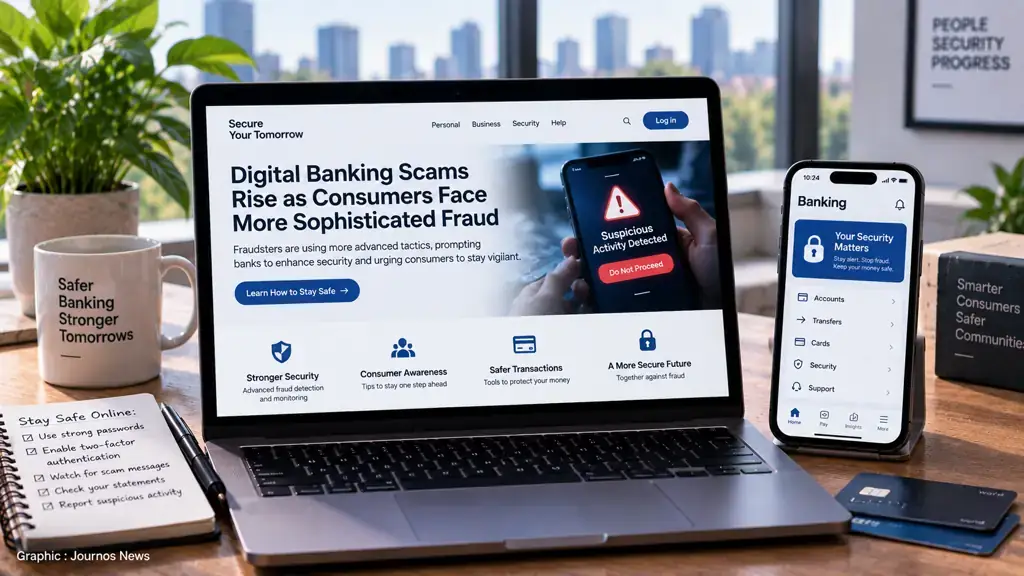
Digital banking has made it easier to move money, pay bills and manage accounts, but the same convenience has created new opportunities for fraudsters targeting consumers through increasingly convincing scams.
Banks and financial regulators continue to warn customers about phishing messages, impersonation schemes, fraudulent investment offers and other methods designed to persuade people to surrender account credentials or authorize transactions themselves.
The risk is not limited to sophisticated hacking. Many financial scams depend on social engineering, in which criminals manipulate victims into believing that a request is legitimate.

That makes basic verification practices an important part of protecting digital bank accounts.
Be suspicious of unexpected requests
One of the most common warning signs is an unsolicited request involving money or account information.
A message may claim that a bank account has been compromised, a payment needs to be verified or an unusual transaction requires immediate action.
The urgency is often deliberate.
Fraudsters want potential victims to react before they have time to examine the request carefully.
■ Related News




The Federal Trade Commission advises consumers not to click unexpected links or provide personal or financial information in response to unsolicited messages.
Instead, customers should contact their bank through a telephone number, website or mobile application they already know to be genuine.
Never give away authentication information
Banking credentials can provide direct access to money, while additional authentication information can help criminals bypass security protections.
Consumers should not share passwords, one-time verification codes, PINs or other authentication information with someone who contacts them unexpectedly.
A person claiming to represent a bank may already know some personal information about the customer. That does not establish that the caller or message is genuine.
The safest approach is to end the communication and independently contact the institution.
Check the destination before transferring money
Digital payments can be completed within seconds, which makes it particularly important to verify where money is going before approving a transaction.
Consumers should check account numbers, recipient names and payment details carefully.
A familiar-looking name is not necessarily sufficient evidence that the recipient is legitimate.
The same principle applies to investment opportunities, online purchases and requests for emergency payments.
If someone creates pressure by insisting that a transfer must happen immediately, that pressure itself should be treated as a warning sign.
Keep devices and banking applications updated
Account security also depends on the devices used to access financial services.
Software updates frequently include security fixes, while outdated operating systems and applications can leave known vulnerabilities unaddressed.
Consumers should use official application stores when installing banking applications and avoid downloading financial software from links supplied through unsolicited messages.
Device security measures such as screen locks and biometric authentication can provide additional protection if a phone or computer is lost.
Turn on transaction alerts
Banking alerts can provide an early indication that an account has been accessed or a transaction has been initiated.
Depending on the bank, customers may be able to receive notifications for card purchases, transfers, withdrawals or other account activity.
These alerts do not prevent every fraudulent transaction, but they can shorten the time between an unauthorized payment and its discovery.
That matters because reporting a suspicious transaction quickly can give the financial institution a better opportunity to investigate and determine what action may be available.
Verify before approving a payment
Some modern scams do not require criminals to bypass a bank’s security system.
Instead, they persuade the customer to approve the transaction.
This can make fraudulent payments appear to the bank as authorized activity even though the customer was manipulated into making the payment.
Consumers should therefore treat unexpected authentication prompts as something to investigate rather than automatically approve.
If an authentication request appears when no transaction has been initiated, the customer should contact the financial institution using an official channel.
Be careful with investment offers
Digital platforms have also made it easier for fraudsters to promote fake investments.
Promises of unusually high or guaranteed returns, pressure to invest immediately and requests to send money to unfamiliar accounts are common warning signs.
The U.S. Securities and Exchange Commission and other regulators have repeatedly warned investors about fraudulent investment schemes promoted through online platforms and social media.
Consumers should independently research an investment and verify the identity and regulatory status of the person or company offering it before transferring funds.
What to do if money has already been sent
Acting quickly is important if a person realizes that they have been deceived.
The customer should contact the bank or payment provider immediately, explain that the transaction may be fraudulent and ask what recovery or cancellation options are available.
Passwords should also be changed if account credentials were exposed.
If the scam involved identity information, the victim may need to take additional steps to protect affected accounts and report the incident to the relevant authorities.
Keeping records of messages, payment information, telephone numbers and other evidence can also help investigators and financial institutions understand what happened.
Security starts with slowing down
Digital banking itself is not the problem.
The technology allows consumers to manage money efficiently and gives financial institutions sophisticated tools for detecting suspicious activity.
But fraudsters increasingly exploit the human side of financial security.
A convincing message, a fake customer-service representative or an urgent payment request can cause a person to bypass otherwise effective security controls.
The most useful protection is often simple: stop, verify and then act.
Consumers who receive an unexpected request involving money or account information should avoid responding through the communication channel provided by the sender.
Instead, they should independently contact the bank or financial institution and confirm whether the request is legitimate.
In an increasingly digital financial system, that extra pause can be one of the most valuable security measures a customer has.
Reporting Credit: U.S. Federal Trade Commission — consumer fraud and phishing guidance; U.S. Securities and Exchange Commission — investor-fraud warnings and investor protection guidance; Consumer Financial Protection Bureau — consumer financial fraud and banking guidance.