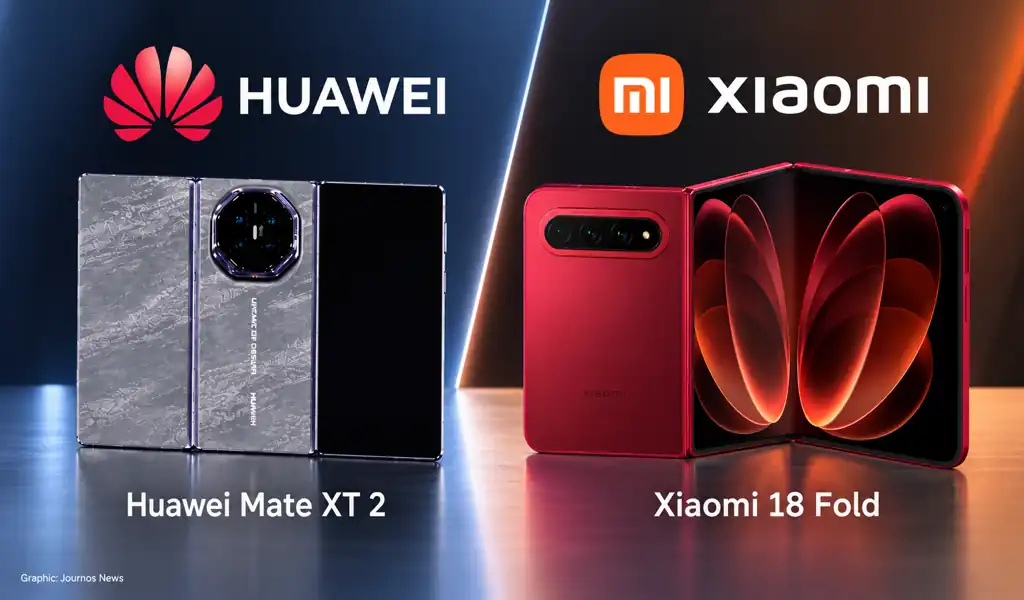
Huawei and Xiaomi have launched new foldable smartphones in China, bringing two different approaches to premium mobile hardware into direct competition as domestic manufacturers increasingly develop proprietary technologies across chips, displays and device design.
Huawei unveiled the Mate XT2, its latest tri-fold smartphone, while Xiaomi introduced the Xiaomi 18 Fold on September 7. Huawei is continuing with a two-hinge design intended to expand a smartphone into a substantially larger display, whereas Xiaomi has chosen a conventional book-style foldable architecture.
The launches add another layer to competition in China’s premium smartphone market, where manufacturers are using increasingly differentiated hardware and internally developed technologies to compete for high-end consumers.

Huawei Extends Its Tri-Fold Architecture
Huawei’s Mate XT2 builds on the company’s existing tri-fold approach, using two folding mechanisms to expand the device into a larger-screen format.
The previous Mate XT featured a fully opened display measuring 10.2 inches diagonally. Huawei’s new generation retains the basic architecture while introducing updated hardware and structural changes.
The Mate XT2 is powered by Huawei’s Kirin 9050 Pro processor and uses a LogicFolding architecture that the company says is designed to improve performance and efficiency. Huawei has also emphasized durability and privacy features as part of its effort to develop the more complex folding format for everyday use.
Launch information places the Mate XT2 at 19,999 yuan for the entry configuration, rising to 24,999 yuan for the highest configuration. Sales are scheduled to begin September 12.
The pricing puts the device firmly into the luxury segment and distinguishes Huawei’s tri-fold strategy from more conventionally priced premium smartphones.
■ Related News




Xiaomi Chooses the Book-Style Foldable
Xiaomi is taking a different route with the Xiaomi 18 Fold, which opens from a phone-sized exterior into a larger internal display.
The company has positioned the model as a premium flagship and highlighted its internally developed XRING O3 processor. Xiaomi’s official launch material describes the 18 Fold as its first flagship smartphone powered by the next-generation chip.
The device also features a Leica-branded camera system, extending Xiaomi’s use of imaging technology as a component of its premium smartphone strategy.
Pricing starts at 10,999 yuan and reaches 14,999 yuan for the highest configuration. That makes the Xiaomi considerably less expensive than Huawei’s Mate XT2, although both remain positioned above conventional flagship smartphones.
The difference in architecture and pricing gives the companies distinct propositions within the same premium foldable market.
Proprietary Technology Becomes Part of the Competition
The launches highlight a broader shift in how China’s leading smartphone manufacturers are approaching flagship hardware.
Huawei has developed alternatives to technologies and components affected by U.S. restrictions, while Xiaomi has invested in proprietary semiconductor technology of its own. As a result, processors and other internally developed technologies increasingly form part of broader product strategies rather than serving simply as individual hardware components.
That approach can give manufacturers greater control over product development while reducing dependence on external suppliers. It also makes the smartphone itself a showcase for capabilities spanning semiconductors, software, displays, imaging and artificial intelligence.
The two foldables therefore represent more than competing form factors. They also illustrate how Chinese smartphone companies are integrating internally developed technologies into high-end consumer devices.
Foldable Design Becomes a Premium Differentiator
Foldable smartphones remain a smaller segment of the overall mobile-phone market, but the category has become an important area for differentiation among manufacturers competing at the premium end.
The underlying proposition is to provide a substantially larger display without requiring users to carry a conventional tablet-sized device. For manufacturers, folding hardware also creates opportunities to distinguish flagship products as conventional smartphone designs become increasingly mature.
Huawei’s continued investment in a tri-fold configuration indicates an effort to move beyond the two-panel designs more commonly associated with foldable phones.
Xiaomi’s 18 Fold takes a less complicated structural approach while competing through other premium technologies, including its processor platform and Leica-branded imaging system.
A Wide Price Gap Reflects Different Strategies
The two launches also demonstrate how differently manufacturers are positioning foldable technology.
Huawei’s Mate XT2 starts at nearly 20,000 yuan, while Xiaomi’s 18 Fold begins at 10,999 yuan. The gap gives Xiaomi a lower-priced entry point into the premium foldable segment, while Huawei is positioning its tri-fold architecture as a significantly more expensive technology proposition.
A central question for Huawei’s approach is whether consumers will consider the additional folding section and resulting display flexibility worth the substantial price premium.
The answer will depend on practical factors including durability, software support, battery life and everyday usability, as well as the perceived value of the larger display.
Competition Extends Beyond China’s Domestic Market
The launches come during a busy period for the global smartphone industry. Apple is expected to unveil new products on September 9, immediately following the Huawei and Xiaomi announcements.
For Chinese manufacturers, competition therefore extends beyond the domestic market and includes global companies with established brands and large technology ecosystems.
The increasingly differentiated hardware strategies of Huawei and Xiaomi are part of that wider competition. Their latest foldables show how premium smartphone manufacturers can pursue different combinations of industrial design, semiconductor development, imaging and display technology.
Domestic Semiconductor Development Gains Importance
The Xiaomi 18 Fold’s use of the XRING O3 also highlights the growing role of domestic semiconductor development in China’s consumer electronics sector.
Xiaomi’s investment in its own processor technology gives the company another internally controlled component for its flagship devices. Huawei, meanwhile, continues developing proprietary hardware technologies while operating under restrictions that affect its access to some advanced foreign components.
The implications extend beyond smartphones. Greater reliance on domestically developed processors and other technologies connects consumer electronics competition with China’s broader development of semiconductor, artificial-intelligence and advanced manufacturing capabilities.
For the smartphone industry, the result is a competitive environment in which the architecture of the device and the technologies inside it are increasingly linked to wider corporate technology strategies.
Two Paths for the Next Foldable Generation
Huawei and Xiaomi are entering the latest phase of the Chinese foldable market with markedly different designs.
Huawei is using a tri-fold architecture to pursue a larger display within a smartphone-oriented form factor. Xiaomi is retaining the more established book-style configuration while emphasizing its own processor technology and premium imaging system.
Their launches leave consumers with two different approaches to high-end foldable hardware—and manufacturers with a continuing test of how much complexity, cost and proprietary technology the market is willing to support.
For China’s smartphone industry, the significance extends beyond the two devices. The launches show that competition at the premium end is increasingly being fought through proprietary semiconductor technology, industrial design and integrated hardware ecosystems as well as conventional smartphone specifications.
Reporting Credit: Huawei — official Mate XT2 product and launch information; Xiaomi — official September 7, 2026 announcement for the Xiaomi 18 Fold and XRING O3 platform; Xiaomi Community — official Xiaomi 18 Fold product information, including the Leica camera configuration; Huawei and Xiaomi — official corporate and product materials concerning their respective proprietary technologies.