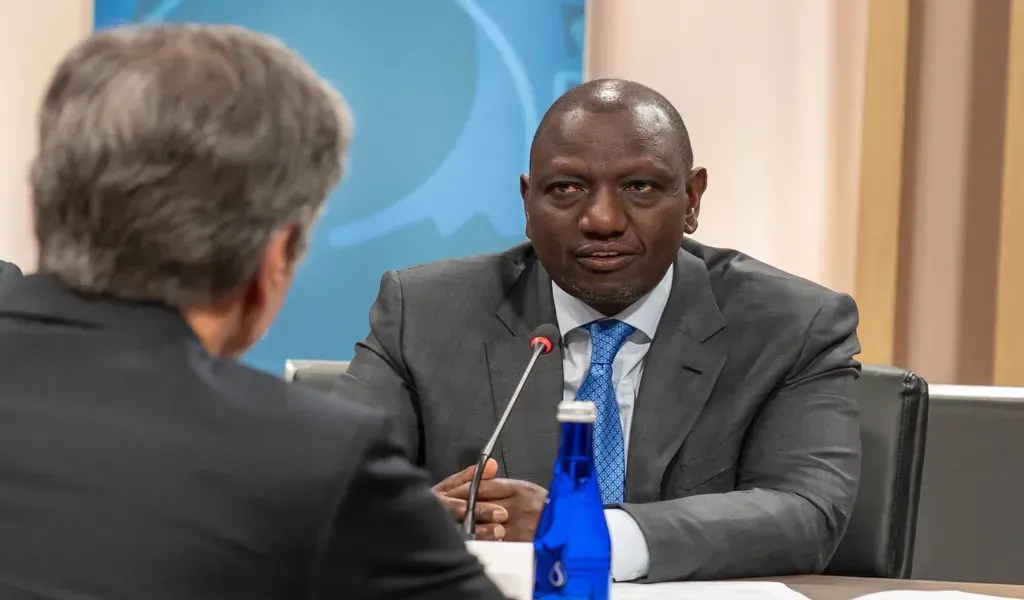
KENYA, East Africa – Kenya is moving to restrict foreign participation in selected small-scale trading activities, with President William Ruto directing government agencies to begin enforcement against foreign nationals engaged in hawking and other targeted businesses from Sept. 7, 2026.
Ruto announced the directive on Sept. 2 after meeting representatives of micro, small and medium enterprises at State House in Nairobi. He linked the measures to protecting Kenyan traders from competition and called for legislation that would further restrict foreign participation in activities designated for citizens.
The government has not, however, announced a blanket prohibition on foreign-owned businesses. Foreign Affairs Principal Secretary Abraham Korir Sing’Oei said Ruto’s remarks had been taken out of context and emphasized that existing Kenyan law continues to protect foreign traders and workers who hold the required permits and licenses.

Government targets selected small-scale activities
Ruto specifically identified foreign nationals involved in hawking and small retail businesses as a focus of the enforcement effort.
The president said Kenya had worked to improve investor confidence, stabilize the economy and reduce inflation, but argued that the resulting investment environment should attract businesses capable of expanding production and employment rather than foreign operators competing directly with small Kenyan traders.
He directed the Ministry of Investments, Trade and Industry to begin enforcement and called on officials and lawmakers to advance legislation addressing foreign participation in restricted trading activities.
The immediate measures therefore focus on particular forms of small-scale commerce rather than foreign investment as a whole.
Proposed restrictions still require parliamentary action
The longer-term legal framework remains under consideration.
■ Related News


Ruto acknowledged that legislation seeking to restrict foreigners from specified trading activities had not yet been passed by Parliament. He called on traders and other stakeholders to scrutinize the proposed law and identify potential loopholes before it becomes legislation.
That creates an important distinction between the enforcement measures announced by the government and restrictions that would ultimately be established through statute.
For foreign businesses, the scope of any permanent limitations will depend on the legislation adopted by Parliament, as well as the licensing and permit requirements already in force.
Officials clarify protections for legal foreign traders
Sing’Oei subsequently sought to narrow interpretations of Ruto’s remarks, saying they arose from the debate surrounding the Local Content Bill and should not be understood as a general order barring foreign nationals from doing business in Kenya.
He said Kenyan law protects traders and employees of different nationalities when they possess the necessary documentation, including valid work permits and licenses.
The clarification is significant because it indicates that the government’s enforcement policy is intended to target activities that fall within existing or proposed restrictions, rather than automatically remove legally operating foreign businesses from the Kenyan market.
Local ownership remains at the center of the debate
The policy reflects a broader government effort to increase the share of domestic economic opportunities available to Kenyan entrepreneurs.
Ruto has argued that local businesses should have greater access to small-scale commercial activities, while foreign investors should contribute through larger investments, production and employment.
If Parliament approves the proposed legislation, those priorities would receive a more defined statutory framework.
The debate therefore extends beyond the treatment of foreign traders to questions about how Kenya wants foreign capital and domestic enterprise to interact within its economy.
Foreign investors face questions over market boundaries
Kenya’s Investment Promotion Act provides a framework for foreign investors seeking to establish businesses in the country, including procedures for obtaining an investment certificate.
The current policy debate is narrower than a general restriction on foreign investment because it focuses on particular small-scale commercial activities.
Still, uncertainty over where protected local commerce ends and permitted foreign investment begins could matter for businesses operating at the smaller end of the market.
The distinction between legal foreign investment and restricted trading activity will depend increasingly on how the proposed framework is defined and implemented.
Cross-border commerce could also be affected
The issue has implications beyond Kenya because foreign traders in the country include nationals from neighboring states and other parts of the region.
Restrictions affecting small-scale commercial activity could therefore influence cross-border trading patterns in East Africa, particularly for businesses and individuals whose activities depend on access to Kenya’s domestic market.
The government’s challenge will be to pursue greater local participation while maintaining the legal and regulatory framework governing regional trade and foreign investment.
Enforcement will determine the policy’s immediate impact
The first test will be how authorities apply the Sept. 7 enforcement directive.
Officials will need to distinguish between foreign nationals conducting activities that are subject to restrictions and those operating legally with the permits and licenses required under existing law.
That distinction becomes particularly important while Parliament continues to consider the proposed legislation.
Sing’Oei’s clarification that properly documented foreign traders and workers remain protected reinforces the role of existing legal requirements in determining which businesses can continue operating.
Government links restrictions to broader economic strategy
Ruto has presented the policy as part of a wider effort to increase the domestic economic value generated by investment.
He has encouraged Kenyan entrepreneurs to move beyond trading imported goods and expand into manufacturing and production, with the government seeking stronger local businesses, greater employment and increased domestic economic activity.
The restrictions on selected foreign traders consequently form part of a broader discussion over Kenya’s economic model and the role foreign investors should play in it.
Policy direction remains subject to legislation
Kenya has signaled a stronger preference for local participation in certain areas of small-scale commerce, but the precise limits remain dependent on enforcement decisions, existing law and the outcome of the parliamentary process.
The immediate development is the government’s decision to begin enforcement against foreign nationals involved in targeted trading activities from Sept. 7 while lawmakers consider a broader legal framework.
For foreign traders, that creates uncertainty over the future scope of permitted activity. It does not, based on the government’s own clarification, amount to a blanket ban on foreign business ownership or legally documented foreign workers and traders in Kenya.
Reporting Credit: Office of the President of Kenya; Ministry of Investments, Trade and Industry; Kenya State Department for Foreign Affairs; Kenya Law.