A July 2026 scoping review published in Frontiers in Public Health examined research into “time affluence,” a concept describing whether people perceive themselves as having enough time to engage in meaningful activities and relationships. Across the literature reviewed, greater perceived time sufficiency was generally associated with more favorable aspects of psychological well-being.
The finding does not establish that an empty calendar improves health. Instead, it draws attention to a more basic part of everyday life: how people experience the time they have.
When free time still feels rushed
Time affluence is not simply a measure of how many hours someone has available. It concerns whether those hours feel sufficient for the things a person considers meaningful.

Two people can therefore have similar schedules while experiencing their free time differently. One may feel constantly pressed by the next obligation, while another may feel able to decide what to do without the same sense of urgency.
That distinction is central to the research reviewed in Frontiers in Public Health. The literature treats time not only as something that can be counted, but also as a psychological resource connected with people’s ability to engage in activities and relationships that matter to them.
For weekends, the difference can be particularly noticeable.
When the weekend becomes another schedule
Saturday and Sunday often absorb the responsibilities that do not fit easily into the working week. Household chores, shopping, exercise, family commitments, social plans and personal projects can leave little space between one obligation and the next.
A person may technically be away from work while still feeling that there is no time that truly belongs to them.
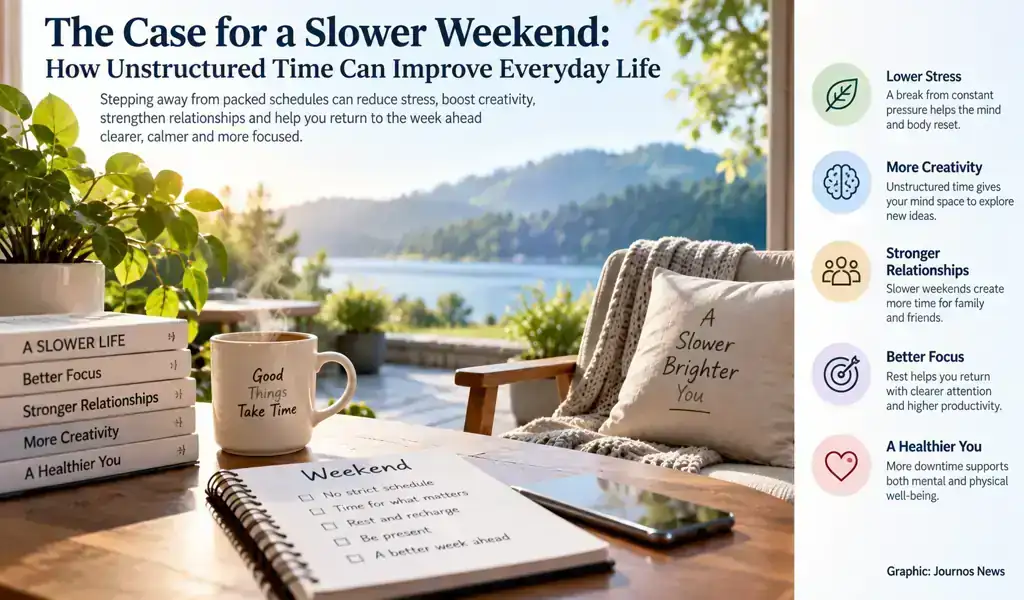
A slower weekend offers a different arrangement. Rather than eliminating plans altogether, it leaves some part of the day open enough for choices to develop without having to be scheduled in advance.
That might mean reading, walking, cooking, spending time with friends or family, or simply deciding what to do next. The activity itself is not necessarily the important distinction; the absence of constant pressure can be.
The evidence calls for caution
The review does not conclude that unstructured weekends are inherently beneficial.
Its purpose was to map how researchers have defined and measured time affluence and how the concept has been associated with health and well-being. The authors found substantial variation in definitions and research methods, which makes broad conclusions difficult.
The literature also places greater emphasis on psychological outcomes than on physical or population-level measures.
For that reason, the evidence supports a narrower interpretation: feeling that there is enough time appears to be associated with aspects of well-being, but the mechanisms involved and the effects of deliberately slowing down require further research.
Time for meaningful activities
The concept becomes more useful when considered as a question of choice rather than idleness.
A long walk can be exercise, but it can also simply be a walk. Cooking can develop a skill, but it can also be an enjoyable way to spend an afternoon. Meeting a friend can be part of a social plan without needing to become another item to complete.
The research reviewed links time affluence with the ability to participate in meaningful and relational activities. This helps explain why having more hours is not necessarily the same as experiencing greater freedom.
When leisure is organized around productivity, even enjoyable activities can begin to carry the pressure of another assignment.
Having some unallocated time creates the possibility of choosing according to circumstances rather than following a predetermined sequence.
Open time can be difficult to protect
An empty calendar also does not guarantee an uninterrupted experience of leisure.
Digital habits can quickly occupy periods that were otherwise left open. Notifications, messages, short-form videos and other online activities can fragment attention even when there are no formal appointments.
In that sense, creating time affluence may involve more than reducing commitments. It can also involve preserving periods in which attention is not continually redirected.
A slower weekend therefore does not have to mean doing nothing. It can mean having enough flexibility to stay with an activity, conversation or moment without immediately moving on to the next demand.
Slowness can include other people
A less structured weekend is not necessarily solitary.
Relationships are among the meaningful activities highlighted in the research on time affluence. Having more perceived temporal space can allow social interactions to unfold without being fitted tightly between other commitments.
An afternoon with family or friends can therefore be part of a slower rhythm rather than another obligation to complete.
The broader point is that time freedom concerns how people experience and use their available time, not simply how little they have planned.
Leisure does not need to justify itself
There is also a cultural dimension to the idea.
Leisure is often given a productive explanation: walking becomes exercise, reading becomes self-improvement, and rest becomes preparation for the next working day. These activities can have genuine value, but the framing can make it difficult to regard time without an obvious output as worthwhile.
The research on time affluence does not require people to abandon productive activities. It instead draws attention to the value of feeling that there is enough time to make meaningful choices.
That makes a slower weekend less a prescription for inactivity than an opportunity to experience time with less pressure.
Leaving room to breathe
The July review does not prove that people should eliminate plans or spend weekends entirely unstructured. Its findings point to something more measured: the perception of having sufficient time is an important area of study in understanding psychological well-being.
For everyday life, that distinction can be practical. A weekend can contain plans and still include periods that are deliberately left open.
The value may lie not in accomplishing less, but in having some control over what happens next.
Reporting Credit: Frontiers in Public Health; authors of the July 2026 scoping review on time affluence, health and well-being.