KUWAIT, Middle East – Kuwait is increasingly relying on its substantial financial reserves and borrowing capacity to manage widening fiscal pressures as weaker oil revenues and higher government spending push the country deeper into deficit.
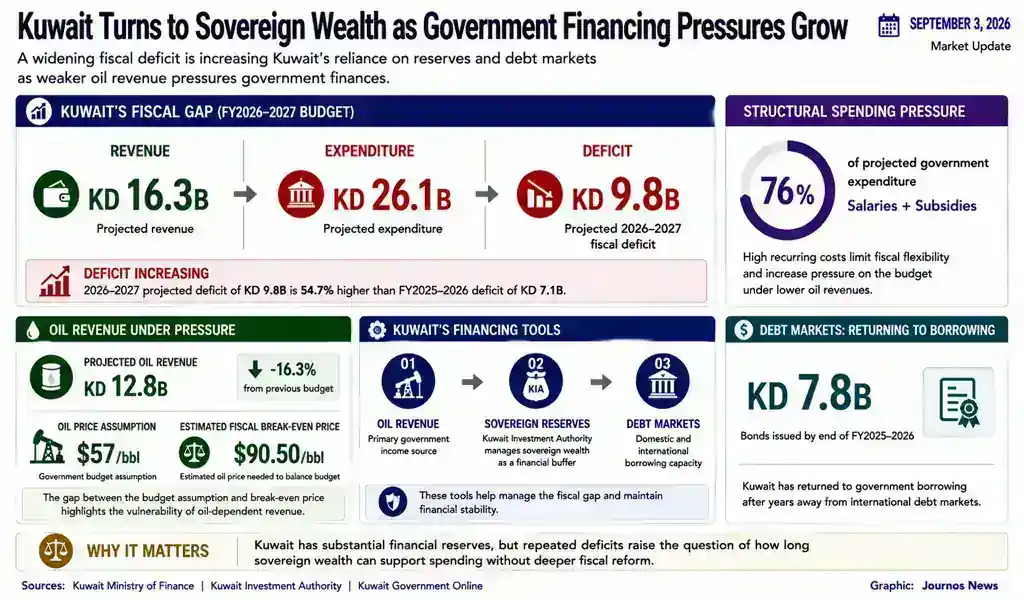
The government’s 2026–2027 budget projects KD 9.8 billion ($31.9 billion) in deficit, with expenditures of KD 26.1 billion against revenues of KD 16.3 billion. The projected shortfall is 54.7% larger than the previous budget’s deficit.
The pressure has become more immediate following a KD 7.1 billion deficit in the 2025–2026 fiscal year, as lower oil revenues weighed on government finances.

Oil dependence exposes fiscal weakness
Kuwait remains heavily dependent on oil revenue to finance the state.
For the 2026–2027 budget, the government expects oil revenue of about KD 12.8 billion, down 16.3% from the previous budget. The budget assumes an average oil price of $57 a barrel, while the estimated price needed to balance government finances is about $90.50 a barrel.
That gap leaves Kuwait vulnerable when oil prices or production fall below the levels needed to support government spending.
The problem is structural as well as cyclical. Salaries and subsidies account for roughly 76% of projected government expenditure, limiting the speed at which spending can be reduced when oil income declines.
Sovereign reserves provide fiscal flexibility
Kuwait has an unusually large financial buffer compared with many oil-producing countries.
■ Related News


The Kuwait Investment Authority (KIA) manages the country’s General Reserve Fund and Future Generations Fund. KIA describes the General Reserve Fund as the government’s public treasury and says it provides financing for government expenditure and helps absorb fiscal and economic shocks.
That reserve structure gives Kuwait an important advantage: the government can use accumulated national wealth to cover financing needs rather than relying entirely on current oil revenue.
But drawing on reserves also raises a longer-term question about how quickly Kuwait’s financial assets should be used to support recurring government expenditure.
Debt markets have returned to Kuwait
Kuwait has also reopened the door to government borrowing.
After years away from international debt markets, the government returned to borrowing following approval of a new financing and liquidity law in 2025. By the end of fiscal 2025–2026, Kuwait had issued about KD 7.8 billion of bonds, including an international offering.
Borrowing gives the government another way to manage temporary financing gaps without immediately liquidating investment assets.
It also allows Kuwait to preserve more of its sovereign wealth for future investment and long-term financial security.
Regional conflict adds fiscal pressure
Kuwait’s finances have also been affected by disruptions to regional energy and trade flows.
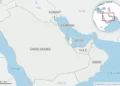
The Strait of Hormuz has become a major vulnerability during the continuing conflict involving Iran and the United States. Disruptions to oil exports and additional government spending have added pressure to Kuwait’s fiscal position.
For a country whose government revenue is heavily linked to petroleum exports, interruptions to production or exports can quickly widen an already large deficit.
The impact also extends beyond lost oil income, with governments facing additional costs related to logistics, imports and emergency measures.
Reserve use carries a long-term tradeoff
Kuwait’s financial strength means that a large deficit does not immediately translate into a conventional sovereign debt crisis.
The country has substantial assets managed through its sovereign wealth system, and the KIA’s mandate is explicitly designed to preserve and grow national wealth for current and future generations.
The tradeoff is that repeated withdrawals to finance recurring spending could reduce the resources available for future investment.
That makes fiscal reform increasingly important. Kuwait has sought to diversify its economy and increase non-oil revenue, but the state’s spending structure remains closely tied to public-sector wages, subsidies and oil income.
Borrowing creates another policy option
Debt financing can help Kuwait smooth its fiscal adjustment.
Rather than immediately cutting spending or selling investments, the government can combine borrowing with reserve withdrawals while pursuing reforms intended to increase non-oil revenue and private-sector activity.
The government has already indicated that the General Reserve Fund can be used to cover deficits under Kuwait’s financial framework.
The challenge is determining how much of the deficit should be financed through debt and how much through accumulated wealth.
Kuwait still has financial room
Despite the growing deficit, Kuwait enters this period from a position of considerable financial strength.
The country’s sovereign wealth provides a substantial buffer against oil-price volatility, while relatively low public debt compared with many advanced economies gives the government additional borrowing capacity.
That does not eliminate the underlying fiscal problem.
The more important question is whether Kuwait can use its financial strength as a bridge toward a more sustainable fiscal model rather than as a permanent substitute for reform.
Fiscal pressure tests Kuwait’s wealth strategy
Kuwait’s current situation illustrates the central challenge facing oil-rich sovereign wealth economies: large reserves can protect a government from short-term shocks, but they do not remove the need to align recurring spending with sustainable revenue.
For now, Kuwait has several financing tools available — sovereign wealth, domestic and international debt markets, and continued oil income.
How those tools are combined will determine how much pressure falls on the country’s reserves and how quickly Kuwait must accelerate its efforts to diversify government revenue.
Reporting Credit: Kuwait Ministry of Finance and Kuwait Government Online — 2026–2027 budget and fiscal-financing data; Kuwait Investment Authority — functions of the General Reserve Fund and sovereign wealth structure; Kuwait State Audit and financial authorities — fiscal and public-finance information.