Journos News - Breaking News, World News, Top Stories, Todays Headlines and Flash Reports
Saturday, July 18, 2026
  • Login
  • Home
  • World
    • Africa
    • Americas
    • Asia
    • Europe
    • Middle East
    • Oceania
  • Politics
  • Business
  • Technology
  • Health
  • Science
  • Sports
  • Entertainment
  • Culture
No Result
View All Result
  • Home
  • World
    • Africa
    • Americas
    • Asia
    • Europe
    • Middle East
    • Oceania
  • Politics
  • Business
  • Technology
  • Health
  • Science
  • Sports
  • Entertainment
  • Culture
No Result
View All Result
Journos News - Breaking News, World News, Top Stories, Todays Headlines and Flash Reports
No Result
View All Result
Home World News Middle East

Iranian Strike on Kuwait Desalination Plant Highlights Gulf’s Growing Water Security Risks

Attack exposes vulnerability of critical infrastructure as regional conflict threatens drinking water supplies across the Middle East

The Daily Desk by The Daily Desk
July 18, 2026
in Middle East, World News
0
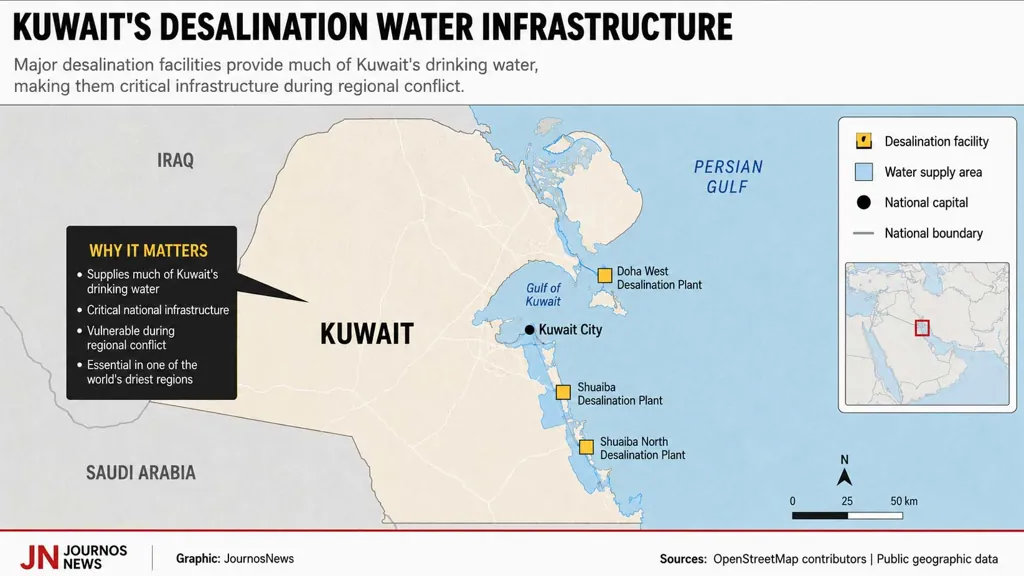
Kuwait map showing major desalination facilities and water supply areas. — Graphic: JournosNews (File)

Map showing Kuwait's major desalination facilities and water supply areas during heightened regional tensions. — Graphic: JournosNews (File)

DUBAI, United Arab Emirates — An Iranian strike damaged a power generation and water desalination plant in Kuwait on Friday, disrupting one of the country’s main sources of drinking water and highlighting the growing vulnerability of critical civilian infrastructure as conflict spreads across the Gulf.

Kuwaiti authorities said the attack damaged several power generation units and sparked a fire that firefighters later brought under control. Officials also activated emergency contingency plans to maintain electricity and water services while engineers assessed the extent of the damage.

Although no major interruptions to public water supplies were immediately reported, the attack renewed concerns that the region’s desalination network could become an increasingly important target as military tensions escalate.

Gulf Nations Depend Heavily on Desalination

The strike underscores how dependent Gulf countries have become on desalination to meet their freshwater needs.

Kuwait produces about 90% of its drinking water through desalination, while Oman relies on the technology for roughly 86% of its freshwater supply. Saudi Arabia obtains about 70% of its drinking water from desalinated seawater.

RELATED POSTS

Ukraine Appoints Serhii Koretskyi as Prime Minister Ahead of Critical Winter

Japan Approves Imperial Family Reform, Keeps Male-Only Succession

Strategic Hormuz Islands Return to Focus as U.S.-Iran Conflict Escalates

Global Survey Finds China and Xi Viewed More Favorably Than U.S. and Trump in Many Countries

EU, Ukraine Launch Joint Defense Production Partnership to Expand Wartime Arms Manufacturing

Israel, Lebanon Advance Pilot Withdrawal Plan After U.S.-Mediated Rome Talks

Most modern plants use reverse osmosis, a process that forces seawater through specialized membranes to remove salt and impurities. Hundreds of these facilities line the Persian Gulf coastline, placing infrastructure that supplies millions of people within range of missiles and drones.

Without desalination plants, many of the region’s largest cities would struggle to sustain their populations because natural freshwater resources remain scarce.

Water Infrastructure Emerges as Strategic Target

The conflict has largely drawn international attention because of its impact on oil markets and commercial shipping through the Strait of Hormuz. However, Friday’s strike highlighted another strategic vulnerability: the infrastructure that provides drinking water across the Gulf.


Iranian strikes have occurred near several desalination facilities during the conflict.

Earlier this year, Kuwait reported damage near the Doha West desalination complex after debris from intercepted drones or nearby attacks fell in the area.

Iran has also accused the United States of striking desalination facilities on Qeshm Island in March, claiming the attack disrupted water supplies to about 30 villages. Washington has not acknowledged carrying out such an operation.

Yemen’s Houthi rebels have also targeted Saudi desalination infrastructure during previous periods of regional conflict, reinforcing concerns that freshwater facilities could face continued threats.

Power and Water Systems Are Closely Connected

Many Gulf desalination plants operate alongside power stations, meaning damage to electricity infrastructure can also reduce freshwater production.

The facilities rely on several interconnected systems, including seawater intake, filtration equipment and continuous electricity supplies. A failure in any one of those systems can significantly reduce or halt water production.

Regional governments and U.S. security officials have long classified desalination plants as strategic infrastructure because prolonged disruptions could quickly create humanitarian and national security challenges.

A 2010 CIA assessment warned that attacks on desalination facilities could trigger national emergencies across several Gulf states. The report estimated that more than 90% of the region’s desalinated water originated from just 56 major facilities, making them particularly vulnerable to military attacks or sabotage.

Climate Change Adds Long-Term Pressure

Security threats are not the only challenge confronting Gulf desalination networks.

Scientists say climate change is increasing the risks facing coastal infrastructure through stronger storm surges, heavier rainfall and rising sea levels. Warmer ocean temperatures are also expected to increase the likelihood and intensity of cyclones developing in the Arabian Sea.

As geopolitical tensions and climate pressures converge, experts say protecting desalination facilities is becoming an increasingly important national security priority for Gulf governments. The plants now serve not only as essential utilities but also as critical infrastructure supporting millions of people across one of the world’s most water-scarce regions.

This report is based on reporting by The Associated Press.

Article Topics: Iran | Kuwait | Desalination | Water Security | Middle East Conflict | Critical Infrastructure | Persian Gulf

Tags: #CriticalInfrastructure#Iran#Kuwait#PersianGulf#RegionalSecurity
The Daily Desk

The Daily Desk

The Daily Desk is a contributor at JournosNews.com covering politics, media, governance, and the evolving dynamics of public discourse. Stories published under this byline are produced in accordance with JournosNews' editorial standards, with an emphasis on verified reporting, accuracy, context, and impartiality.

Related Posts

Ukraine Appoints Serhii Koretskyi as Prime Minister Ahead of Critical Winter

by The Daily Desk
July 17, 2026
0
Serhii Koretskyi speaks during an official Naftogaz Group event. — Photo: Naftogaz Group

KYIV, Ukraine — Ukraine's parliament confirmed Serhii Koretskyi as the country's new prime minister on Thursday, placing the veteran energy...

Read moreDetails

Japan Approves Imperial Family Reform, Keeps Male-Only Succession

by The Daily Desk
July 17, 2026
0
Members of Japan's imperial family attend a ceremonial session of the National Diet. — Photo: Prime Minister's Office of Japan

TOKYO, Japan - Japan's parliament approved legislation Friday aimed at strengthening the country's shrinking imperial family while preserving the centuries-old...

Read moreDetails

Strategic Hormuz Islands Return to Focus as U.S.-Iran Conflict Escalates

by The Daily Desk
July 17, 2026
0
Map showing the strategic islands near the Strait of Hormuz and major shipping routes. — Graphic: JournosNews

DUBAI, United Arab Emirates - Three disputed islands at the entrance to the Strait of Hormuz have again become a...

Read moreDetails

Global Survey Finds China and Xi Viewed More Favorably Than U.S. and Trump in Many Countries

by The Daily Desk
July 16, 2026
0
U.S. President Donald Trump and Chinese President Xi Jinping attend an official welcome ceremony in Beijing.

WASHINGTON - China and its leader, Xi Jinping, are viewed more favorably than the United States and President Donald Trump...

Read moreDetails

EU, Ukraine Launch Joint Defense Production Partnership to Expand Wartime Arms Manufacturing

by The Daily Desk
July 16, 2026
0
Map showing the EU–Ukraine defense industrial partnership between Brussels and Kyiv.

KYIV, Ukraine - The European Union and Ukraine have launched a new defense industrial partnership aimed at expanding joint weapons...

Read moreDetails

Israel, Lebanon Advance Pilot Withdrawal Plan After U.S.-Mediated Rome Talks

by The Daily Desk
July 16, 2026
0
Editorial map showing southern Lebanon, northern Israel, the Blue Line, and the location of diplomatic talks held in Rome.

BEIRUT, Lebanon - Lebanon and Israel moved closer Wednesday to implementing a key stage of their withdrawal agreement after two...

Read moreDetails

UK Watchdog Upholds ICC Prosecutor Karim Khan’s Suspension Amid Rising U.S. Pressure

by The Daily Desk
July 15, 2026
0
Portrait of International Criminal Court Prosecutor Karim Khan during a meeting in Brussels in 2022.

THE HAGUE, Netherlands — Britain's legal regulator has upheld the suspension of International Criminal Court (ICC) Chief Prosecutor Karim Khan...

Read moreDetails

China Expels Politburo Member Ma Xingrui in Latest High-Level Anti-Corruption Purge

by The Daily Desk
July 15, 2026
0
Portrait of Chinese official Ma Xingrui during the IAEA General Conference in Vienna in 2013.

BEIJING, China — Chinese authorities have expelled senior Communist Party official Ma Xingrui from the ruling party after concluding an...

Read moreDetails

U.S. Reimposes Iran Port Blockade as Strait of Hormuz Fighting Threatens Ceasefire

by The Daily Desk
July 15, 2026
0
Editorial map of the Strait of Hormuz showing major shipping routes, regional ports, and the reported operational area between Iran, Oman, and the United Arab Emirates.

DUBAI, United Arab Emirates - The United States has reinstated a blockade of Iranian ports, accusing Tehran of attacking commercial...

Read moreDetails
Load More
JournosNews logo

Journos News delivers globally neutral, fact-based journalism that meets international media standards — clear, credible, and made for a connected world.

  • Categories
  • World News
  • Politics
  • Business & Markets
  • Technology
  • Health
  • Science
  • Sports
  • Arts & Culture
  • Resources
  • Editorial Standards
  • Submit a Story
  • Advertise with Us
  • Syndication & Partnerships
  • Site Map
  • Press & Media Kit
  • Editorial Team
  • Careers

Join thousands of readers receiving the latest updates, tips, and exclusive insights straight to their inbox. Never miss an important story again.

  • About Us
  • Editorial & Trust Center
  • Contact Us
  • Privacy Policy
  • Terms of Use & Copyright Notice

© JournosNews.com All rights reserved.

Welcome Back!

Login to your account below

Forgotten Password?

Retrieve your password

Please enter your username or email address to reset your password.

Log In
JournosNews

Independent Journalism.
Verified Facts.

You're about to read a professionally edited article from JournosNews.com.

Every article is produced in accordance with our editorial standards, emphasizing factual accuracy, transparent attribution, fairness, editorial independence, and meaningful context.

Editorial Standards
No Result
View All Result
  • Home
  • World
    • Africa
    • Americas
    • Asia
    • Europe
    • Middle East
    • Oceania
  • Politics
  • Business
  • Technology
  • Health
  • Science
  • Sports
  • Entertainment
  • Culture

© JournosNews.com All rights reserved.

This website uses cookies. By continuing to use this website you are giving consent to cookies being used. Visit our Privacy and Cookie Policy.