Last verified update reviewed: August 28, 2026 | 01:10 UTC
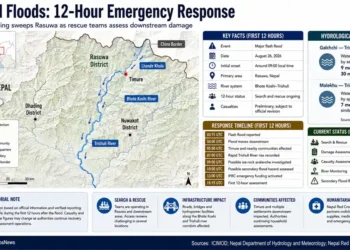
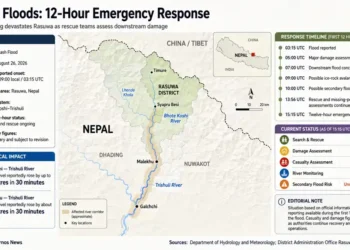
The following tracker uses the August 26 flash flood in Rasuwa as the starting point and continues through the latest verified developments available on August 28.
Major Developments We’re Following
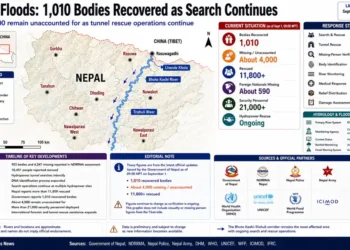
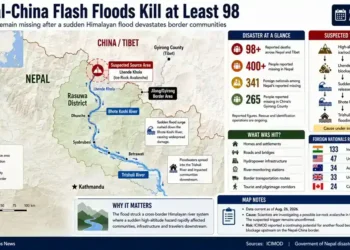
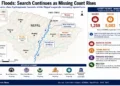
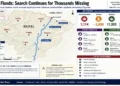
- The latest status report attributed to Nepal’s National Disaster Risk Reduction and Management Authority (NDRRMA) reports 389 deaths and 977 people missing following the Bhote Koshi flood.
- Nepal Police has separately reported 389 recovered bodies, with victims recovered across Rasuwa, Nuwakot, Dhading, Gorkha, Tanahun, Nawalparasi and Chitwan.
- Rescue and search operations remain underway, with authorities working to reach communities isolated by destroyed roads and bridges.
- A lake formed by debris blocking a river near the disaster area is rising, and Nepal’s disaster authorities have warned of a potential additional flood hazard.
- The Nepal Army has carried out major rescue operations, including the evacuation of people trapped at the Upper Trishuli hydropower project.
- International humanitarian agencies are supporting the response. The IFRC previously released nearly CHF 1 million through its emergency funding mechanism for the Nepal Red Cross response.
What We Know
- Event: Major flash flood and associated debris flow
- Initial event: August 26, 2026
- Primary affected district: Rasuwa
- Primary river system: Bhote Koshi–Trishuli
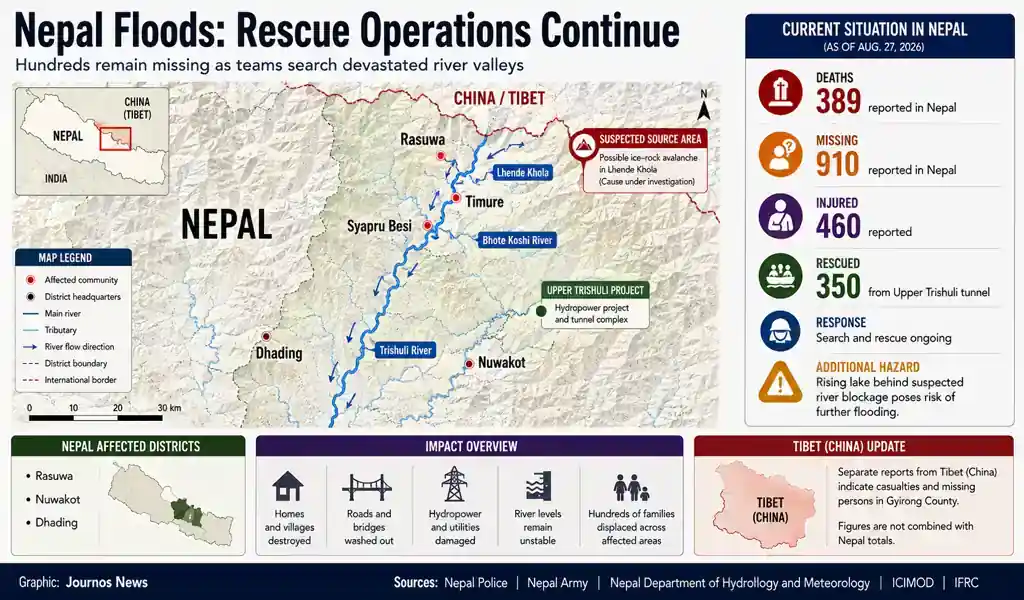
- Deaths: 389 in the latest NDRRMA/Nepal Police reporting
- Missing: 977 in the latest NDRRMA status report
- Earlier missing figure: 910 in an earlier national disaster-management assessment
- Search and rescue: Ongoing
- Affected downstream districts: Multiple districts including Nuwakot, Dhading, Gorkha, Tanahun, Nawalparasi and Chitwan
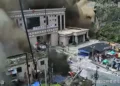
- Infrastructure: Roads, bridges, homes and hydropower infrastructure have been damaged or destroyed.
- Additional hazard: A river blockage and rising lake are being monitored upstream.
- Scientific assessment: ICIMOD reported that the initial flood involved a powerful surge of water, sediment and boulders and investigated a possible ice-rock avalanche as part of the event’s origin.
What We Don’t Know
- The final death toll has not been established.
- The final number of missing people remains unresolved.
- The extent of damage in remote mountain communities remains incomplete.
- Some missing-person lists are still being reconciled between Nepalese authorities and foreign governments.
- The stability of the newly formed lake and the precise consequences of a possible blockage failure remain under assessment.
- The full number of foreign nationals affected has not been conclusively established.
Public Safety Information
Nepal’s disaster authorities have warned people living along lower riverbanks, passengers and rescue personnel to exercise caution and remain in safe locations away from riverbanks and other hazardous areas because of the rising lake created by the river blockage.

The Department of Hydrology and Meteorology maintains Nepal’s official hydrological and flood-warning systems, including rainfall and river monitoring.
JournosNews should reproduce specific evacuation or warning instructions only when issued by the relevant Nepalese authority.
Live Updates
August 28 — Latest National Assessment Reports 389 Deaths
Nepal’s latest disaster-status reporting places the number of recovered bodies at 389, with the bodies recovered across several districts affected by the flood’s downstream movement.
The latest figure represents a substantial revision from earlier assessments as search and recovery teams gained access to affected areas.
August 28 — 977 People Reported Missing
The latest NDRRMA status report cited in current reporting says 977 people remain missing after the disaster.
An earlier national assessment had placed the number at 910. JournosNews is retaining both figures in the chronology because the difference reflects changing official assessments rather than automatically treating the earlier figure as a JournosNews error.
August 28 — Nepal Police Continues Search Operations
Nepal Police continues search and rescue operations in affected districts while also helping move people from areas considered at risk from further flooding.
Police reporting identifies recovered bodies in Rasuwa, Nuwakot, Dhading, Gorkha, Tanahun, Nawalparasi East, Nawalparasi West and Chitwan.
August 28 — Secondary Flood Risk Remains Under Assessment
Nepal’s disaster authorities have warned that a lake created when debris blocked a river near the original flood site is continuing to rise.
Authorities have urged residents and people involved in rescue operations to stay away from riverbanks and hazardous areas. The potential behaviour of the blockage and lake remains under assessment.
August 28 — Hydrological Monitoring Remains Critical
The Department of Hydrology and Meteorology operates Nepal’s national hydrological monitoring and flood-warning infrastructure.
The monitoring network is particularly important as authorities assess downstream river conditions following the sudden rise in the Bhote Koshi and Trishuli systems.
August 27 — Earlier National Assessment Recorded 910 Missing
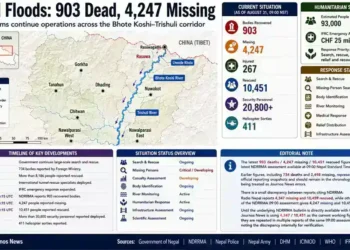
An earlier disaster-management assessment reported 359 deaths and 910 people missing, including foreign nationals.
That figure was subsequently superseded by later reporting that put the recovered death toll at 389 and the missing figure at 977. JournosNews should preserve this progression to show how casualty assessments developed.
August 27 — Nepal Army Conducts Major Rescue Operation
The Nepal Army rescued approximately 350 workers and local residents who had been trapped inside the Upper Trishuli hydropower project tunnel following the flooding.
The operation demonstrated the continuing role of the security forces in reaching people isolated by flood damage.
August 27 — Infrastructure Damage Hampers Access
Floodwaters and debris damaged roads and bridges in the affected mountain region, making access to some communities difficult.
The destruction of transportation infrastructure has complicated both search operations and delivery of emergency assistance.
August 27 — ICIMOD Continues Scientific Assessment
The International Centre for Integrated Mountain Development reported that the flood sent water, sediment and boulders through the Bhote Koshi and downstream river system.
ICIMOD also investigated a possible ice-rock avalanche entering the Lhende Khola as part of the scientific assessment of the event’s origin.
August 27 — Humanitarian Response Expanded
The International Federation of Red Cross and Red Crescent Societies said it was releasing nearly CHF 1 million to support the Nepal Red Cross response.
The humanitarian response is focused on reaching isolated communities and addressing immediate emergency needs.
August 26 — Flash Flood Strikes Rasuwa
The initial flash flood struck Rasuwa in the morning, sending a powerful surge through the Bhote Koshi river system.
ICIMOD reported rapidly rising water levels and extensive downstream movement of sediment and boulders.
August 26 — Rapid Downstream River Rise Recorded
ICIMOD reported that the Trishuli River at Galchchi rose by as much as nine metres within 30 minutes, while the Malekhu station recorded a rise of approximately seven metres over a similar period.
Several hydrological monitoring stations were damaged or swept away, although Galchchi remained operational.
August 26 — Communities and Infrastructure Hit
The flood damaged communities, roads, bridges and hydropower infrastructure in Rasuwa and along downstream river corridors.
The IFRC reported that some communities became isolated because bridges and roads were destroyed.
August 26 — Initial Emergency Response Begins
Nepalese authorities and emergency services began search and rescue operations as information about casualties and damage emerged.
Early figures were incomplete because several affected areas were difficult to access. Subsequent official assessments have significantly revised the casualty figures upward.
Sources / References
Government of Nepal — Official Government Portal; Nepal Police — casualty, missing-person and rescue information; Nepal Department of Hydrology and Meteorology — flood monitoring and warnings; International Centre for Integrated Mountain Development (ICIMOD) — scientific and hydrological assessment; Nepal Army — rescue operations; International Federation of Red Cross and Red Crescent Societies (IFRC) — humanitarian response.