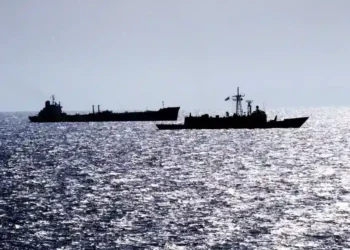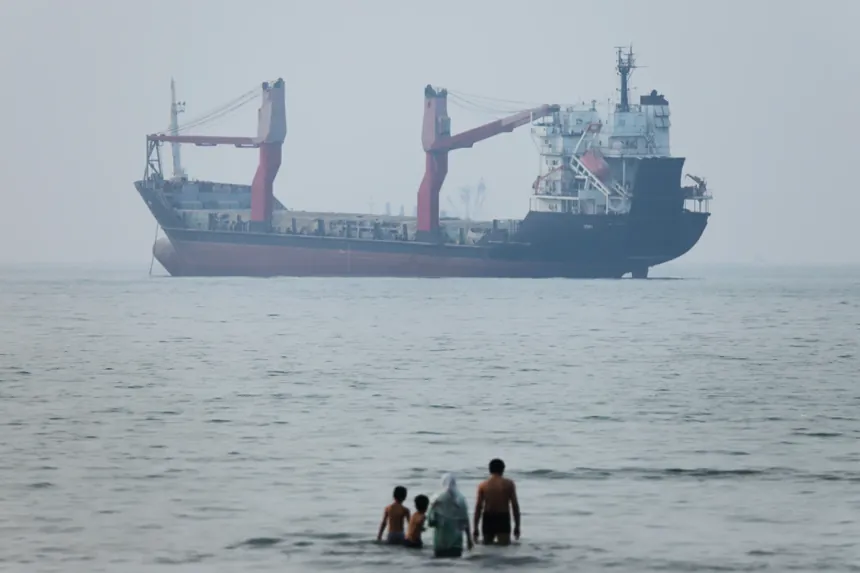
DUBAI, United Arab Emirates – Iran has warned that oil tankers transiting the Strait of Hormuz must follow shipping routes approved by Tehran or risk a “forceful response,” escalating tensions over a strategic maritime passage central to global energy supplies. The Associated Press reported that the warning was issued Thursday by Iran’s Khatam al-Anbiya joint military command as diplomatic efforts continue to secure a permanent end to the Iran war.
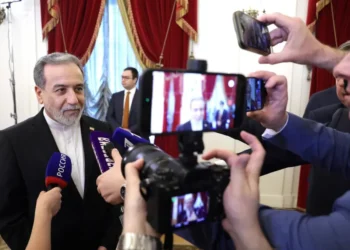
The statement, carried by Iranian state television, came a day after U.S. and Iranian diplomats met with mediators in Qatar to discuss ongoing negotiations. Control of navigation through the Strait of Hormuz has emerged as one of the key issues in the talks.
Iran Reasserts Control Over Strategic Waterway
Iran’s military command said vessels using the Strait of Hormuz must comply with navigation protocols established by the Islamic Republic.

According to the statement, any tanker that deviates from designated routes or fails to follow Iranian instructions would face an “immediate and forceful response” from the country’s armed forces, potentially placing the security of those vessels at risk.
The military also warned that any interference by U.S. forces operating in the strait would prompt what it described as a rapid and decisive reaction.
The report did not identify a specific incident that prompted the latest warning.
Diplomatic Efforts Continue
The renewed rhetoric followed a statement from the U.S. military’s Central Command after regional security discussions in Bahrain, where officials from Middle Eastern countries reaffirmed their commitment to maintaining the free flow of commerce through the Strait of Hormuz.
The AP reported that this language may have contributed to Tehran’s response, although Iranian authorities did not publicly identify the reason for issuing the warning.




Under an interim agreement between Iran and the United States, commercial vessels were allowed to transit the strait without paying passage fees for 60 days. Iran has maintained, however, that it should control shipping routes and eventually collect transit charges, a position opposed by the United States and several Gulf Arab nations.
Efforts by Oman and a United Nations agency to establish an alternative shipping route closer to Oman’s coastline were followed by attacks across the Middle East last weekend, underscoring continued regional instability.
Shipping Traffic Gradually Recovers
Despite recent security concerns, commercial traffic through the Strait of Hormuz has begun to recover.
Marine data and analysis company Lloyd’s List Intelligence reported that at least 258 vessels passed through the waterway last week, compared with 138 during the previous week. The increase came despite Iranian strikes on two commercial ships on June 25 and June 27, according to the AP report.
Richard Meade, editor-in-chief of Lloyd’s List, said during a Thursday webinar that the earlier attacks appeared to have faded from immediate concern among some shipping operators.
Even so, Meade cautioned that vessel traffic remains well below pre-war levels, when roughly 130 ships moved through the strait each day. He said shipping companies continue to make routing decisions based on rapidly changing political approvals and evolving security assessments, describing the situation as highly unstable rather than a new operating norm.
Funeral Preparations Continue in Iran
The maritime warning coincided with preparations for the funeral of Iran’s late Supreme Leader Ayatollah Ali Khamenei.
Iranian state media broadcast footage Thursday night showing what it identified as Khamenei’s casket arriving at the Imam Khomeini Hussainiya in Tehran for a farewell ceremony. Hundreds of mourners were shown praying beside the casket, which was covered with a green cloth.
The official weeklong funeral is scheduled to begin on Saturday.
Earlier this week, Iranian state television also reported that a foreign vessel became stranded in the Strait of Hormuz after allegedly ignoring instructions from Iran’s Revolutionary Guard. The AP reported, however, that the vessel’s appearance, location and other available details suggested it was linked to Iran and may have been stranded for several months.
Pakistan’s Foreign Ministry spokesperson Tahir Andrabi said Wednesday’s diplomatic discussions produced “positive progress” and expressed hope that another round of negotiations would take place soon after Khamenei’s funeral concludes.
Tags: Iran, Strait of Hormuz, Oil Tankers, Maritime Security, United States, Gulf Shipping, Khatam al-Anbiya, Ayatollah Ali Khamenei, Qatar Talks, Lloyd’s List Intelligence, Middle East, Global Energy