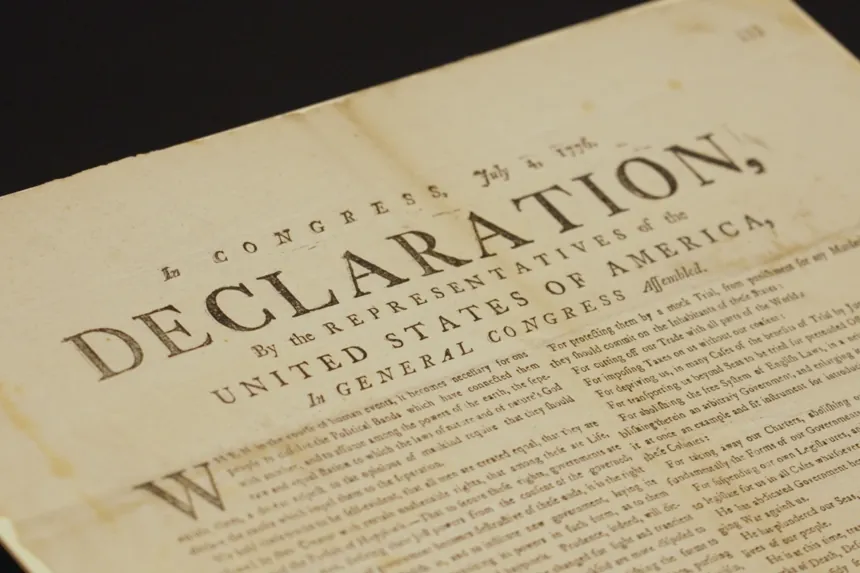
LONDON – A rare early printed copy of the Declaration of Independence has been identified at Britain’s National Archives after a volunteer uncovered it while cataloging 18th-century Royal Navy records, The Associated Press reported. The discovery marks the only known surviving copy of its kind outside the United States and comes ahead of the 250th anniversary of American independence.
Michael Scurr, a volunteer who has spent more than a decade helping catalog historical documents, made the find while reviewing the correspondence of a Royal Navy captain. The document was attached to a report concerning the capture of the American privateer Dalton on Christmas Eve in 1776 and was simply labeled as “another paper.”
When Scurr unfolded the document, he immediately recognized the printed word “Declaration” at the top, identifying it as a copy of America’s founding declaration.

Rare Early Printing Identified
Researchers at the National Archives determined that the document is one of only 11 known surviving copies of the so-called Exeter printing of the Declaration of Independence. According to the archives, the edition was printed in Exeter, New Hampshire, between July 16 and July 19, 1776, only days after the original Declaration was adopted on July 4.
Officials said it is the only known example of this printing located outside the United States.
Amanda Bevan, who leads the National Archives project cataloging Royal Navy captains’ correspondence from the American Revolutionary War, said the document’s historical importance extends beyond its rarity.
According to Bevan, the declaration was found among papers captured from a vessel operating under the authority of the Continental Congress, with orders signed by its president, John Hancock. The discovery provides additional evidence of how the newly adopted declaration accompanied American privateers during the conflict.
Window Into the Revolutionary War at Sea
Bevan said the find highlights the often-overlooked role of American privateers, privately owned ships authorized to disrupt British commerce and support the limited naval forces of the Continental Congress.
■ Related News




She believes the Dalton’s captain likely read both his official orders and the Declaration of Independence aloud to the crew before their mission, reflecting not only military objectives but also the ideals motivating the revolutionary cause.
The Dalton, an 18-gun privateer, was pursued for seven hours on Christmas Eve in 1776 by the 64-gun HMS Raisonnable under the command of Captain Thomas Fitzherbert before being captured off the coast of Portugal.
Its crew of approximately 120 men was taken prisoner and held in Plymouth, England.
Among them was Charles Hebert, who was 19 years old at the time of his capture. According to journals he kept during more than two years of imprisonment, he documented hunger, illness and repeated punishment before eventually being released in a prisoner exchange.
Historians Welcome the Discovery
The discovery has also drawn interest from historians in the United States.
Matthew Skic, director of collections and exhibitions at the Museum of the American Revolution in Philadelphia, said the document provides a direct physical connection to the people who carried news of American independence during the Revolutionary War.
Skic also said the find demonstrates that significant historical discoveries remain possible even after nearly two and a half centuries of research, reinforcing the continuing value of archival preservation and historical cataloging.
The National Archives unveiled the discovery on Thursday ahead of commemorations marking the 250th anniversary of American independence this weekend.
Tags: United Kingdom, United States, Declaration of Independence, National Archives, American Revolution, Michael Scurr, Amanda Bevan, John Hancock, Dalton, Royal Navy, History, Historical Discovery