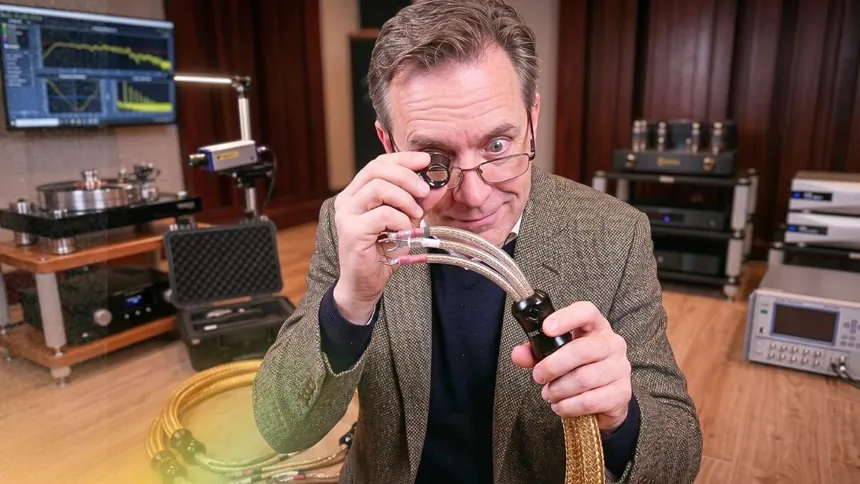
A decades-long debate within the audio industry over whether cables can influence sound quality has gained renewed attention following scrutiny of patent filings that describe passive filter networks built directly into certain premium audio cables.
The patents, filed by MIT Cables founder Bruce Brisson, outline designs that incorporate electrical network components into signal paths rather than relying solely on conductor materials, geometry, or shielding. The filings have fueled discussion because they describe intentional signal-shaping behavior that differs from the conventional expectation that audio cables should function as neutral transmission devices.
Patents Describe Integrated Passive Networks
The earliest patent cited in the discussion dates to 1992, when Bruce Brisson received U.S. Patent 5,142,252, titled “Audio Signal Transmission Line With a Low Pass Filter.”

According to the patent documentation, the invention incorporates discrete inductive components into an audio transmission line to create filtering behavior. The patent explicitly describes a low-pass filter structure rather than improvements related solely to conductor design or shielding techniques.
A later filing, U.S. Patent 7,242,780, expanded on the concept. Described as an “audio signal cable with passive network,” the patent details resistor-capacitor (RC) circuits connected between cable conductors and tuned to specific frequencies.
Examples included in the patent reference frequency points ranging from approximately 30 Hz to 3.5 kHz in a guitar-cable implementation, frequencies that fall within ranges listeners commonly associate with tonal balance and musical character.
Patent classification records also place the invention under classifications associated with amplitude-frequency equalizers and fixed equalization systems, indicating that examiners viewed the design as a form of frequency-response shaping rather than a purely passive transmission medium.
Measurements Support Filtering Behavior
Independent testing cited in the discussion provides additional, though limited, evidence that some commercial products based on these concepts exhibit measurable filtering characteristics.
■ Related News



In testing conducted by Alpha Audio, the publication reported unusual capacitance behavior from MIT’s EVO Three cable at frequencies above 100 kHz. While those measurements occurred outside the audible range, they demonstrated that the cable was not behaving like a simple conductor alone.
The measurements do not establish that a specific audible equalization curve exists across every MIT product, nor do they prove audible coloration on their own. However, they do support the broader observation that additional circuitry influences signal behavior within at least some cable designs.
As a result, the patent documentation and measurement data contribute different pieces of evidence. The patents describe intentional passive networks designed around specific frequency targets, while independent measurements indicate that at least one commercial implementation exhibits measurable filtering characteristics.
Engineering Language Gave Way to Proprietary Terminology
Comments from Brisson over the years provide additional context regarding the company’s design philosophy.
In a 2010 interview with Dagogo, Brisson described early MIT speaker cables as “distributed low pass filters,” terminology that closely matches language used in the original patent filings.
He also discussed the importance of what MIT later marketed as “Articulation,” a proprietary term associated with the company’s network technology. According to the interview, Brisson ranked network behavior and impedance management above conductor material and conductor geometry when discussing factors affecting cable performance.
“Conductor material is important, but once you understand how it actually affects the sound, you find it is actually easier to control those effects much more optimally in another manner,” Brisson stated during the interview.
Over time, MIT’s marketing language evolved toward proprietary terminology such as “Articulation Poles,” while standard engineering descriptions became less prominent in product literature.
The article notes that terms used in promotional materials do not appear within the patent filings themselves, where conventional electrical-engineering language is used to describe the underlying circuitry.
Debate Shifts From Neutrality to Preference
The findings raise a different question than the traditional cable debate.
Rather than focusing solely on whether cables can alter sound, the evidence suggests that some cable manufacturers intentionally design products to modify signal behavior through integrated passive networks.
Listening evaluations cited in the article indicate that some listeners have preferred the resulting presentation. Alpha Audio reported that one evaluator ranked an MIT cable highly for perceived detail and imaging, while other listeners described different tonal characteristics.
Those differing impressions highlight the subjective nature of listening preferences and reinforce the distinction between measurable signal shaping and listener preference.
Alternative Approaches Offer Adjustable Control
The article also compares network-based cable systems with standalone equalization products.
Unlike adjustable equalizers, passive networks integrated into cables generally provide fixed frequency-response characteristics determined by the manufacturer. Users typically cannot alter those settings once the product is installed.
By contrast, dedicated equalizers and digital signal-processing devices allow listeners to modify tonal balance, room correction, and frequency response according to personal preferences or listening environments.
The comparison illustrates a broader discussion within the audio community regarding whether fixed signal shaping built into cables offers advantages over more flexible and transparent equalization solutions.
Similar Designs Appear Across Multiple Brands
The article further notes that Alpha Audio’s testing identified similar response behavior from both MIT and Transparent cable designs, each of which incorporates inline network modules.
While comparable measurements do not necessarily indicate identical circuitry, the findings suggest that multiple manufacturers have explored approaches that extend beyond conventional cable construction by introducing additional passive network elements into the signal path.
The broader takeaway is not that all premium cables function as equalizers, but that certain designs intentionally incorporate circuitry capable of influencing signal behavior. Patent records, manufacturer statements, and independent measurements collectively indicate that some products marketed as cables may also perform functions traditionally associated with fixed passive filtering networks.
Tags: MIT Cables, Audio Cables, Passive Networks, Equalization, Audio Engineering, Bruce Brisson, Signal Processing, High-End Audio