WASHINGTON — Republican leaders on Capitol Hill, including senior national security lawmakers, expressed sharp reservations Thursday about the Trump administration’s agreement intended to end the fighting in Iran and establish a framework for future nuclear negotiations, according to reporting from The Associated Press.
The memorandum of understanding signed by President Donald Trump initiates a 60-day negotiating period to reach a final agreement on Iran’s nuclear program. While administration allies emphasized that the deal is not final, provisions involving the lifting of economic sanctions on Iran’s oil exports and the creation of a reported $300 billion reconstruction fund have drawn criticism from within Trump’s own party.
Sen. Roger Wicker, chairman of the Senate Armed Services Committee, warned that the arrangement could weaken longstanding U.S. pressure on Tehran.

“President Trump has pursued peace through strength. I hope the intermediaries working on this deal are not undermining that objective,” Wicker said, also comparing the proposed reconstruction fund to Iran-related provisions under the Obama administration’s 2015 nuclear agreement.
Wicker said the proposed financial framework “would make Iran’s payoff under President Obama’s 2015 deal look like a pittance by comparison,” though the administration has indicated the United States would not directly contribute to the fund.
GOP lawmakers raise concerns over financial terms
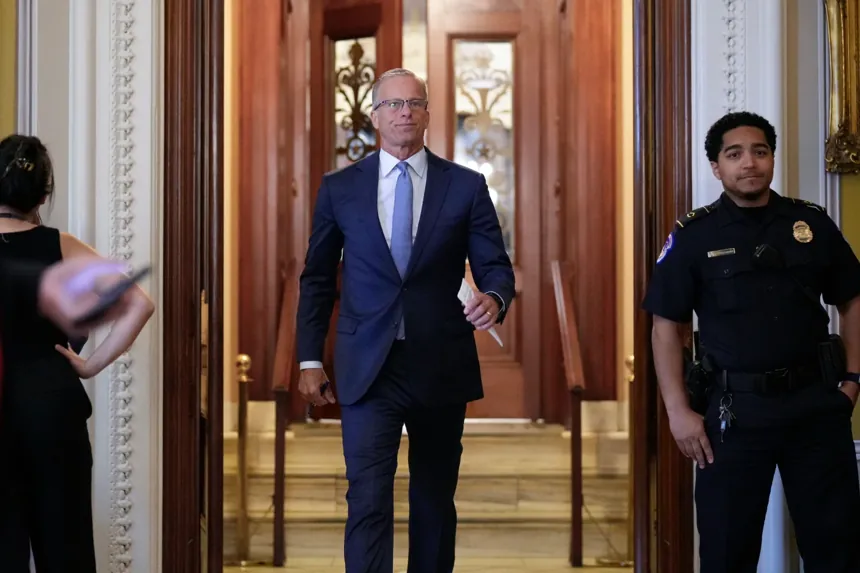
As the memorandum was circulated among lawmakers, several Republican senators raised questions about its economic provisions and enforcement mechanisms. Senate Majority Leader John Thune and Sen. Mike Rounds of South Dakota said they were seeking clarity on how financial incentives would be structured and how compliance with restrictions on terrorism financing would be enforced.
Rounds said the agreement left unresolved questions about “how this is going to be implemented,” warning that “a lot of money’s going to go to Iran.”
Other Republicans aligned more closely with the administration’s foreign policy approach defended the agreement’s intent, arguing it preserves leverage by conditioning Iran’s future behavior.
Sen. Roger Marshall said in a social media post that key provisions would help ensure Iran does not obtain a nuclear weapon, framing the agreement as strengthening regional security.
■ Related News



Louisiana GOP Senate candidate John Fleming suggested the deal’s credibility would depend on enforcement, saying it reflects a “speak-softly-and-carry-a-big-stick” approach that retains the possibility of military action if Iran fails to comply.
Trump defends interim agreement amid criticism
President Trump rejected criticism of the agreement, calling detractors “fools” on his Truth Social platform and dismissing concerns about the reported $300 billion reconstruction fund as “fake news.” He reiterated that no U.S. taxpayer funds would be used.
“All there is for the U.S. is Success, Lower Oil Prices, and Victory,” Trump posted.
The administration maintains that sanctions relief and postwar economic measures are part of a broader strategy to stabilize the region while continuing negotiations over Iran’s nuclear program during the 60-day window.
Conservative allies and media voices warn of risks
Opposition to the agreement also emerged from influential conservative commentators and Trump-aligned media figures, some of whom argued the timing and structure of the deal could undermine U.S. leverage.
Conservative radio host Mark Levin suggested delaying any agreement until after the upcoming midterm elections, arguing that U.S. military readiness and energy policy considerations should take precedence.
Right-wing commentator Laura Loomer questioned the intelligence behind the negotiations, posting on X: “Who is giving the President tainted, pro-Islamic intel?”
Former Vice President Mike Pence also criticized the arrangement, describing it as overly conciliatory toward Tehran and reflecting long-standing distrust of the Iranian government.
Questions persist in Senate over implementation
Despite divisions within the Republican Party, lawmakers across several factions continued to raise concerns about implementation, oversight, and long-term consequences for U.S. foreign policy. The memorandum’s 60-day negotiating window now sets the stage for further congressional scrutiny as details of enforcement and funding mechanisms remain under review.
Tags: Senate Armed Services Committee, Iran Nuclear Program, US Iran Relations, Sanctions Policy, Republican Party, Donald Trump, Foreign Policy Negotiations, Midterm Elections, Oil Markets, National Security