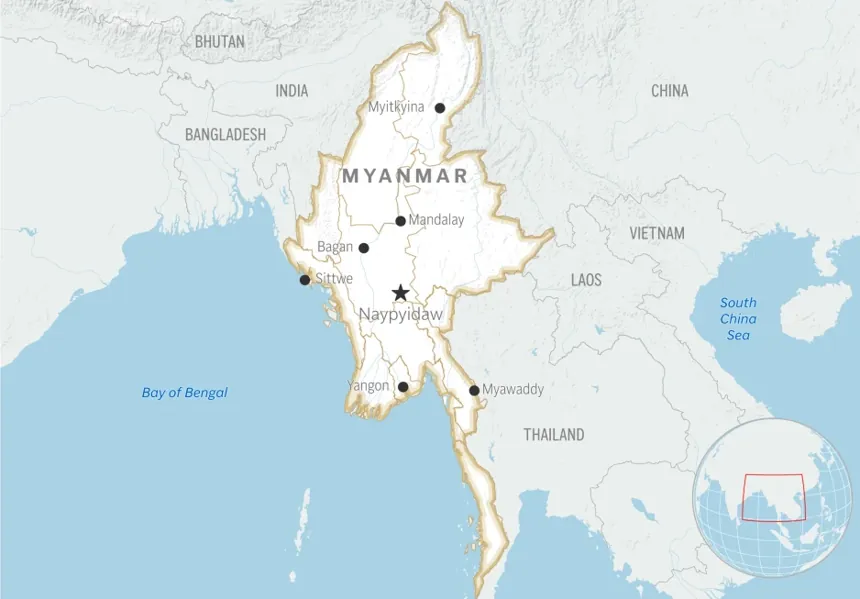
BANGKOK, Thailand — Myanmar’s military government says it has recaptured two strategically important border towns near India and Thailand from ethnic armed groups, marking a significant battlefield reversal in the country’s prolonged civil war and underscoring the junta’s efforts to regain territorial control after months of setbacks.
State-run newspaper Myanma Alinn reported that government troops retook Tonzang in northwestern Chin State after a 10-day military operation. The town lies close to the Indian border and had been controlled by Chin ethnic resistance forces since 2024.
A day earlier, the military announced it had also regained control of Mawtaung, a key trade town near the Thai border in the southern Tanintharyi region, following a two-week offensive against the Karen National Union (KNU) and allied resistance fighters.

Strategic Momentum Shifts
The twin offensives represent one of the junta’s most notable territorial gains since armed resistance groups dramatically expanded their control across multiple regions after the 2021 military coup that ousted the elected government of Aung San Suu Kyi.
Analysts noted that the military has gradually regained momentum since mid-2025, aided by forced conscription measures, intensified air operations, and several China-backed ceasefire arrangements that eased pressure on other fronts.
The recapture of Tonzang is particularly significant because the town sits near supply routes linked to India’s Mizoram state, while Mawtaung serves as an important commercial gateway connecting Myanmar with Thailand. Control of border crossings has become central to both military logistics and revenue generation during the conflict.
Regional Security Concerns Grow
The developments come amid broader instability across Myanmar’s border regions, where ethnic militias and anti-junta resistance groups have seized major territory since late 2023 under coordinated offensives known as Operation 1027.
Chin State and Tanintharyi have experienced sustained fighting since the coup, displacing civilians and disrupting trade routes with neighboring countries. International aid organizations have repeatedly warned about worsening humanitarian conditions in conflict-affected areas.

Government reports stated that more than 200 armed engagements occurred during the Mawtaung operation and claimed that dozens of resistance fighters were killed. Independent verification remains difficult because of severe restrictions on media access and communications in many parts of Myanmar. Resistance groups had not publicly responded to the military’s claims at the time of reporting.
Peace Talks Remain Uncertain
The military gains also follow recent calls by junta leader Min Aung Hlaing for renewed peace negotiations with armed resistance organizations. However, analysts say mutual distrust and continued military offensives make any nationwide settlement unlikely in the near term.
Myanmar’s conflict has evolved into one of Southeast Asia’s most complex wars, involving the military, ethnic armed organizations, and pro-democracy resistance groups operating across multiple regions. The fighting has increasingly drawn concern from neighboring countries over refugee flows, border security, and regional stability.