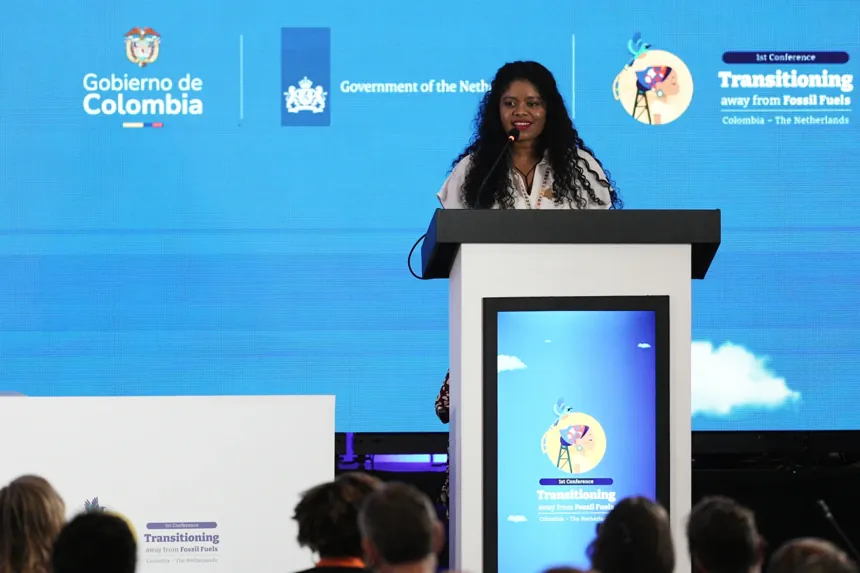
Global talks on a fossil fuel transition opened in Santa Marta, Colombia, bringing together government officials, policymakers, and climate experts to discuss pathways away from coal, oil, and gas. The conference, convened by Gustavo Petro, focuses on aligning energy transition goals with economic realities in developing countries. Early discussions highlighted the gap between climate commitments and available financing.
The Data Behind the Transition Debate
According to the International Energy Agency, global energy demand continues to grow, with fossil fuels still accounting for a majority of supply despite rapid expansion in renewables. Data shows that while renewable capacity additions reached record levels in recent years, emissions reductions remain uneven across regions.
Scientists contributing to assessments by the Intergovernmental Panel on Climate Change say that limiting global warming to internationally agreed thresholds requires a substantial reduction in fossil fuel use over the coming decades. However, projections vary depending on policy implementation and technological deployment.

Regional Priorities in Latin America
Colombia and several Latin American countries are advocating for a “just transition” framework that considers economic dependence on fossil fuel exports. Official figures indicate that hydrocarbons contribute significantly to fiscal revenues in countries such as Colombia, complicating efforts to rapidly phase down production.
President Petro has called for international financial mechanisms to support diversification, arguing that without external support, developing economies face structural constraints. Government representatives at the conference stressed that timelines for transition must reflect national circumstances.
Policy Implications and Financing Gaps
Delegates are expected to discuss carbon markets, climate financing, and multilateral support mechanisms. According to climate policy analysts, current funding levels fall short of estimated requirements for large-scale energy system transformation in emerging economies.
Institutions such as the United Nations Environment Programme have reported that adaptation and mitigation financing gaps persist, particularly in regions vulnerable to climate impacts. Data suggests that public and private investment remains concentrated in advanced economies.
Scientific Context and Projections
Model projections reviewed in recent climate assessments indicate that global emissions must decline sharply by mid-century to meet international targets. However, these projections depend on assumptions about policy enforcement, technological innovation, and behavioral changes.
■ Related News



Researchers note that uncertainties remain around the pace of renewable deployment, carbon capture scalability, and geopolitical factors affecting energy markets. As a result, scientists emphasize that multiple transition pathways exist, each with different economic and environmental outcomes.
What Remains Uncertain
Key uncertainties include the availability of transition financing, the political feasibility of rapid fossil fuel phase-outs, and the role of emerging technologies. Analysts also point to potential divergences between developed and developing countries over responsibility and timelines.
The outcome of the Santa Marta conference is expected to inform future international climate negotiations, though no binding agreements are anticipated at this stage.