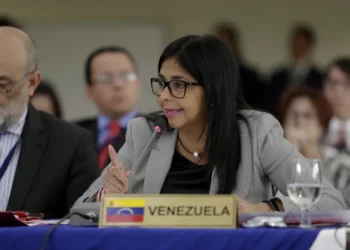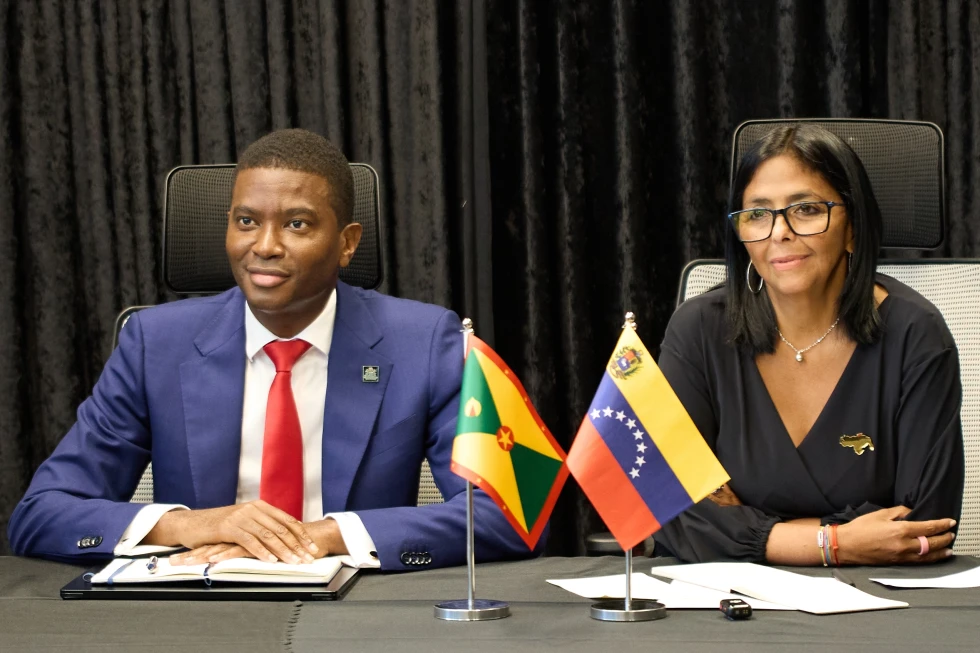
A diplomatic dispute between Venezuela and Guyana has intensified after Venezuela’s acting president, Delcy Rodríguez, wore a controversial pin depicting a disputed territory during official state visits, prompting formal protests from Georgetown.
The pin, shaped like the resource-rich Essequibo region, represents an area administered by Guyana but claimed by Venezuela. Guyanese officials say the symbol effectively asserts Venezuela’s territorial claim, raising concerns over diplomatic signaling and regional stability.
Reporting from The Associated Press indicates that Guyana has formally complained to Caribbean leaders, warning that the display of such imagery during official engagements could be interpreted as tacit support for Venezuela’s position in the long-running dispute.

Diplomatic Pressure Builds Over Venezuela-Guyana Dispute
Guyana’s President Irfaan Ali has urged regional partners to take a clear stance, emphasizing that symbolic gestures like the pin risk undermining international legal processes.
In a communication to Caribbean Community leaders, Ali warned that allowing such symbols during official visits could be seen as “acquiescence or tolerance” of Venezuela’s territorial claim.
The issue has gained traction across the Caribbean, where governments have sought to balance diplomatic engagement with Venezuela against longstanding support for Guyana’s sovereignty.
Strategic Stakes Rise Around Essequibo Region
The controversy centers on the Essequibo region, a vast and resource-rich area that makes up roughly two-thirds of Guyana’s territory and has been the focus of a decades-long dispute between the two देशों.
The case is currently before the International Court of Justice, where Guyana is seeking a legal affirmation of its borders. Officials in Georgetown argue that Venezuela’s symbolic assertions—such as maps and insignia—could complicate or politicize the judicial process.




Rodríguez has defended wearing the pin, saying it reflects Venezuela’s longstanding view of its territorial boundaries and expressing confidence that international legal proceedings will support Caracas’ position.
Regional Stability Tested by Symbolic Diplomacy
The dispute comes at a time of heightened geopolitical flux in Venezuela, following recent leadership changes and renewed efforts to build regional alliances.
Observers note that the increasing use of the Essequibo symbol by Venezuelan officials suggests a coordinated effort to reinforce domestic and international narratives around the claim.
At the same time, Guyana has warned that such actions risk escalating tensions, particularly as the country expands offshore oil production in waters near the disputed area—raising the economic stakes of the conflict.
International Response and Legal Implications
The Caribbean Community (Caricom) has reaffirmed its support for Guyana’s territorial integrity and called for a peaceful resolution through legal channels, underscoring the importance of maintaining regional stability.
Analysts say the dispute highlights how symbolic gestures—such as clothing or insignia—can carry significant diplomatic weight, particularly when tied to unresolved territorial claims.
With the case pending before international courts and tensions already elevated, further symbolic or policy moves by either side could deepen divisions and complicate mediation efforts.
Outlook: Symbolism Fuels Broader Geopolitical Risks
While the immediate dispute centers on a single emblem, its implications extend far beyond symbolism. The incident reflects deeper tensions over sovereignty, natural resources, and regional influence in northern South America.
As legal proceedings continue and diplomatic exchanges intensify, the Venezuela-Guyana dispute is likely to remain a focal point for regional diplomacy, with broader implications for international law and resource competition.