A second school shooting in southeastern Turkey within 48 hours is intensifying scrutiny over institutional safeguards, weapons access, and the state’s ability to contain emerging domestic security risks.
A deadly school shooting in Turkey’s Kahramanmaraş province on Wednesday has sharpened concerns over internal security vulnerabilities after an eighth-grade student opened fire inside a middle school, killing four people and wounding at least 20 others. The attack, which officials said left three students and one teacher dead, came less than a day after a separate shooting at another school in nearby Şanlıurfa province.
The back-to-back incidents are rare in Turkey’s modern domestic security landscape, where school shootings have historically been uncommon. The rapid succession of attacks is now shifting the focus away from isolated criminal violence and toward a more consequential question: whether existing institutional controls are showing signs of fragmentation under social and security pressure.

As first reported by Reuters, provincial governor Mükerrem Ünlüer said the student brought multiple firearms concealed in a backpack, with the weapons believed to belong to his father, a retired police officer. That detail is likely to intensify scrutiny over off-duty weapons storage, familial access, and enforcement gaps surrounding licensed firearms.
The timing of the attack — coming immediately after another school shooting in the same broader southern region — raises the possibility that Turkish authorities may now be confronting not merely separate acts of violence, but a potential contagion dynamic that tests the resilience of local prevention systems.
Command Fractures Surface Around Weapons Control
The most immediate pressure point emerging from the Kahramanmaraş shooting centers on weapons custody and the integrity of post-service police firearm controls.
Officials said the suspect arrived carrying five firearms and multiple magazines linked to his father, a former police officer. According to reporting by The Associated Press, investigators have not yet established motive, but the pathway through which a middle-school student obtained such an arsenal is already likely to become central to the inquiry.
This transforms the incident from a singular act of school violence into a broader institutional stress test. The issue is no longer only school security, but whether safeguards around former security personnel’s weapons are robust enough to prevent domestic leakage into civilian spaces.




The reputational risk for local authorities may deepen if the investigation finds procedural failures in storage, reporting, or post-retirement monitoring standards.
Deterrence Weakens as Violence Clusters Regionally
The second attack in two days has introduced a destabilizing pattern that could challenge confidence in regional deterrence mechanisms.
Tuesday’s shooting in Şanlıurfa, in which 16 people were wounded before the attacker killed himself, was initially treated as an exceptional event. Wednesday’s incident changes that assessment by creating a cluster pattern in geographically adjacent provinces.
For security planners, the clustering effect matters as much as the casualty toll. Rapid repetition can signal weaknesses in crisis communication, copycat prevention, emergency school protocols, or intelligence-sharing between provincial authorities.
Even absent evidence of direct linkage, the psychological effect of consecutive attacks can itself become a security variable, forcing the state to recalibrate how quickly local violence narratives spread and influence subsequent actors.
Institutional Confidence Faces a New Domestic Test
Turkey’s education and interior institutions now face a forward-looking credibility challenge: whether they can reassure the public that the incidents remain anomalies rather than indicators of a widening domestic threat vector.
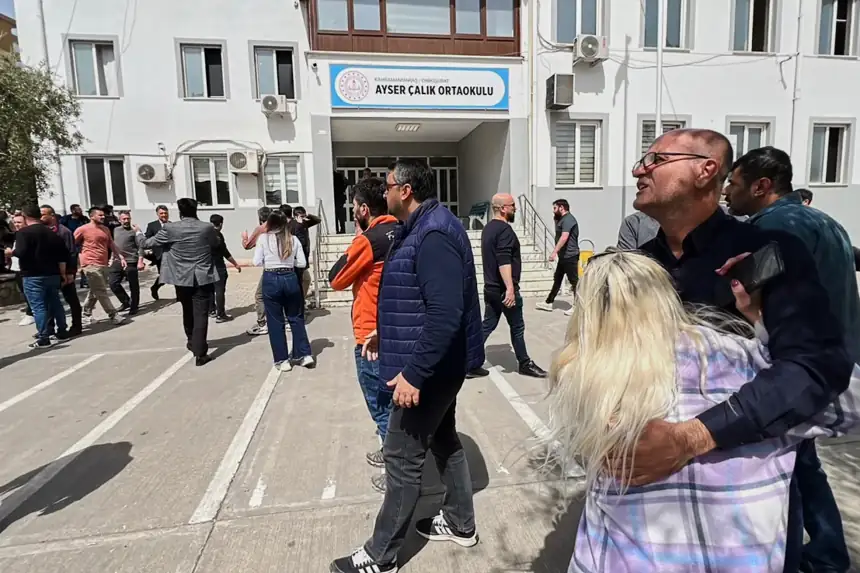
The scenes of parents rushing to school grounds and emergency teams securing the Onikişubat district underscore how quickly localized violence can evolve into a broader public confidence issue.
The strategic risk lies less in immediate casualty figures than in erosion of confidence across schools, families, and provincial governance networks. If two attacks in rapid succession reshape public expectations around school safety, the pressure will extend beyond policing into education policy, crisis messaging, and firearm oversight.
The coming investigation is therefore likely to carry significance beyond criminal accountability. Its broader implication is whether Turkey’s internal security architecture can absorb an unfamiliar pattern of school-based violence without allowing isolated attacks to evolve into a deeper institutional fracture line.