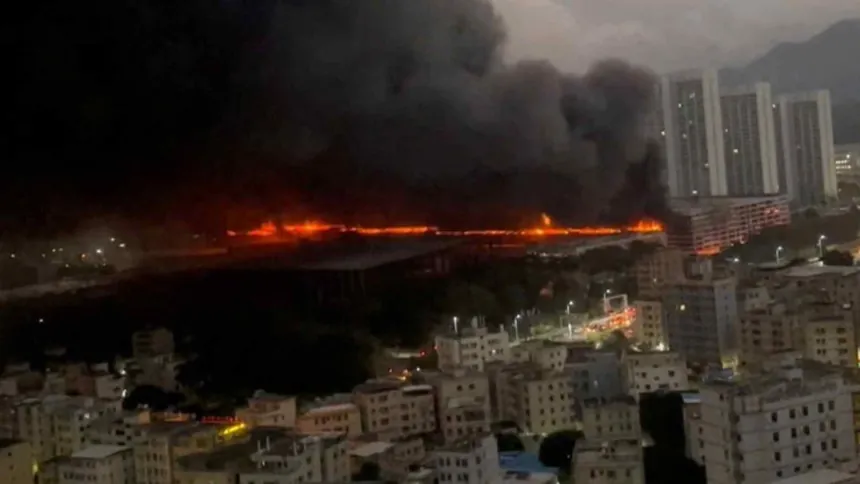
The blaze, confined to a storage area for test and scrapped vehicles, adds to scrutiny around EV fire-response protocols in major production hubs.
A fire at Chinese electric-vehicle giant BYD’s Shenzhen industrial complex has renewed focus on industrial safety and risk management in the EV sector, after the company said the blaze broke out in a parking garage used for “test and scrapped vehicles.” The fire was extinguished without casualties, according to company and local fire authorities, limiting the immediate operational impact but drawing wider attention because the site is tied to BYD’s global headquarters footprint in Shenzhen’s Pingshan district.
The dominant international framing here is strategic industrial resilience, as BYD remains central to global EV supply chains and China’s export-led automotive expansion. Any fire incident at a Shenzhen facility—particularly one associated with vehicle storage and testing—carries implications for investor confidence, battery-safety narratives, and the broader competitiveness debate between Chinese EV manufacturers and overseas rivals. Reuters reported that BYD shares slipped modestly after the incident, underscoring how even contained events can ripple through market sentiment.

Supply-Chain Confidence Faces a Reputational Test
Videos verified by Reuters showed thick black smoke and flames spreading across a long section of a multistory parking structure, with fire trucks and police rapidly deployed. While BYD emphasized that the affected vehicles were not customer deliveries but rather test and scrapped units, the imagery is likely to feed ongoing international scrutiny over how EV makers handle battery isolation, end-of-life storage, and fire suppression systems.
That distinction matters commercially. Storage areas for decommissioned or engineering-test vehicles often carry elevated fire risks because damaged battery packs can be unstable, particularly if they are awaiting teardown, diagnostics, or recycling. The absence of casualties and the fast containment response may help limit reputational fallout, but global regulators and insurers will still watch closely for findings on ignition source and structural safeguards.
Battery Safety Debate Extends Beyond China
The incident also lands at a sensitive time for the international EV industry, where fire risks remain politically and commercially significant. Experts cited by Reuters noted that EV fires often burn longer than internal-combustion vehicle fires and may reignite, complicating emergency response and increasing pressure on automakers to refine thermal-runaway prevention and scrappage procedures.
For BYD, which has aggressively expanded across Europe, Southeast Asia, and Latin America, the broader issue is not the isolated blaze itself but whether such incidents influence overseas regulators, fleet buyers, and consumers already weighing battery-safety assurances. As Chinese EV brands compete more directly with Western and Korean manufacturers, operational incidents at home can quickly become part of international trade and trust narratives.
Strategic Stakes Rise for China’s EV Leadership
Shenzhen is more than a factory location—it is a symbol of China’s leadership in next-generation mobility. A fire involving scrapped and test vehicles at such a flagship industrial base highlights the hidden risks embedded in the EV lifecycle, particularly around recycling, storage, and post-test engineering fleets.




The longer-term geopolitical implication is that as China’s EV makers dominate global growth, industrial incidents increasingly become strategic headlines, shaping perceptions of manufacturing quality, regulatory discipline, and technological trust. Even a contained fire with no injuries can influence how international markets assess resilience in the world’s most important EV supply ecosystem.