NEW YORK – Most U.S. stocks traded higher Tuesday as easing oil prices helped stabilize investor sentiment, although continued weakness in semiconductor shares weighed on technology stocks and kept the broader market mixed.
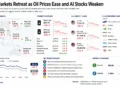
The S&P 500 was little changed in early trading as gains in several sectors offset declines in technology. By 9:35 a.m. EDT, the Dow Jones Industrial Average had gained 385 points, or 0.7%, while the Nasdaq Composite fell 0.6%, pressured by another round of losses among chipmakers.
Investor sentiment was supported by another wave of corporate earnings that exceeded Wall Street expectations.

Strong Earnings Lift Broader Market
Several major companies reported stronger-than-expected quarterly results, helping support gains outside the technology sector.
Coca-Cola rose 5.8% after reporting a 7% increase in spring-quarter revenue. Chief Executive Officer Henrique Braun said the company continued to perform well despite what he described as a “dynamic consumer landscape.”
Sherwin-Williams climbed 7%, while Illinois Tool Works gained 3.7% after both companies also posted quarterly profits that exceeded analysts’ forecasts.
Corporate earnings have remained a key driver of U.S. equity markets, with investors closely monitoring whether company performance can continue supporting stock valuations near record highs.
Semiconductor Stocks Extend Global Decline
Despite broader market strength, semiconductor companies remained under pressure as investors reassessed expectations for artificial intelligence-related growth.
■ Related News
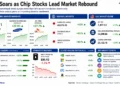
Micron Technology, whose shares have more than tripled this year, reported quarterly revenue for the period ending May 28 that was more than four times higher than a year earlier.
Even with those results, investors remained concerned that spending on AI infrastructure could slow if heavy investment fails to generate the expected returns in productivity and profitability. The emergence of lower-cost artificial intelligence models from China has also raised questions about future demand for advanced memory chips and computing capacity.
Micron shares fell 8.4%, making the company the largest drag on the S&P 500 during early trading. Advanced Micro Devices declined 7.7%, while Nvidia lost 1.1%.
The weakness extended beyond U.S. markets.
South Korea’s Kospi index fell 10.8% after sharp declines in SK Hynix and Samsung Electronics. According to The Associated Press, the losses were severe enough to trigger temporary trading halts on the Seoul exchange.
Morningstar equity analyst Jing Jie Yu said investors appeared concerned about China’s advances in semiconductor manufacturing and the potential impact on established global chipmakers and equipment suppliers.
Yu said, however, that the market reaction appeared excessive, describing the sell-off as largely a “knee-jerk reaction.” He added that leading global semiconductor companies are unlikely to face a significant competitive threat in the near term.
Falling Oil Prices Support Investor Sentiment
Energy markets extended their recent decline as immediate concerns over global crude oil supplies continued to ease.
Brent crude for October delivery fell 2.2% to $83.97 per barrel after briefly climbing above $102 per barrel last week amid fears that conflict in the Middle East could disrupt oil shipments.
Lower energy prices also supported the bond market.
The yield on the benchmark 10-year U.S. Treasury note declined to 4.62% from 4.65% at Monday’s close, reflecting stronger demand for government bonds.
Investors continue to monitor developments in global energy markets, corporate earnings and artificial intelligence spending as key factors influencing market direction.
This report is based on reporting by The Associated Press.