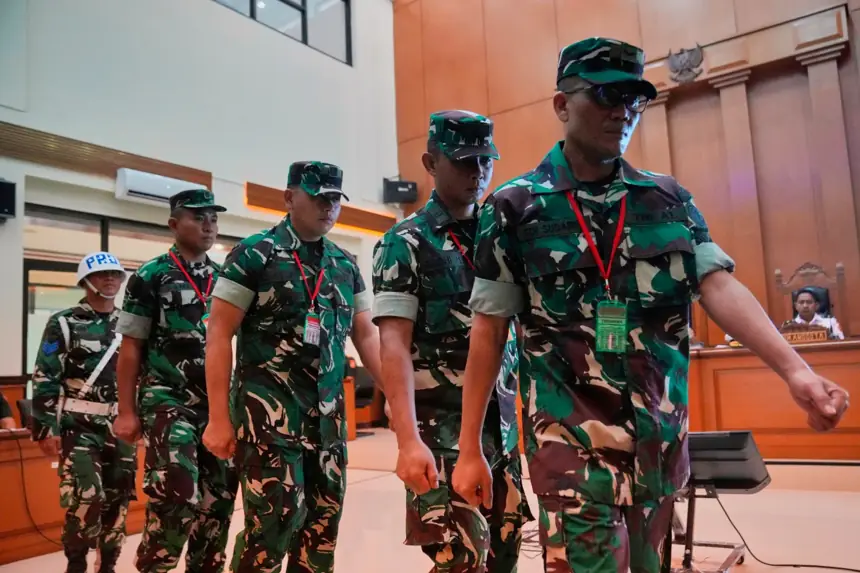
A military court in Indonesia has opened proceedings against four service members accused of carrying out an acid attack on a prominent anti-corruption investigator, a case that is drawing renewed international attention to judicial accountability and the role of the armed forces in civilian affairs. The trial is being closely watched by rights groups and foreign observers, who view it as a test of Indonesia’s commitment to legal transparency and institutional reform.
Judicial Scrutiny Intensifies Over Military Conduct
The defendants, all active members of Indonesia’s armed forces, face charges linked to a 2017 acid attack that left senior anti-corruption investigator Novel Baswedan severely injured. According to reporting from The Associated Press, prosecutors allege the accused coordinated and executed the assault, which blinded Baswedan in one eye and significantly damaged his vision.
Indonesian authorities have previously faced criticism over delays in bringing suspects to trial. Analysts interviewed by international media outlets note that the case has become emblematic of broader concerns about whether military personnel are held to the same legal standards as civilians.

Rule-of-Law Concerns Extend Beyond National Borders
The trial’s outcome carries implications beyond Indonesia, as regional partners and global governance organizations assess the country’s adherence to democratic norms. Legal experts cited by Reuters have emphasized that military courts handling cases involving civilian victims often raise questions about impartiality and transparency.
Observers say the proceedings could influence Indonesia’s standing in international anti-corruption frameworks, particularly given Baswedan’s role in investigating high-level graft cases. The attack itself had previously sparked global condemnation, with advocacy groups calling for an independent and transparent judicial process.
Pressure Mounts From Civil Society and International Observers
Civil society organizations within Indonesia, alongside international human rights groups, have urged authorities to ensure that the trial is conducted openly and without undue influence. In remarks carried by BBC News, activists stressed that accountability in this case is critical to restoring public trust in both law enforcement and the judiciary.
There is also growing pressure on the Indonesian government to demonstrate that institutional protections do not shield perpetrators from prosecution. Analysts told the Financial Times that a credible verdict could reinforce confidence in Indonesia’s reform trajectory, while any perceived shortcomings may deepen skepticism.
Strategic Stakes Rise for Governance and Reform Agenda
The case unfolds at a time when Indonesia is seeking to position itself as a stable democratic leader within Southeast Asia. Experts argue that how the government handles sensitive cases involving state actors will shape perceptions of governance and political maturity.




The trial also intersects with broader debates over the jurisdiction of military courts versus civilian judicial systems. Regional observers suggest that reforms in this area could have lasting implications for civil-military relations across emerging democracies.
Conclusion
As the trial progresses, its outcome is expected to carry significant weight in determining Indonesia’s credibility on legal accountability and anti-corruption enforcement. International stakeholders will be watching closely for signals that the country’s institutions can uphold justice transparently, particularly in cases involving powerful state actors.