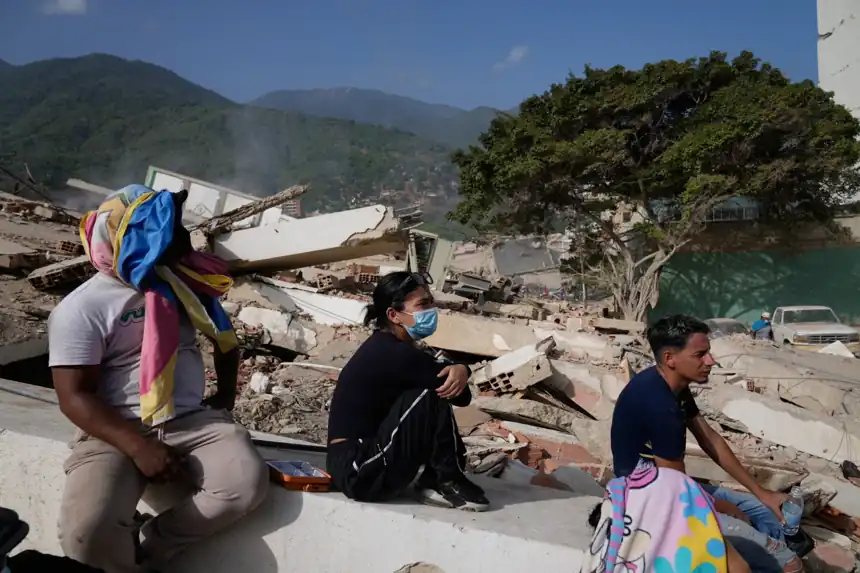
CARACAS, Venezuela — Thousands of Venezuelans remain without permanent shelter after two powerful earthquakes devastated parts of the country, forcing families to sleep in cars, parks, public squares, and open spaces while authorities continue search-and-rescue operations and assess damaged buildings.
The twin earthquakes, measuring 7.2 and 7.5 in magnitude, struck Venezuela just 39 seconds apart on Wednesday evening, causing widespread destruction in Caracas and neighboring regions. Hundreds of buildings suffered severe structural damage, while the death toll has climbed into the hundreds and is expected to increase as emergency crews search through collapsed structures.
The disaster has created a new humanitarian challenge in a country already struggling with years of economic hardship. Before the earthquakes, humanitarian agencies estimated that nearly 8 million Venezuelans required assistance, while more than half of the population was living in extreme poverty.

Families forced to create makeshift shelters
For many residents, vehicles have become temporary homes as they wait for government officials to determine whether damaged buildings remain safe.
Francisco Quintero, a musician from Caracas, said his family now spends each night near their aging car after evacuating their apartment building. His children sleep inside the vehicle while the trunk houses the family’s pet parakeet and several turtles.
Quintero said adults in the family search each evening for somewhere nearby to rest while they wait for authorities to decide what assistance may become available.
Across the capital and surrounding communities, similar scenes have emerged as displaced residents gather beneath trees, on roadside shoulders, and in public parks with only a few personal belongings.
Hard-hit communities struggle with uncertainty
In the coastal state of Guaira, one of the areas most heavily affected by the earthquakes, families have occupied a baseball field after losing their homes.


Alexandra Martínez, who arrived with her two children, said her apartment suffered catastrophic structural damage.
“The apartment is completely wrecked,” she said. “The walls, the kitchen, everything, are destroyed. It split right down the middle.”
Many displaced residents have spread blankets across open ground or sought shade beneath trees while waiting for emergency assistance.
Residents await safety inspections
In Caracas, thousands of people remain reluctant to return to homes that are still standing but show visible signs of structural damage.
Desiré Gil said she and her family have been sleeping in a grassy public plaza because they fear their apartment building could collapse.
“We have nowhere to live,” she said. “This is the only option we have for the moment.”
Gil explained that although their building remains standing, sections of the structure have begun crumbling, making it too dangerous to occupy.
Many residents are waiting for Venezuela’s civil protection agency to inspect damaged buildings before deciding whether they can safely return home.
However, authorities have not announced when widespread inspections will begin, as emergency services remain focused on rescue operations in the country’s hardest-hit regions.
According to officials, at least 920 people have died and more than 3,300 have been injured, while thousands more remain unaccounted for.
Hospitals and shelters face growing pressure
The earthquakes have also strained Venezuela’s healthcare system.
Gil said her pregnant daughter experienced contractions and sought treatment at a local hospital but was turned away because part of the maternity ward had collapsed and medical facilities were already overwhelmed by earthquake victims.
The Ministry of Education announced that some school buildings would be converted into temporary shelters, although officials have not confirmed how many facilities will be available for displaced families.
For now, many survivors say they have little choice but to remain outdoors until longer-term housing arrangements are established.
Older buildings face heightened seismic risk
Engineering experts said much of the destruction reflects the age of Venezuela’s building stock.
Civil engineer and university professor José Rangel said more than half of Caracas was constructed before the country’s updated seismic building code was introduced in 1982.
He told state television that buildings erected before those standards were implemented remain particularly vulnerable during major earthquakes.
Rangel said engineers had already been developing plans to strengthen schools, hospitals, bridges, and other essential infrastructure before the disaster struck.
He emphasized that evaluating damaged buildings will likely require weeks and urged engineers and architects across the country to participate in inspection efforts.
“The causes of the collapse must be determined,” Rangel said. “It’s how we learn lessons after an earthquake.”
Long recovery expected for displaced communities
Among those awaiting inspections is Magaly Noguera, whose high-rise apartment building sustained damage during the earthquakes.
She recalled sheltering with family members beneath a kitchen doorway before making what felt like an endless descent down the building’s stairwell to safety.
“I don’t want to be in my house,” she said.
Noguera and her family now sleep outdoors near a government building alongside many other displaced residents.
Elsewhere across Caracas, families continue carrying mattresses, blankets, and whatever possessions they managed to save as they search for safe places to spend the night while Venezuela begins what is expected to be a lengthy recovery process.
Tags: Venezuela, Caracas, Earthquake, Humanitarian Crisis, Natural Disaster, Guaira, Search and Rescue, Housing, Emergency Response, Seismic Safety, Infrastructure, Displaced Families