U.S. equities edged lower on Tuesday as renewed uncertainty surrounding geopolitical tensions with Iran weighed on investor sentiment and pushed energy prices higher. The pullback follows a prior session rally linked to comments from Donald Trump suggesting potential diplomatic progress in the Middle East, a development that initially eased market concerns over supply disruptions.
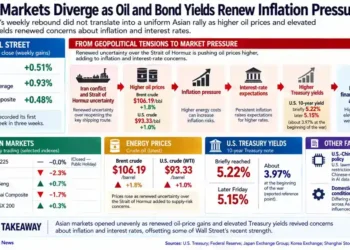
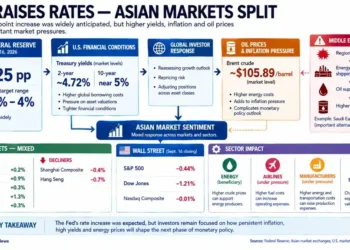
The S&P 500 declined 0.4% to 6,556.37, while the Dow Jones Industrial Average fell 0.2% to 46,124.06. The Nasdaq Composite recorded a sharper drop of 0.8% to 21,761.89, reflecting broader weakness in technology shares. Market data reported by the Associated Press indicates that equities have fluctuated in response to shifting signals on the trajectory of the conflict and its economic implications.
Oil Prices Rebound Amid Ongoing Supply Concerns
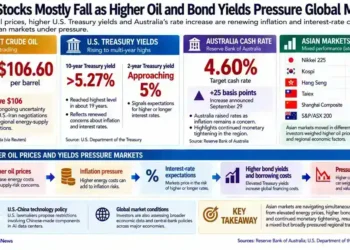
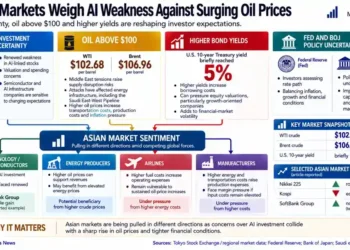
Crude markets reversed earlier losses, highlighting persistent concerns about potential disruptions to global energy flows. Brent crude rose 4.6% to settle at $104.49 per barrel, while West Texas Intermediate increased 4.8% to $92.35 per barrel, according to market pricing data.

The rebound follows a sharp decline in the previous session, when optimism over possible diplomatic engagement temporarily eased fears of supply constraints in the Persian Gulf. However, conflicting developments—including continued regional attacks and official denials of direct negotiations—have sustained volatility in energy markets.
Analysts note that elevated oil prices could feed into broader inflationary pressures, particularly if supply risks persist over an extended period.
Treasury Yields Rise, Challenging Equity Valuations
U.S. government bond yields moved higher, reflecting changing expectations around monetary policy. The yield on the 10-year U.S. Treasury increased to 4.39%, compared with 4.34% in the previous session and 3.97% prior to the escalation in the Middle East conflict.
Shorter-duration yields also climbed, with the two-year Treasury yield rising to 3.92% from 3.83%, signaling a reassessment of near-term interest rate expectations.
Higher yields typically tighten financial conditions by increasing borrowing costs for households and corporations. They also weigh on equity valuations by raising the discount rate applied to future earnings, contributing to downward pressure on stock prices.
■ Related News



Rate Cut Expectations Recede as Inflation Risks Mount
Market participants have adjusted expectations for U.S. monetary policy in response to rising energy costs. According to data from CME Group, traders have largely scaled back expectations for interest rate cuts by the Federal Reserve in 2026.
In contrast, some derivatives pricing now reflects the possibility of additional rate increases, a shift from earlier projections that anticipated policy easing. This reassessment underscores concerns that higher oil prices could sustain inflationary pressures, complicating the central bank’s policy trajectory.
Commodity Markets Reflect Shifting Risk Appetite
Gold prices continued to decline despite geopolitical uncertainty, diverging from its traditional role as a safe-haven asset. Spot gold settled at $4,402 per ounce, significantly below its peak earlier in the month.
The decline reflects competition from higher-yielding assets, as rising Treasury rates reduce the relative attractiveness of non-interest-bearing assets such as gold. Analysts indicate that the adjustment also points to moderating speculative demand following a period of record highs.
Corporate Developments Highlight Sector Divergence
Individual stocks reflected company-specific developments amid broader market volatility. Estée Lauder shares declined 9.8% after confirming discussions regarding a potential merger with Spain-based Puig. The company stated that no final agreement has been reached.
In contrast, Smithfield Foods reported quarterly earnings and revenue exceeding analyst expectations, driving its shares 4.3% higher.
Global Markets Mixed as Asia Responds to Diplomatic Signals
International equity markets showed mixed performance. European indices posted varied results, while Asian markets recorded gains in their first trading session following the diplomatic comments from Washington.
Hong Kong’s Hang Seng Index advanced 2.8%, and South Korea’s KOSPI rose 2.7%, reflecting regional optimism over potential de-escalation.