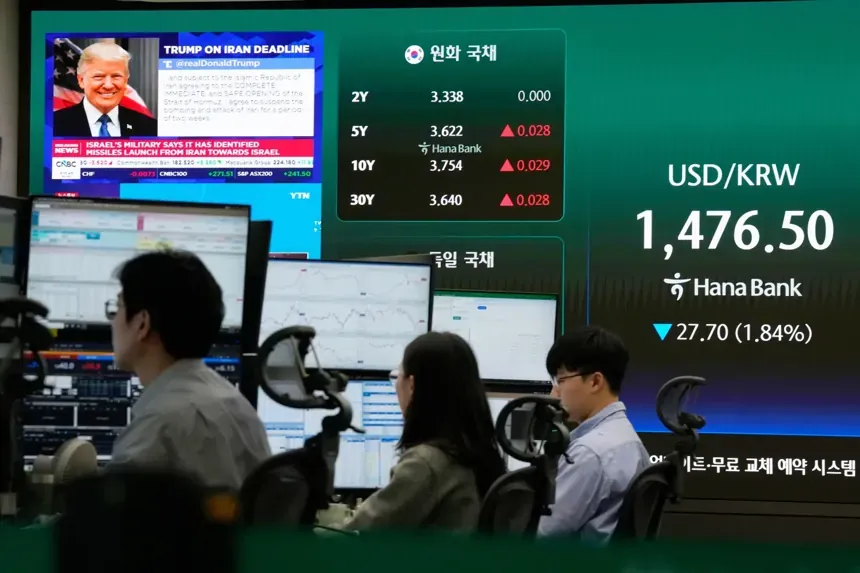
Wall Street futures and global equities advanced sharply on Wednesday after a two-week U.S.-Iran ceasefire agreement eased fears of prolonged supply disruption through the Strait of Hormuz, driving crude prices back below the $100-a-barrel threshold. The dominant business angle is market reaction, with investors rapidly repricing inflation risk, transport costs, and global growth expectations. Reuters reported Brent crude falling more than 13% toward $95 while U.S. crude dropped roughly 15% to near $96, triggering a broad relief rally across stocks and bonds.
The reopening of the Strait of Hormuz, which handles roughly one-fifth of global oil transit, materially reduced the near-term supply shock that had supported elevated energy prices for weeks. Equity futures reflected that shift immediately: Nasdaq futures outpaced gains in the Dow and S&P 500 as lower yields and reduced inflation concerns improved sentiment toward growth-sensitive sectors. Analysts said the move was less a sign of full normalization than a rapid unwind of war-risk premiums embedded in global assets.
Oil Retreat Reshapes Inflation and Rate Expectations
The steep fall in crude was the central macroeconomic catalyst behind the rally. With Brent and WTI both moving below $100, traders scaled back expectations of a fresh inflation surge that had been building during the conflict-driven shipping disruption. That adjustment was visible in sovereign debt markets, where benchmark U.S. Treasury yields moved lower as investors reassessed the probability of additional policy tightening.

The 10-year U.S. Treasury yield fell toward 4.26%, according to Reuters market data, reflecting easing concern that higher fuel costs would spill into broader consumer prices. Lower oil also eased pressure on transportation, manufacturing, and consumer discretionary sectors, all of which had faced margin compression risks during the five-week escalation.
Sector Rotation Favors Airlines, Pressures Energy
The most immediate equity response came through sector rotation. Airline and travel-linked stocks led premarket gains as lower jet fuel expectations improved operating margin assumptions ahead of the northern hemisphere summer season. Delta, United, and American Airlines all posted double-digit premarket advances in early trading indicators, supported by both fuel relief and resilient booking trends.
By contrast, oil majors and exploration companies came under pressure as the geopolitical premium embedded in crude futures evaporated. Reuters said global energy stocks were among the weakest performers, with major U.S. producers and European integrated oil companies retreating between 4% and 6% in early sessions. The reversal underscores how quickly energy-sector leadership can fade when supply-route risk normalizes.
Europe and Asia Extend the Relief Rally
The repricing was not confined to U.S. markets. European benchmarks posted some of their strongest single-session gains in months, while Asia-Pacific equities closed sharply higher as exporters, semiconductor names, and industrials benefited from improved risk appetite. Japan’s Nikkei, South Korea’s Kospi, and major European indexes all moved decisively upward as investors rotated back into cyclical exposure.
Still, analysts cautioned that the market move depends heavily on whether tanker insurers, shippers, and commodity traders regain confidence in the Strait’s operating stability. A temporary ceasefire reduces immediate stress, but sustained normalization in freight flows remains the key variable for whether this develops into a durable macro recovery trade.
■ Related News