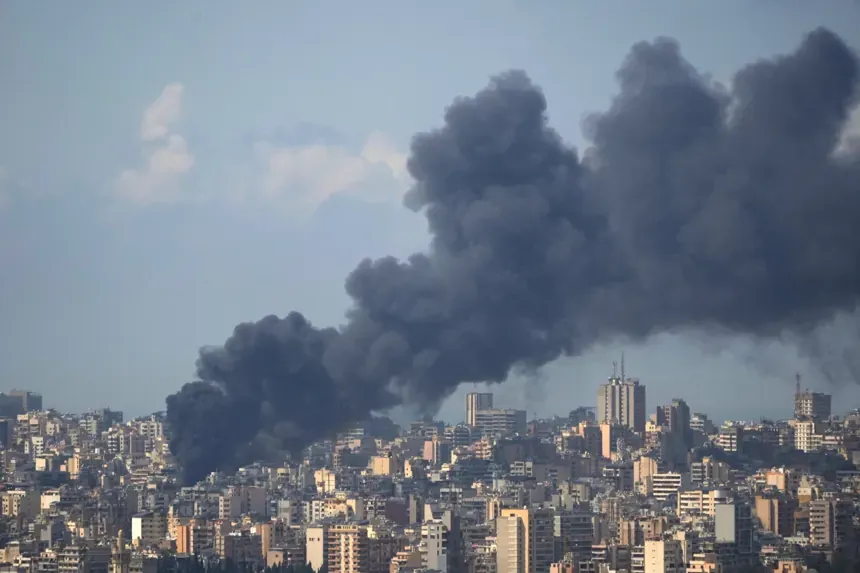
BEIRUT — Israeli airstrikes on densely populated districts of central Beirut on Wednesday sharply escalated the regional conflict, underscoring that the newly announced Iran-related ceasefire has failed to contain hostilities on the Lebanon front. The strikes, which Lebanese officials said killed dozens and wounded hundreds in initial estimates, immediately heightened fears of a broader destabilization across the eastern Mediterranean.
The bombardment marked one of the most significant attacks on Beirut’s commercial and residential core since the current Israel-Hezbollah war expanded in early March. According to reporting from The Associated Press, Israeli forces described the operation as a coordinated assault on more than 100 Hezbollah-linked sites in Beirut, southern Lebanon and the Bekaa Valley, while Lebanon’s leadership said civilian neighborhoods bore the brunt of the strikes.
For international observers, the latest escalation exposes the fragility of the Pakistan-mediated ceasefire framework that had been expected to reduce violence after the U.S.-Israeli confrontation with Iran. Instead, Lebanon has emerged as the unresolved theater most likely to test whether regional mediation efforts can prevent a wider strategic spillover.

Diplomatic Pressure Builds
Lebanese officials framed the strikes as a direct blow to ongoing de-escalation efforts. Social Affairs Minister Haneed Sayed described the attacks as a “dangerous turning point,” emphasizing that many internally displaced civilians had sought refuge in the targeted areas of Beirut.
Prime Minister Nawaf Salam separately accused Israel of intensifying operations just as Beirut was signaling readiness for negotiations aimed at ending cross-border hostilities. The criticism is likely to amplify calls from European and regional governments for Lebanon to be formally folded into the wider ceasefire architecture now centered on Iran.
The diplomatic significance extends beyond Lebanon itself. If mediators fail to bridge the gap between the Iran truce and the Israel-Hezbollah battlefield, the ceasefire risks being viewed less as a regional de-escalation framework and more as a narrow bilateral pause with limited strategic durability.
Regional Stability Tested
Israel’s military said the strikes targeted missile launch infrastructure, intelligence assets and Hezbollah command sites, again accusing the group of embedding military capabilities in civilian districts. Residents and municipal officials in Beirut disputed those claims, saying the hit buildings were residential and commercial properties.
That dispute is geopolitically consequential. Competing narratives over whether civilian infrastructure is being militarized will likely shape the next phase of international legal scrutiny, especially as Lebanon seeks broader diplomatic backing at the United Nations and among Western capitals.




The return of major strikes to central Beirut also signals that the conflict’s urban geography is widening, a factor that raises the risk of deeper humanitarian and economic damage in Lebanon’s most internationally connected city.
Humanitarian Risks Intensify
The renewed strikes came as displaced families had begun preparing to return home following news of the Iran ceasefire. That fragile sense of relief quickly gave way to renewed uncertainty after Israeli officials made clear the Lebanon campaign would continue.
The reversal has compounded the displacement crisis already affecting more than one million people across Lebanon. For humanitarian agencies and donor governments, the immediate concern is whether sustained bombardment of Beirut and other urban centers could overwhelm shelter systems, hospitals and aid corridors already under severe pressure.
A prolonged mismatch between diplomatic announcements and battlefield realities may also deepen civilian mistrust in mediation efforts, complicating future ceasefire enforcement.
Strategic Stakes Rise
Hezbollah has so far signaled conditional openness to mediation while refusing to return to previous ceasefire terms that, according to the group, allowed Israel to continue near-daily strikes. Reuters reporting indicates the group has paused some attacks while awaiting clarification from mediators, but the latest Beirut strikes make that restraint increasingly difficult to sustain.
The strategic stakes now center on whether Lebanon becomes the pressure valve through which the wider Iran-Israel confrontation continues indirectly. Any collapse in mediation could draw in additional regional actors, threaten maritime confidence in the eastern Mediterranean, and complicate Western diplomatic efforts already focused on Gulf security and the Strait of Hormuz.
The next 48 hours are likely to determine whether international mediation evolves into a broader Lebanon-inclusive framework or whether Beirut becomes the focal point of the region’s next major escalation.