The United States carried out large-scale military strikes in Syria on Friday, targeting Islamic State fighters and infrastructure days after an ambush killed two U.S. service members and an American civilian interpreter. U.S. officials said the operation was intended to disrupt the group’s ability to carry out further attacks and to signal a firm response following the deaths.
The strikes, confirmed by the Pentagon and U.S. Central Command, come as Washington maintains a limited military presence in eastern Syria as part of the international campaign against Islamic State, nearly a decade after the group lost its territorial stronghold.
Scope of the military operation
A U.S. official described the action as a “large-scale” strike that hit about 70 targets linked to Islamic State across central Syria. The targets included weapons storage facilities and other infrastructure used by the militant group, according to officials who spoke on condition of anonymity to discuss sensitive military operations.
U.S. Central Command said American aircraft, helicopters, and artillery fired more than 100 precision-guided munitions during the operation. Officials said additional strikes could follow, depending on assessments of damage and ongoing threats.
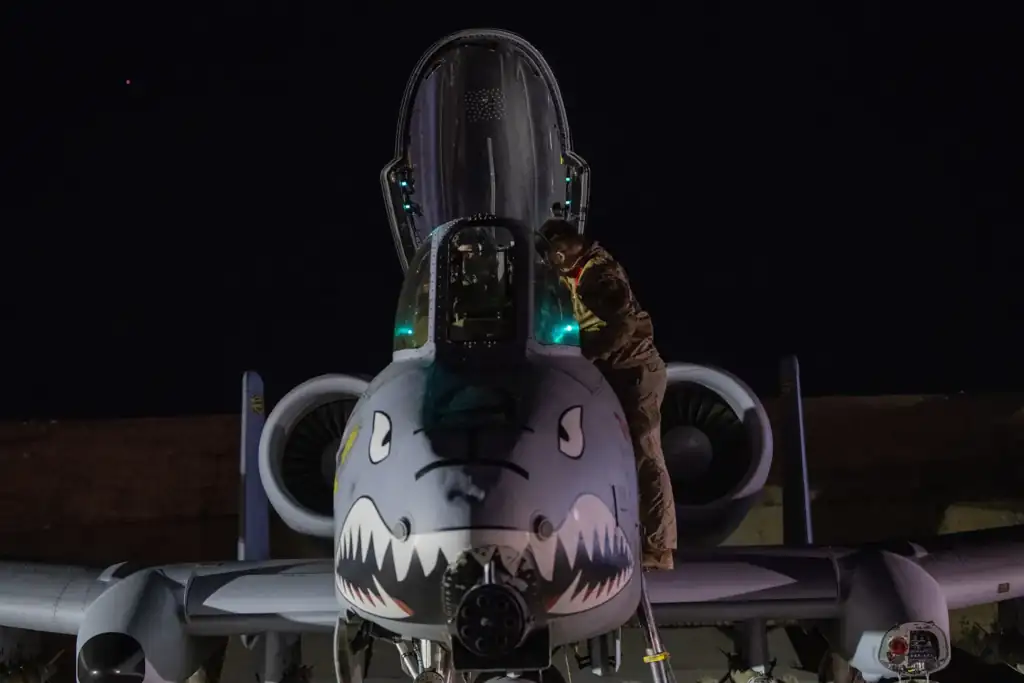
The Pentagon said the operation involved a mix of air and ground-attack capabilities, including F-15 Eagle and F-16 fighter jets, A-10 Thunderbolt aircraft, AH-64 Apache helicopters, and HIMARS rocket artillery. Some aircraft were launched from regional bases, including from Jordan, officials said.
Defense Secretary Pete Hegseth said in a social media post that the strikes were aimed at eliminating Islamic State fighters and weapons sites, describing the action as a direct response to the recent killings of Americans.
Trump orders retaliation after attack
President Donald Trump pledged retaliation earlier this week after the shooting in the Syrian desert, which U.S. officials attributed to Islamic State. The attack occurred near the ancient city of Palmyra, an area where U.S. forces operate alongside local partners against remnants of the group.
In public remarks and online posts, Trump said the strikes were directed at Islamic State “strongholds” and warned the group against any future attacks on U.S. personnel. He emphasized that the United States would respond forcefully to threats against its forces.
Hundreds of U.S. troops remain deployed in eastern Syria as part of a multinational coalition focused on preventing Islamic State from regrouping after its defeat as a territorial entity in 2019. The group, while significantly weakened, has continued to carry out sporadic attacks against military and security targets.
U.S. priorities and regional posture
The new operation comes as the Trump administration has signaled an intention to focus more military and security resources closer to the Western Hemisphere. In recent weeks, U.S. officials have highlighted expanded maritime operations in the Caribbean aimed at countering drug trafficking and enforcing sanctions on oil shipments linked to Venezuela.
As part of that shift, some U.S. military assets have been redeployed from the Middle East. The Navy’s most advanced aircraft carrier moved last month from the Mediterranean Sea to South American waters, reflecting changing priorities, though officials have stressed that counterterrorism missions in the Middle East remain active.
Syria’s response and cooperation
The strikes are a significant moment for U.S.-Syria relations following the ouster of longtime leader Bashar Assad about a year ago. Washington has gradually increased coordination with Syrian security forces under President Ahmad al-Sharaa, whom Trump has publicly backed in recent days.
Trump said al-Sharaa supported the U.S. action and was angered by the attack on American forces. Syrian officials have acknowledged cooperation with U.S. troops in counterterrorism efforts, particularly against Islamic State cells operating in remote areas.
Syria’s foreign ministry said in a statement on X that the attack on U.S. personnel underscored the need for stronger international cooperation against terrorism. The ministry said Syria remained committed to combating Islamic State and preventing the group from establishing safe havens.
Syrian state television reported that U.S. strikes hit targets in rural parts of Deir ez-Zor and Raqqa provinces, as well as in the Jabal al-Amour area near Palmyra. It said the sites included weapons depots and command locations used by Islamic State fighters.
Islamic State activity and claims
Islamic State has not publicly claimed responsibility for the attack that killed the Americans. However, the group has claimed other recent assaults on Syrian security forces, including one in Idlib province that killed four Syrian soldiers.
In its statements, the group has labeled Syria’s current leadership and military as “apostates,” reflecting its longstanding hostility toward rival factions. President al-Sharaa previously led a group affiliated with al-Qaida but has had a prolonged and violent rivalry with Islamic State.
Americans killed in the attack
The U.S. service members killed were identified as Sgt. Edgar Brian Torres-Tovar, 25, of Des Moines, and Sgt. William Nathaniel Howard, 29, of Marshalltown. The civilian victim was Ayad Mansoor Sakat of Macomb, Michigan, who was working as an interpreter for U.S. forces.
The attack also wounded three additional U.S. troops and members of Syria’s security forces. The assailant was killed at the scene.
According to Syria’s Interior Ministry, the gunman had joined internal security forces as a base guard about two months earlier and had recently been reassigned due to suspicions of possible Islamic State ties. Officials said he opened fire during a meeting between U.S. and Syrian security personnel who were having lunch together after clashing with Syrian guards.
Trump met privately with the families of those killed at Dover Air Force Base in Delaware before attending the dignified transfer ceremony, a formal military ritual honoring service members who die in combat.
This article was rewritten by JournosNews.com based on verified reporting from trusted sources. The content has been independently reviewed, fact-checked, and edited for accuracy, neutrality, tone, and global readability in accordance with Google News and AdSense standards.
All opinions, quotes, or statements from contributors, experts, or sourced organizations do not necessarily reflect the views of JournosNews.com. JournosNews.com maintains full editorial independence from any external funders, sponsors, or organizations.
Stay informed with JournosNews.com — your trusted source for verified global reporting and in-depth analysis. Follow us on Google News, BlueSky, and X for real-time updates.