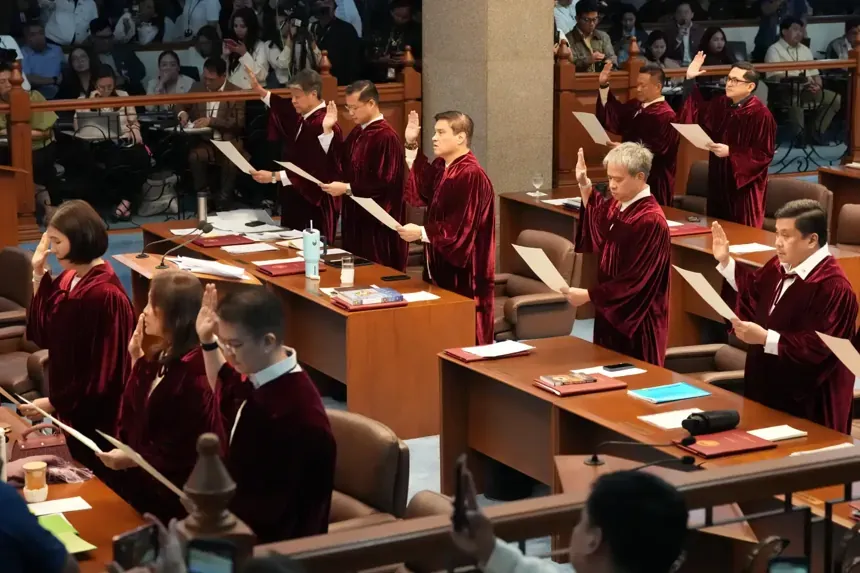
The Philippine Senate formally convened as an impeachment court Monday to begin proceedings against Vice President Sara Duterte, escalating a political confrontation that has exposed deep fractures within the country’s governing establishment.
Senators took their oaths as judges in Manila as the upper chamber prepared to hear impeachment charges tied to alleged misuse of public funds, unexplained wealth, and threats against President Ferdinand Marcos Jr. and his allies. The proceedings come amid growing institutional tensions and public demonstrations by both Duterte supporters and critics.
The impeachment trial carries major political implications ahead of the Philippines’ 2028 presidential election, where Duterte is widely viewed as a potential contender. Under Philippine law, a conviction would remove her from office and bar her from holding future public positions.

Political Rivalry Intensifies
The case marks a dramatic deterioration in relations between the Marcos and Duterte political camps, once allies during the 2022 national elections. Analysts say the impeachment battle now reflects a broader power struggle between two of the Philippines’ most influential political dynasties.
The House of Representatives voted overwhelmingly earlier this month to impeach Duterte after lawmakers endorsed accusations involving confidential state funds and alleged threats against senior officials. Duterte has denied wrongdoing and described the impeachment effort as politically motivated.
Tensions surrounding the proceedings intensified further following a chaotic confrontation inside the Senate last week linked to Senator Ronald dela Rosa, a close Duterte ally wanted by the International Criminal Court over allegations tied to former President Rodrigo Duterte’s anti-drug campaign.
Authorities said gunfire erupted during an attempted arrest operation inside the Senate compound, although no injuries were reported. The incident heightened concerns over political instability and institutional divisions in the country.
International Scrutiny Grows
The impeachment proceedings are unfolding alongside mounting international attention on the Philippines’ human rights record and democratic institutions. Rodrigo Duterte remains under scrutiny by the International Criminal Court over allegations connected to thousands of deaths during his administration’s anti-drug crackdown.
■ Related News




Sara Duterte has accused the Marcos administration of enabling political persecution against her family, including actions linked to international legal cases involving her father. President Marcos has publicly denied interfering in the impeachment process, insisting that Congress must independently carry out its constitutional role.
Under Philippine constitutional rules, at least two-thirds of the 24-member Senate must vote to convict the vice president. Political observers noted that shifting alliances within the chamber could significantly influence the outcome of the trial.
Institutional Stability Under Pressure
The proceedings have become one of the most consequential constitutional confrontations in the Philippines in recent years, testing the balance of power between the executive branch, Congress, and the judiciary.
The Senate impeachment court was convened under the leadership of Senate President Alan Peter Cayetano, whose recent rise to the chamber’s top position was supported by Duterte allies. Analysts say the evolving political alignments could complicate efforts to secure a conviction.
Public protests have continued in Manila as rival political factions mobilize supporters, while security around government institutions has been strengthened amid fears of further unrest.