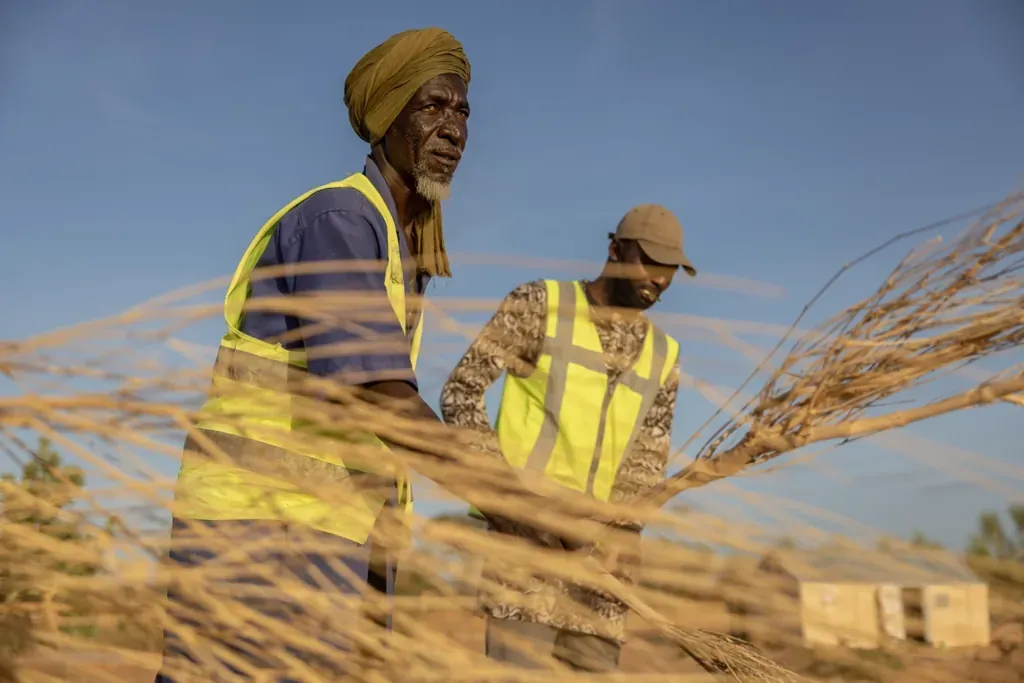
As bushfires increasingly threaten lives and livelihoods in Mauritania’s arid southeast, refugee volunteers from neighboring Mali have become a critical line of defense. Backed by the United Nations, the firefighters work alongside local authorities to contain fast-moving blazes, offering protection to both refugee camps and host communities under growing climate pressure.
In the vast desert near the Malian border, fires can ignite suddenly and burn for days, destroying scarce grazing land essential to survival. For the refugees who fled violence at home, fighting fires has become a way to give back to the country that offered them safety.
Training in a harsh landscape
As the sun drops over the desert near the Mbera refugee camp, groups of men line up, swaying in rhythm as they strike dry ground with thin tree branches. There is no fire on this evening, but the drill continues. The technique, honed over years, is designed to smother flames in an environment where water is scarce or unreachable.
More than 250,000 Malian refugees now live in Mauritania, many concentrated in and around Mbera, about 48 kilometers from the Malian border. Like the local population, most depend on livestock and the fragile vegetation that sustains it. When fires sweep through, the consequences can be immediate and severe.
Hantam Ag Ahmedou, now a firefighter himself, was 11 when his family fled Mali in 2012. He said the generosity of the host communities left a lasting impression on the refugees.
“We said to ourselves: there is this generosity of the host community,” he told The Associated Press. “We needed to do something to lessen the burden.”
An old method, adapted by newcomers
Ag Ahmedou’s father was among those who helped organize the first volunteer firefighting groups inside the refugee population. At the time, about 200 refugees joined efforts that local Mauritanians had already been carrying out for decades.
What the refugees added was experience from similar environments in Mali. In the open desert, water is rarely an option.
“You cannot stop bushfires with water,” Ag Ahmedou said. “That’s impossible. Fires sometimes break out a hundred kilometers from the nearest water source.”
Instead, firefighters use branches, particularly from acacia trees, which are resistant to heat. By beating the fire’s edge and cutting off oxygen, they can gradually halt its advance.
A growing volunteer brigade
Since 2018, the volunteer force has operated under the patronage of the United Nations High Commissioner for Refugees. Funding from the European Union supports training, basic equipment, and the clearing of firebreaks designed to slow or stop spreading flames.
Today, the group counts more than 360 refugee volunteers. They work closely with regional authorities and local firefighting services. When an alert comes in, teams load into pickup trucks and head into the desert.
At a fire site, a 20-member unit spreads out along the perimeter, striking the ground in coordinated movements. Additional teams remain on standby in case the first group needs relief, as fires can take hours or days to contain.
Ag Ahmedou began accompanying the brigade as a teenager, carrying food and water for the crews. He joined active firefighting at 18 and has since helped extinguish hundreds of blazes.
He acknowledges the risks but says fear cannot be allowed to dictate action.
“If the fire is not stopped, it can penetrate the refugee camp and the villages, kill animals, kill humans, and devastate the economy of the whole region,” he said.
Climate change and rising pressure
Mauritania is among the countries most exposed to climate stress. About 90% of its territory lies within the Sahara Desert, and desertification has accelerated in recent years. The United Nations says climate change has intensified competition over grazing land and water, increasing the risk of tension between refugees and host communities.
Tayyar Sukru Cansizoglu, the UNHCR’s representative in Mauritania, said bushfires have become a shared threat.
“With climate change, even Mauritanians cannot find enough grazing land for their own cows and goats,” he said. “A single bushfire becomes life-threatening for everyone.”
When the first refugees arrived in 2012, authorities cleared land for Mbera camp, which now hosts more than 150,000 people. Another estimated 150,000 Malian refugees live in villages scattered across the surrounding region, in some areas outnumbering locals by a wide margin.
Chejna Abdallah, the mayor of the border town of Fassala, said pressure on natural resources, especially water, has fueled tensions.
Replanting what fire destroys
Firefighting is no longer the brigade’s only task. To counter vegetation loss, volunteers have begun establishing small plant nurseries across the desert. Acacia saplings are a priority, but this year the group also planted its first lemon and mango trees.
Abderrahmane Maiga, a 52-year-old firefighter, carefully waters a young seedling near Mbera, pressing soil into place with his hands.
“It’s only right that we stand up to help people,” he said.
Maiga recalls a major fire in 2014 that required dozens of refugees and local residents to battle flames for nearly 48 hours. By the end, several volunteers collapsed from exhaustion.
No easy future
As violence in Mali continues, many refugees see no possibility of returning home. Ag Ahmedou said he is keenly aware of local tensions but believes cooperation is the only viable path.
“This is the life I was born into — a life in the desert, a life of food scarcity and degraded land,” he said. “There is nowhere else to go.”
For him and others, fighting fires is part of a broader struggle for survival and coexistence.
“We cannot go to Europe and abandon our home,” he said. “So we have to resist. We have to fight.”
This article was rewritten by JournosNews.com based on verified reporting from trusted sources. The content has been independently reviewed, fact-checked, and edited for accuracy, neutrality, tone, and global readability in accordance with Google News and AdSense standards.
All opinions, quotes, or statements from contributors, experts, or sourced organizations do not necessarily reflect the views of JournosNews.com. JournosNews.com maintains full editorial independence from any external funders, sponsors, or organizations.
Stay informed with JournosNews.com — your trusted source for verified global reporting and in-depth analysis. Follow us on Google News, BlueSky, and X for real-time updates.