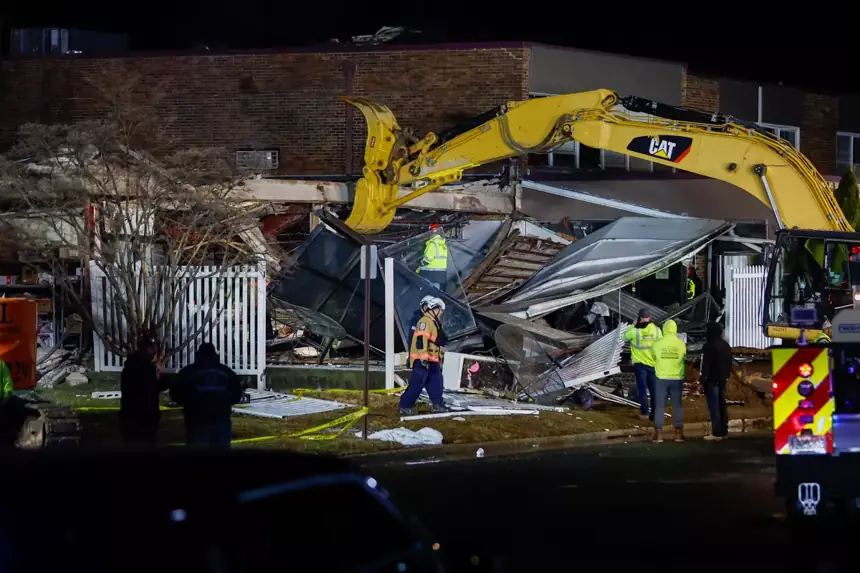
A deadly explosion at a Pennsylvania nursing home has rapidly evolved from a local emergency into a broader test of infrastructure resilience inside the long-term care sector. The blast at Bristol Health & Rehab Center killed at least two people, triggered a partial building collapse, and forced rescuers into a prolonged hand-search through unstable debris. As first reported by The Associated Press, utility crews had been responding to reports of a gas odor when the explosion struck, immediately placing facility safety systems and emergency escalation protocols under renewed scrutiny.
What makes the incident strategically significant is not only the loss of life, but the institutional setting: nursing homes concentrate medically vulnerable residents in buildings where evacuation windows are narrow and infrastructure failures carry amplified human consequences. The result is a story no longer confined to one Pennsylvania township, but one that raises larger questions about gas monitoring, maintenance standards, and crisis readiness across elder-care facilities nationwide.
Rather than centering solely on the immediate cause, the emerging editorial angle points toward institutional resilience under pressure—how quickly a care facility, first responders, and utility systems can absorb and survive cascading infrastructure failure.

Emergency Response Faces Its Hardest Test
Fire officials remained in rescue mode for hours after the blast, deploying search dogs, sonar, and heavy machinery while crews dug through the collapsed section by hand. The scale of the response underscored how quickly a suspected utility issue transformed into a mass-casualty incident inside a high-dependency residential setting.
That operational reality matters because nursing homes present uniquely compressed rescue conditions: limited resident mobility, oxygen systems, medication dependencies, and structural confinement all magnify the speed at which localized damage becomes life-threatening. The response in Bristol now becomes a live case study in whether emergency planning standards for long-term care sites remain adequate under worst-case infrastructure failure.
Utility Oversight and Building Systems Come Under Strain
According to AP reporting, the explosion occurred just as a utility crew was already on-site investigating a gas leak report. That timeline will likely become central to the investigative phase, particularly around odor escalation, shutoff timing, alarm systems, and whether any warning signs were previously detected within the facility.
The strategic consequence extends beyond this single property. If investigators confirm a preventable leak pathway, regulators may face pressure to revisit inspection regimes for older nursing facilities, many of which operate with aging mechanical systems and complex retrofit histories.
Long-Term Care Safety Standards Enter a Higher-Risk Debate
The blast’s broader significance lies in what it reveals about concentrated vulnerability inside elder-care infrastructure. Facilities designed for resident stability can become structurally brittle under sudden utility failure, particularly when evacuation requires both staff coordination and outside fire support.
■ Related News




This shifts the forward-looking risk toward regulatory review: state health departments, building inspectors, and utility providers may all face renewed demands for stronger preventive protocols, especially in high-occupancy medical residential sites. A tragedy initially framed as a local disaster may therefore become a wider benchmark for long-term care safety reform.
The likely next phase is no longer just cause determination, but whether the Pennsylvania explosion accelerates a national reassessment of infrastructure resilience standards in nursing homes. In that sense, the real consequence may be measured less by the immediate blast zone than by how many similarly vulnerable facilities now come under urgent review.