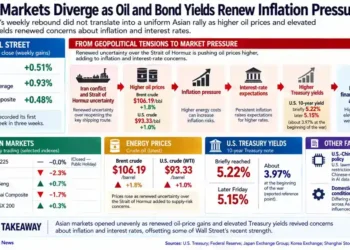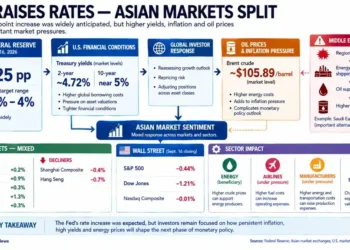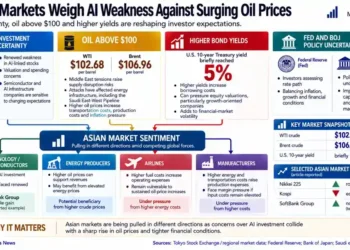
Fresh geopolitical risk gripped global markets Thursday as oil prices surged and U.S. equities surrendered most of their earlier rebound, with investors recalibrating inflation and monetary policy expectations after President Donald Trump signaled an expanded military campaign against Iran. Brent crude climbed to nearly $106 per barrel, while U.S. benchmark crude briefly approached $114, pushing energy back to the center of macro risk calculations.
The dominant business angle is trade and macroeconomic impact, with the latest move in crude now feeding directly into expectations for consumer inflation, corporate margins, and the Federal Reserve’s 2026 policy path. While the S&P 500 slipped 0.1%, the intraday reversal from a much steeper decline underscored how markets remain highly sensitive to every geopolitical signal tied to the Strait of Hormuz, through which roughly a fifth of global seaborne oil typically passes.
Macro Pressure Returns Through the Energy Channel
The sharp rise in crude prices is economically significant because it functions as a broad-based cost transmission mechanism. Higher benchmark oil prices immediately translate into more expensive refined products, freight, aviation fuel, and petrochemical inputs, increasing cost pressure across logistics-heavy sectors.

U.S. gasoline prices have already moved sharply higher, with pump prices above $4 per gallon, according to market tracking cited in the source reporting. That creates a direct hit to household discretionary spending, particularly in consumer-sensitive industries such as travel, retail, and leisure.
This renewed commodity spike also complicates the Federal Reserve’s inflation fight. Persistent energy-led price increases risk keeping headline inflation above the central bank’s 2% target, limiting room for policymakers to ease borrowing costs even as labor-market momentum softens.
Equity Markets Rotate as Sector Winners and Losers Re-Emerge
Thursday’s trading pattern reflected a classic geopolitical commodity shock.
Travel-linked stocks led the downside as investors priced in higher jet fuel and operating costs. Airline and cruise operators weakened, while energy majors and upstream producers outperformed on expectations of stronger near-term cash flow from elevated crude benchmarks.
The move also revived sector rotation themes seen during previous oil disruptions:



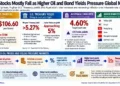
- Energy benefited from improved revenue leverage
- Consumer discretionary faced margin and demand concerns
- Industrials and transport came under renewed cost pressure
- Rate-sensitive growth stocks lost support as Fed cut hopes faded
Treasury yields remained relatively stable, with the 10-year yield near 4.30%, signaling that bond markets are increasingly balancing geopolitical flight-to-safety flows against inflation persistence.
Fed Expectations Shift Toward a Longer Hold
One of the most important economic consequences is the repricing of interest-rate expectations.
At the start of 2026, traders had positioned for multiple Federal Reserve rate cuts to cushion slowing employment and weaker manufacturing data. The latest oil shock has materially weakened that thesis. Futures markets now increasingly imply the benchmark rate may remain unchanged through year-end if energy inflation remains embedded in consumer prices.
For businesses, that means:
- borrowing costs may stay elevated longer
- refinancing conditions remain restrictive
- consumer credit demand could soften further
- capital expenditure decisions may be delayed
The macro story is no longer simply about conflict headlines. It is about whether sustained disruption around Hormuz can transform a geopolitical event into a global inflation persistence cycle.