SEOUL, South Korea — North Korea has unveiled a new facility involved in producing material for nuclear weapons, with leader Kim Jong Un declaring that the country will continue expanding its nuclear forces “at an exponential rate,” according to state media.
The disclosure, reported Thursday by the official Korean Central News Agency (KCNA), highlights Pyongyang’s continued focus on strengthening its nuclear capabilities despite years of international sanctions and stalled diplomatic efforts with the United States.
Kim made the remarks after visiting the facility on Wednesday, where he and senior officials reviewed what KCNA described as plans to significantly expand the country’s nuclear forces in the coming years.

Facility Believed to Be Uranium Enrichment Plant
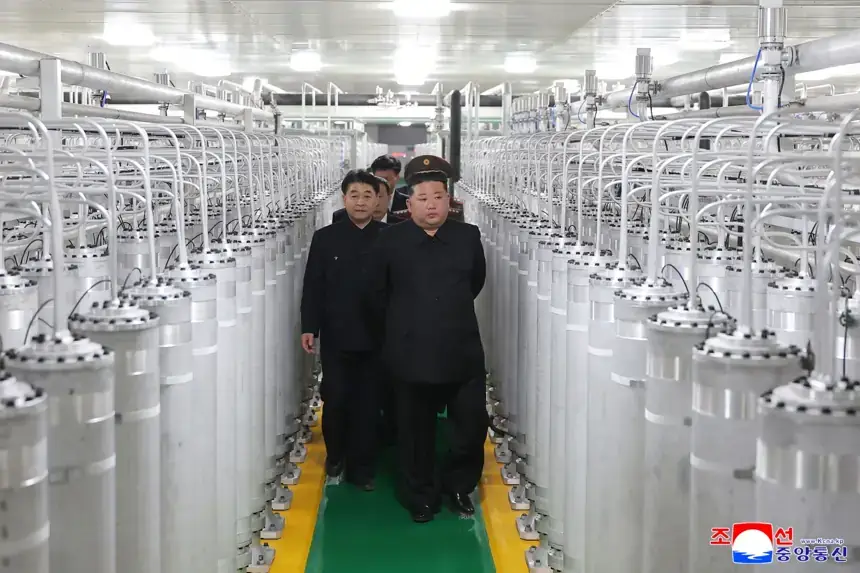
KCNA did not identify the location of the site but said it employed “more sophisticated technology.” South Korea’s Joint Chiefs of Staff assessed the facility as a uranium enrichment plant and said it was coordinating closely with the United States to monitor developments related to North Korea’s nuclear activities.
Images released by KCNA showed Kim touring what appeared to be a centrifuge hall containing rows of metallic tubes and piping commonly associated with uranium enrichment operations. Additional photographs showed him meeting with senior officials while examining technical materials, although the exact nature of those documents was not confirmed.
The newly disclosed site is the third uranium enrichment facility publicly revealed by North Korea. The country previously showcased an enrichment plant at its Yongbyon nuclear complex to visiting American scholars in 2010. In 2024, state media published photographs of another enrichment site that outside experts have linked to the Kangson complex.
Expansion Signals Long-Term Nuclear Strategy
Some nuclear experts cited in the original reporting assessed the newly revealed installation as a possible expansion of enrichment operations at Yongbyon.
Ankit Panda of the Carnegie Endowment for International Peace said preliminary analysis suggested the facility could be a newly added enrichment plant at Yongbyon and appeared to represent a significant increase in North Korea’s uranium enrichment capacity.
■ Related News

South Korean Unification Minister Chung Dong-young said last year that North Korea was operating four uranium enrichment facilities, including the Yongbyon complex, and that they were functioning continuously.
The latest disclosure reinforces indications that Pyongyang intends to further develop its nuclear infrastructure rather than return to negotiations focused on dismantling its weapons program.
Kim Reaffirms Nuclear Weapons Status
During the visit, Kim argued that strengthening North Korea’s nuclear deterrent had become increasingly urgent because of what he described as confrontation with “the most ferocious enemies,” an apparent reference to the United States and South Korea.
KCNA reported that Kim characterized North Korea’s status as a nuclear weapons state as an “invariable” position. He also claimed the country’s capacity to produce nuclear materials had more than doubled over the past five years, though that assertion could not be independently verified.
The comments reflect Pyongyang’s longstanding position that its nuclear arsenal is central to national security and not subject to unilateral dismantlement.
Diplomacy Remains at an Impasse
Relations between North Korea and the United States have remained largely frozen since nuclear negotiations collapsed in 2019.
U.S. President Donald Trump has repeatedly expressed interest in resuming diplomacy with Kim. However, North Korean officials have maintained that Washington must abandon demands for denuclearization as a condition for renewed talks.
Since the breakdown of negotiations, North Korea has conducted a series of weapons tests and repeatedly pledged to expand its nuclear arsenal.
Questions Persist Over Missile Capabilities
While many specialists believe North Korea possesses missiles capable of reaching the U.S. mainland, some continue to question whether the country has fully mastered the technologies needed to deploy operational nuclear warheads over intercontinental distances.
Among the remaining uncertainties are whether North Korean warheads can reliably survive atmospheric reentry and whether the country has perfected systems capable of carrying multiple nuclear warheads on a single missile.
South Korean officials estimated in 2018 that North Korea possessed between 20 and 60 nuclear weapons. Some experts now assess the country’s stockpile at more than 100 warheads, though precise figures remain difficult to verify.
North Korea unveiled a battlefield nuclear warhead design in 2023, leading some analysts to speculate that another nuclear test could follow. However, the country has not conducted a nuclear detonation since September 2017.