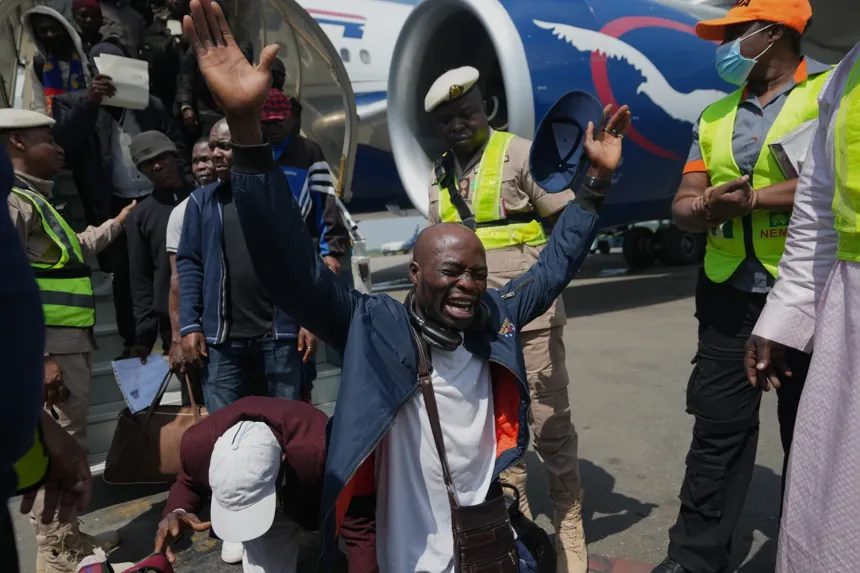
LAGOS, Nigeria — Hundreds of Nigerian migrants returning from South Africa after rising anti-immigrant tensions are confronting a difficult reality: the economic conditions that drove many of them to leave years ago have become even more severe.
For 52-year-old Iniebong James, arriving back in Lagos brought an immediate sense of relief after fleeing growing hostility toward foreign nationals in South Africa. That feeling quickly gave way to uncertainty as he began adjusting to life in a country he had left a decade earlier in search of better opportunities.
James was among the Nigerians repatriated from South Africa this month after violence and anti-migrant demonstrations intensified. He told The Associated Press that he had lived and worked as a car mechanic in South Africa’s Eastern Cape Province after overstaying a visitor visa. According to James, he decided to return after being injured during an attack by anti-immigrant protesters in May.

His experience reflects a broader challenge facing many returnees who are now attempting to rebuild their lives in an economy struggling with inflation, unemployment, and rising living costs.
Migration Driven by Economic Pressures
Before leaving Nigeria, James worked as a truck driver in Lagos. He said the closure of his employer during Nigeria’s 2016 economic downturn left him searching for alternatives.
In addition to concerns about employment, he cited frequent electricity outages as a major factor in his decision to relocate to South Africa, a destination long viewed by many Africans as offering stronger economic prospects and better infrastructure.
South Africa has historically attracted migrants from across the continent because of its comparatively advanced economy. However, the country has also experienced recurring outbreaks of xenophobic violence, with some South Africans blaming foreign nationals for unemployment, pressure on public services, and criminal activity.
Recent demonstrations calling for undocumented migrants to leave the country have fueled concerns among foreign communities and prompted several African governments to organize repatriation efforts for their citizens.


James said he is grateful to have returned safely but worries about finding employment in a country facing significant economic challenges.
“I would submit my CV if anybody can accept me, but I am still hoping for the government to help me with a job,” he said.
Returnees Confront Rising Costs
The economic landscape awaiting many returnees differs sharply from the one they left behind.
Since President Bola Tinubu introduced major economic reforms in 2023, including the removal of long-standing fuel subsidies and currency policy changes, Nigerians have faced rising prices across many sectors.
Inflation has increased significantly, placing additional pressure on households already struggling with high living costs. According to returnees, everyday expenses now consume a much larger share of income than they did a decade ago.
James pointed to fuel prices as an example of the dramatic change. When he left Nigeria in 2016, fuel cost around 85 naira per liter. Upon his return, he found prices had risen to approximately 1,400 naira per liter.
“Everything is too expensive,” he said.
The Nigerian government has stated that returning citizens will receive assistance and support before reuniting with their families. However, officials have not publicly detailed long-term reintegration plans for repatriated migrants.
Starting Over After Years Abroad
Migration experts say returning home after many years abroad can be more complex than commonly assumed.
Margaret Monyani, founder of the Johannesburg-based OLAM Africa Research Institute, said reintegration often involves social, economic, and emotional challenges.
“Returning is not always as straightforward as it sounds,” Monyani said. “People just think, go back home and start again. No, what is home?”
That challenge is particularly evident for younger migrants who spent formative years outside Nigeria.
Omotola Adeniyi returned to Nigeria after living in South Africa for more than a decade. She moved there as a child in 2015 and completed her secondary education in the country.
After graduating, however, she struggled to find employment and said many employers rejected her because she was a foreign national.
Unable to afford a return ticket on her own, Adeniyi accepted assistance from Nigeria’s repatriation program. Yet after spending 11 years abroad, she said adjusting to life in Nigeria feels unfamiliar.
Regional Concerns Over Anti-Migrant Sentiment
The recent wave of anti-immigrant protests has drawn reactions from governments across Africa.
Nigeria, Ghana, Malawi, and other countries that repatriated citizens from South Africa have publicly expressed concern about the treatment of foreign nationals. Nigerian and Ghanaian authorities also summoned South African diplomatic representatives following the unrest.
In a statement delivered to returning migrants, Nigeria’s Foreign Affairs Minister Bianca Odumegwu-Ojukwu emphasized the importance of safety over material losses.
She told returnees that protecting themselves and their families was worth any sacrifice required when escaping violence or hostility.
Despite recurring tensions, analysts note that South Africa continues to attract migrants because of economic opportunities that remain limited in many parts of the continent.
Monyani said that while South Africa faces significant social and economic challenges of its own, many of its institutions continue to function more effectively than those in several neighboring countries.
For many migrants, that reality means the difficult choices that prompted them to leave home in the first place remain largely unresolved.
Tags: Nigeria, South Africa, Migration, Repatriation, Bola Tinubu, Xenophobia, Economy, African Migrants