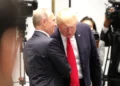
NATO’s top military commander said he does not expect additional U.S. troop reductions in Europe beyond the 5,000 personnel withdrawal announced earlier this month by President Donald Trump, offering reassurance to allies concerned about Washington’s long-term commitment to European security.
Lt. Gen. Alex Grynkewich made the remarks during meetings at NATO headquarters in Brussels, where alliance military officials have been assessing the impact of the Trump administration’s decision to reduce American military deployments across parts of Europe. The move has fueled anxiety among several NATO members already unsettled by growing transatlantic tensions over defense spending, Iran policy, and broader U.S. strategic priorities.
NATO Allies Seek Stability
Grynkewich said the current plan involves approximately 5,000 troops leaving Europe and indicated no immediate additional withdrawals are expected “in the near term.” The Pentagon previously confirmed that the reduction would primarily involve canceled deployments to Poland and Germany rather than the removal of permanently stationed forces.

The decision came after Trump announced plans to scale back the American military presence in Europe, arguing that European allies should assume more responsibility for regional defense. The administration’s approach has intensified debate within NATO about burden-sharing and the future structure of the alliance’s deterrence strategy against Russia.
European officials had feared broader reductions could follow the initial announcement, particularly after Trump suggested that troop cuts in Germany could eventually exceed the currently planned withdrawal levels.
Eastern Flank Concerns Persist
The canceled deployment of roughly 4,000 U.S. troops to Poland has raised operational concerns among NATO’s eastern members, especially the Baltic states that rely heavily on rotational American deployments as part of regional deterrence efforts.
Officials from Estonia and Lithuania acknowledged that the cancellation could temporarily affect planned troop rotations linked to Baltic defense operations. However, regional leaders emphasized that existing NATO commitments remain intact and described the disruption as manageable rather than strategic.
Grynkewich said NATO military planners are evaluating alternative deployments and capability arrangements along the alliance’s eastern flank bordering Russia. He maintained that Europe’s overall security posture would remain stable despite the changes.
■ Related News



Long-Term Strategic Shift Emerging
While NATO officials attempted to ease immediate concerns, Grynkewich acknowledged that Europe should expect gradual redeployments over the coming years as European allies strengthen their own military capabilities. Analysts said the remarks reflect a broader strategic shift inside Washington toward prioritizing competition with China while encouraging European governments to increase conventional defense spending.
Reuters reported that U.S. defense planners are also considering reducing the number of American forces formally committed to NATO’s crisis-response structure, signaling a possible longer-term transformation in how Washington supports the alliance during major emergencies.
Despite the uncertainty, NATO leaders continue to publicly stress alliance unity and deterrence readiness as Russia’s war in Ukraine and wider geopolitical instability continue to shape European security calculations.