Global equity markets moved cautiously at the end of the week, with U.S. stocks extending a multi-week decline as investors weighed easing oil prices against persistent geopolitical tensions and higher borrowing costs. The S&P 500 fell approximately 0.3% in early trading, putting the index on course for a fourth consecutive weekly loss, according to market data reported by the Associated Press.
The pullback reflects broader market concerns over tightening financial conditions, with rising U.S. Treasury yields increasing the cost of capital for businesses and consumers. Analysts cited by Reuters note that sustained yield increases can dampen economic activity by reducing investment and spending.
Oil Price Stabilization Amid Geopolitical Tensions
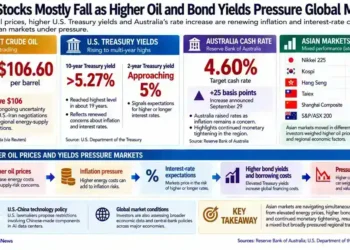
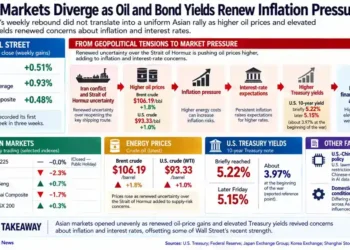
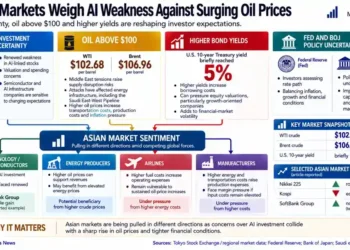
Crude oil prices moderated after recent volatility tied to escalating conflict in the Middle East. Brent crude declined by $0.78 to $107.87 per barrel after briefly reaching near $119 a day earlier, while U.S. benchmark crude fell $0.88 to $94.67 per barrel, according to market pricing data.

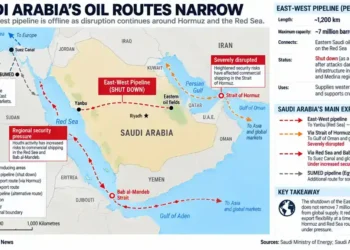
The recent surge in energy prices has been linked to disruptions stemming from the ongoing conflict involving Iran and Israel, now in its third week. Supply concerns have intensified due to disruptions around the Strait of Hormuz, a critical global oil transit route.
Policy signals have also influenced market expectations. U.S. Treasury Secretary Scott Bessent indicated the possibility of easing restrictions on Iranian oil shipments, a move analysts say could help stabilize supply and moderate price pressures.
Bond Yields and Inflation Concerns Pressure Equities
Equity markets remain sensitive to movements in the bond market. Rising yields, driven in part by inflation expectations linked to higher energy costs, have added downward pressure on stock valuations.
Market data compiled by Bloomberg shows that higher yields typically reduce the present value of future corporate earnings, contributing to declines in equity indices during periods of monetary tightening or inflation uncertainty.
Despite the easing in oil prices, analysts caution that sustained geopolitical risk could continue to influence inflation expectations and central bank policy trajectories.




Mixed Performance Across Global Markets
European equities showed relative stability, with major indices including the FTSE 100 and DAX trading largely flat, while France’s CAC 40 posted modest gains of around 0.2%.
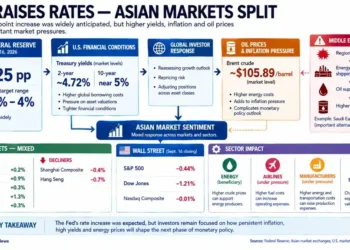
Asian markets ended the session mixed. Hong Kong’s Hang Seng index declined 0.9%, while mainland China’s Shanghai Composite fell 1.2%. In contrast, South Korea’s Kospi index rose 0.3%, reflecting uneven regional sentiment.
Currency markets also reflected cautious positioning, with the U.S. dollar strengthening against the Japanese yen to 158.61, while the euro edged lower to $1.1571.
Corporate Developments Offer Isolated Support
In corporate trading, FedEx shares rose more than 8% after the logistics company reported earnings and revenue that exceeded analyst expectations and raised its full-year guidance. According to company disclosures cited by The Wall Street Journal, the results point to resilience in global shipping demand despite broader macroeconomic uncertainty.
However, such gains were not sufficient to offset broader market weakness driven by macroeconomic and geopolitical factors.
Strategic Outlook
Market participants are likely to remain focused on the interplay between energy prices, geopolitical developments, and interest rate expectations. Analysts interviewed by the Financial Times note that while short-term oil price stabilization may provide relief, sustained volatility could continue to shape inflation dynamics and investor sentiment.
With global equities facing pressure from both external shocks and tightening financial conditions, near-term market direction is expected to depend on developments in energy markets and signals from policymakers regarding inflation and interest rates.