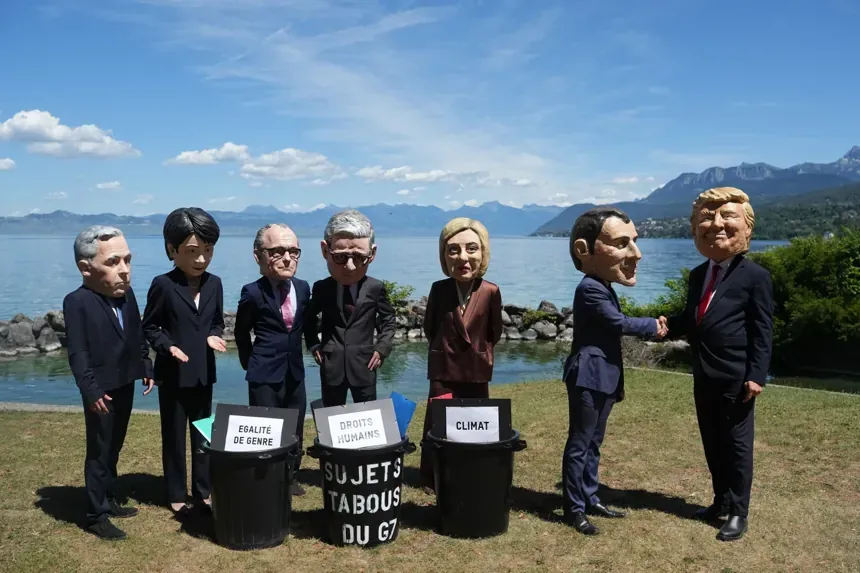
EVIAN-LES-BAINS, France — Leaders of the Group of Seven nations are convening in eastern France for their annual summit amid a packed international agenda that includes conflicts in the Middle East and Ukraine, global trade disputes, energy security, and growing concerns over China’s economic influence.
The three-day gathering, hosted by French President Emmanuel Macron in the Alpine resort town of Evian-les-Bains, brings together leaders from the United States, Canada, France, Germany, Italy, Japan, and the United Kingdom.
U.S. President Donald Trump arrives at the summit at a particularly sensitive moment in international diplomacy. Shortly before departing Washington, Trump announced an agreement aimed at ending the conflict involving Iran, a development that could significantly influence discussions among leaders throughout the summit.

Middle East Conflict Expected to Shape Early Talks
The situation involving Iran is expected to be one of the most closely watched issues during the opening phase of the summit.
Recent uncertainty surrounding hostilities in the region had raised concerns that discussions between allies could become contentious. The reported agreement to end the conflict has altered expectations, with leaders now expected to focus on the implications for regional stability and global energy markets.
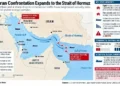
A key issue will be the future of shipping through the Strait of Hormuz, a strategically important waterway for global energy supplies. Leaders are expected to seek greater clarity regarding the details of the agreement and its potential impact on international trade and energy security.
Macron has scheduled dedicated discussions on the Middle East, with regional leaders including Egypt’s President Abdel-Fattah el-Sissi, Qatar’s emir, and the president of the United Arab Emirates expected to participate in related talks.
Ukraine Remains a Major Diplomatic Issue
The war in Ukraine is also expected to feature prominently on the summit agenda.
■ Related News

Ukrainian President Volodymyr Zelenskyy has been invited to participate in discussions and will use the opportunity to present Ukraine’s position directly to G7 leaders, including Trump.
The summit’s Ukraine session is expected to focus on developments in the conflict and diplomatic efforts to address the war. Discussions may also explore broader questions surrounding European security and future negotiations involving Russia.
The issue remains a critical test of unity among Western allies, particularly as different governments assess how best to support Ukraine while encouraging diplomatic solutions.
Economic Concerns and China’s Growing Influence
Beyond security matters, leaders are scheduled to discuss international trade, economic competitiveness, and supply chains.
China, while not a member of the G7, is expected to be a central topic during economic sessions. Several G7 governments have expressed concerns about Chinese exports, industrial subsidies, and the impact of competition from Chinese manufacturers on domestic industries.
The discussions reflect broader efforts by advanced economies to balance economic engagement with China against concerns about market access, strategic industries, and supply-chain resilience.
Trade and economic policy are likely to remain key themes throughout the summit as governments navigate slowing global growth and geopolitical uncertainty.
Technology, Development and Global Cooperation
Additional sessions will address artificial intelligence, online safety, and support for developing economies.
Leaders are expected to examine opportunities and risks associated with rapidly advancing AI technologies, including measures aimed at protecting young people online and strengthening international cooperation on digital governance.
The summit will also include discussions on development assistance and economic partnerships with emerging economies.
Among the invited guests are Indian Prime Minister Narendra Modi, Brazilian President Luiz Inácio Lula da Silva, the leaders of South Korea and Kenya, and several representatives from the Middle East.
A Forum With Five Decades of History
The G7 traces its origins to 1975, when leaders from six industrialized democracies met in Rambouillet, France, to discuss economic challenges following a period of global financial turbulence. Canada joined the following year, creating what became known as the G7.
The organization remains an informal forum for major democratic economies to coordinate policy on global issues. Membership has historically been limited to democratic states, a principle that has shaped debates over expansion.
Russia joined the group in 1998, creating the G8, but its participation was suspended in 2014 following the annexation of Crimea. Since then, the forum has returned to its G7 format.
As leaders gather in Evian-les-Bains, the summit is expected to test their ability to find common ground on some of the most pressing geopolitical and economic challenges facing the international community.
Tags: G7 Summit, Donald Trump, France, Ukraine, Iran, India, Japan