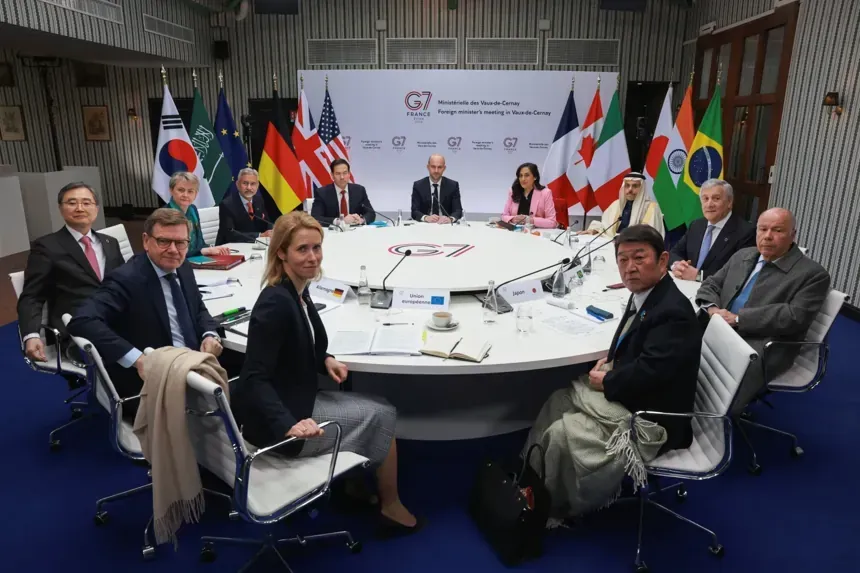
Foreign ministers from the Group of Seven gathered in France under mounting pressure to reconcile widening divisions over the Iran conflict, as Washington’s strategy faces growing skepticism from key allies. The meeting, held amid continued instability in global energy markets, underscored a diplomatic environment increasingly shaped by mistrust and diverging priorities.
According to reporting by Associated Press, U.S. Secretary of State Marco Rubio arrived at the summit tasked with defending Washington’s approach to the escalating confrontation involving Iran. His outreach, however, unfolded against the backdrop of criticism from Donald Trump, whose recent remarks targeting NATO allies added friction ahead of the talks.
Command Fractures Emerge Among Western Allies
The tone of the discussions reflected a widening gap between the United States and its traditional partners. European officials signaled unease not only with the military dimension of the Iran conflict but also with the manner in which decisions were communicated.

French officials, speaking publicly ahead of the meeting, emphasized that the conflict does not align with their national priorities. The remarks highlight a broader reluctance within Europe to be drawn into a confrontation perceived as externally driven.
British representatives echoed this cautious stance, indicating support for defensive measures while distancing themselves from offensive operations. This divergence illustrates a recalibration of alliance roles, with partners seeking to limit exposure to escalation risks.
Strategic Cohesion Tested by Economic and Security Pressures
Beyond political disagreements, the Iran conflict has introduced tangible economic strain. Disruptions linked to tensions around the Strait of Hormuz have heightened concerns over global oil flows, reinforcing the urgency of coordinated action.
Washington has called on allies to play a more active role in securing maritime routes, framing the issue as a shared responsibility tied to international law. Yet this appeal has met resistance, reflecting differing threat perceptions and domestic constraints among G7 members.
The inability to align on a unified response risks weakening collective leverage at a moment when economic and security interests are increasingly intertwined.


Diplomatic Leverage Narrows as Trust Erodes
Efforts by Rubio to stabilize relations were further complicated by lingering tensions within the transatlantic alliance. Recent U.S. rhetoric criticizing North Atlantic Treaty Organization members for insufficient support has amplified existing grievances.
European governments remain sensitive to both public criticism and policy unpredictability, particularly as questions persist over U.S. commitments in parallel conflicts such as Ukraine. These dynamics have constrained the diplomatic space available for consensus-building.
Rubio’s remarks ahead of the meeting suggested limited concern about allied dissatisfaction, reinforcing perceptions that Washington’s strategy is driven primarily by domestic considerations rather than alliance consensus.
Regional Stability Concerns Reshape Diplomatic Priorities
As the Iran conflict approaches its fourth week, calls for de-escalation have become a central theme among non-U.S. participants. Officials from multiple countries stressed the need for a diplomatic pathway to prevent further regional destabilization.
Statements from European leaders underscored fears that continued escalation could spill over into broader economic and security disruptions, including prolonged volatility in energy markets and heightened geopolitical risk.
At the same time, Iran has rejected accusations regarding its nuclear ambitions, maintaining that its program remains peaceful — a position that continues to complicate international efforts to frame a unified response.
Forward Outlook: Alliance Unity Faces Prolonged Test
The G7 meeting highlighted a structural challenge for Western alliances: maintaining cohesion under conditions of asymmetric threat perception and diverging strategic priorities. While the United States continues to push for a more assertive posture, its partners appear increasingly focused on containment and diplomacy.
Absent a convergence of strategy, the current trajectory points toward prolonged diplomatic friction. The outcome of these tensions will likely shape not only the handling of the Iran conflict but also the future credibility of coordinated Western responses to global crises.