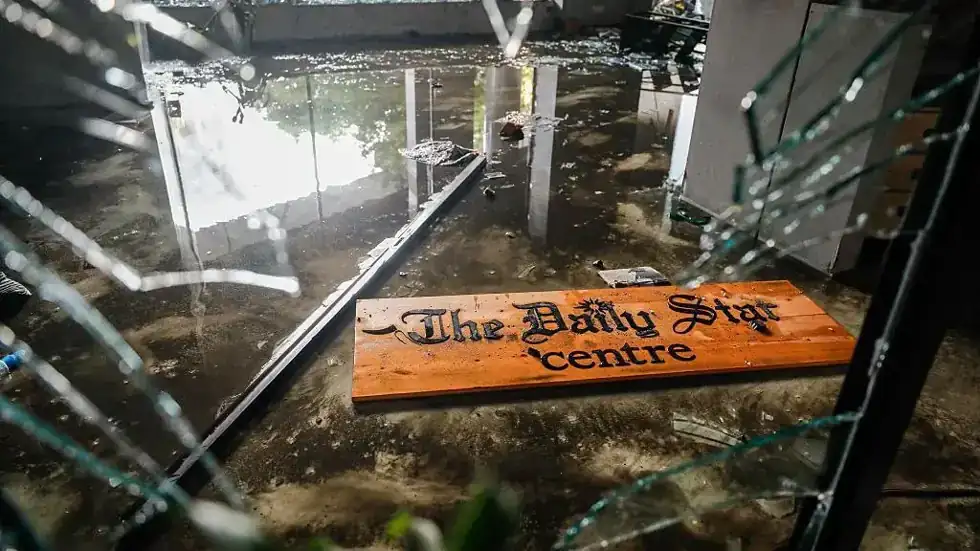
“Dhaka newsroom attack” has become shorthand in Bangladesh’s media circles for a night that tested the limits of press freedom and personal survival. In the early hours of 19 December, journalists at The Daily Star found themselves trapped on their own rooftop as a mob set fire to the building below.
What unfolded over four hours was not a scene from a battlefield, but an assault on one of Bangladesh’s most prominent newsrooms. By dawn, 28 journalists and staff had been rescued. The building was gutted. The newspaper missed print for the first time in its 34-year history.
Rising tensions before the Dhaka newsroom attack
The violence followed the death of Sharif Osman Hadi, a youth movement figure who had helped mobilize protests that led to the ousting of former prime minister Sheikh Hasina in August. Hadi was shot outside a mosque in Dhaka and later died in a Singapore hospital.

In the days after his death, accusations circulated online that The Daily Star and its sister publication Prothom Alo had contributed to a climate hostile to Hadi. The newspapers rejected the claims, and no evidence was publicly presented to substantiate them.
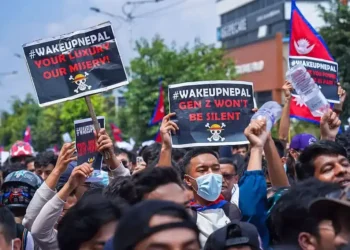
Social media posts accused the outlets of acting as “agents” for India, reflecting broader political tensions that have shaped Bangladesh’s domestic debate in recent months. Protests had already been staged outside the newspapers’ offices before the night of the attack.
“We knew they would burn the building”
Zyma Islam, an investigative reporter at The Daily Star, was finishing a front-page story shortly after midnight when colleagues warned that a crowd was moving along Kazi Nazrul Islam Avenue, Dhaka’s media district.
Minutes later, bricks smashed through the building’s windows.
“It wasn’t sporadic,” Islam later recalled. “You could tell there were a lot of people outside.”
■ Related News

Some staff managed to leave. Twenty-eight remained inside as the noise intensified. Islam and others decided against locking themselves in the newsroom, fearing that fire would follow. Instead, they climbed nine floors to the rooftop.
By 00:50 local time, smoke had engulfed the stairwell. The fire, set on lower floors, funnelled upward through the elevator shaft. On the roof — a small garden space — staff locked the iron access door and barricaded it with heavy planters.
They avoided the edges to prevent motion-activated lights from revealing their position. Down below, flames spread through offices and public areas.
Islam posted a message on Facebook: “I can’t breathe any more. There’s too much smoke. I’m inside. You are killing me.”
Four hours in smoke and darkness
As the fire intensified, journalists soaked shirts and handkerchiefs with water from a rooftop tap and pressed them to their faces. They lay flat in search of cleaner air. Some phoned relatives. One colleague considered jumping to an adjacent building two floors below but was restrained.
At least one staff member collapsed amid the smoke. Islam later said that moment made her fear a fatality was imminent.
Police were contacted during the early stages of the crisis. An army rescue operation began around 4:30 a.m. Soldiers formed a cordon, pushing back the crowd long enough for those trapped to descend the smoke-filled stairwell and escape through the rear of the building.
At ground level, a ladder was propped against a back wall. On the other side, a broken rickshaw van was positioned to cushion their fall. Staff climbed over and jumped down. Several sustained minor injuries.
Islam later sought treatment for carbon monoxide exposure.
Extensive damage and financial losses
The attack caused widespread destruction inside the building. According to the newspaper, furniture was smashed, archives burned, and a ground-floor auditorium gutted. The photo department, which housed decades of archival material, was stripped of equipment. Offices were looted and vandalised up to the seventh floor.
The publication estimated losses at approximately $2 million.
Despite the damage, staff resumed work within hours. Reporters operated remotely while repairs began. Within two weeks, two editorial floors were restored. On 20 December, the paper returned to print with a single-word headline: “Unbowed.”
Managing editor Kamal Ahmed described the return to publication as a statement of continuity rather than defiance. “We are not going to give up,” he said.
Investigations and unanswered questions
Police reported 37 arrests in the immediate aftermath — 11 related to the attack on The Daily Star and 26 concerning Prothom Alo. Authorities said they had identified an individual accused of inciting violence on social media but had yet to apprehend him.
Nearly three months later, questions remain over who organized the assaults and what specific motives lay behind them.
Bangladesh is not formally designated a conflict zone. However, press freedom groups have repeatedly raised concerns about harassment, intimidation and legal pressures facing journalists in the country. The Dhaka newsroom attack has intensified scrutiny of protections available to media workers.
Islam rejects framing the episode as extraordinary in her career. Threats, she says, are part of the profession’s landscape in Bangladesh.
“We got through one night,” she said. “We can get through another.”
The newsroom’s scars remain visible — broken glass stacked by the entrance, sections under repair, insurers assessing losses. Diplomats and visitors continue to tour the site, underscoring the international resonance of the attack.
For the journalists who spent four hours on a smoke-filled rooftop, the memory is less symbolic than physical: the darkness, the choking air, and the sound of flames rising through the building they had worked in for years.
Source: BBC – ‘I can’t breathe any more’: Inside the night a mob burned a newspaper