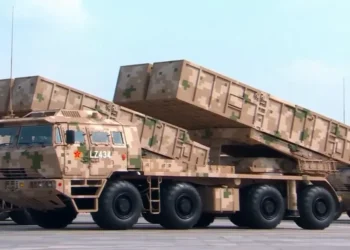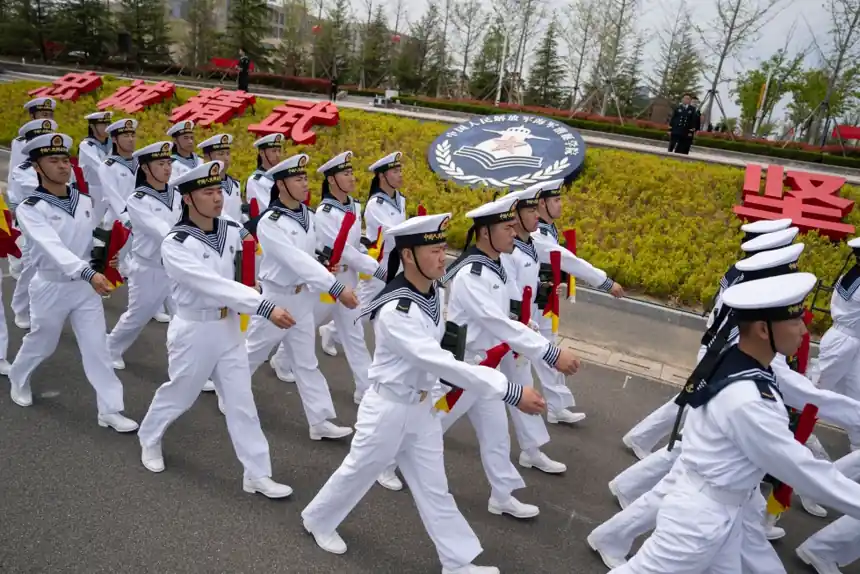
BANGKOK, Thailand – China’s navy conducted a test launch of a long-range ballistic missile from one of its nuclear-powered submarines in the South Pacific on Monday, drawing criticism from Australia, Japan and New Zealand as concerns grow over Beijing’s expanding military capabilities and strategic activities in the region.
China’s official Xinhua News Agency reported that the missile carried a dummy warhead and described the launch as part of routine annual military training. The agency said the exercise complied with international law and international practice and was not directed at any country or specific target.
The missile was launched at 12:01 p.m. local time, according to Xinhua, with the Defense Ministry later reposting the statement.

The launch marked China’s second publicly reported ballistic missile test in the Pacific in recent years. In 2024, Beijing launched an intercontinental ballistic missile carrying a dummy warhead into the Pacific, its first such test since 1980. Defense analysts viewed that earlier launch as a demonstration of China’s growing strategic military capabilities comparable to routine missile testing conducted by the United States.
Regional Governments Voice Concern
The latest launch prompted criticism from several governments across the Indo-Pacific.
New Zealand said it received advance notification only hours before the missile was launched and noted that the projectile entered the South Pacific Nuclear Free Zone.
Established under the 1986 Treaty of Rarotonga, the zone prohibits nuclear weapons throughout much of the South Pacific. China ratified the treaty’s protocols in 1987, committing not to test or threaten to use nuclear weapons against participating states within the region.
“It appears that despite our long-standing concerns about this type of activity, China carried out the test within hours of informing us,” New Zealand Foreign Minister Winston Peters said in a statement to The Associated Press.


Australia also criticized the launch.
“Australia has been clear with China that we regard this as destabilizing to the region,” Australian Foreign Minister Penny Wong told reporters while visiting Fiji.
The missile test occurred on the same day Australia and Fiji signed a new mutual defense agreement aimed at strengthening security cooperation in the Pacific.
Japan likewise expressed concern, with its Defense Ministry urging Beijing to reconsider missile tests that could send projectiles over Japanese territory or create broader regional security risks.
“China’s military activities, combined with its lack of transparency, have become a grave concern for Japan and the international society,” Chief Cabinet Secretary Minoru Kihara said, citing China’s military operations near Japan and increased defense spending.
In response, a spokesperson for China’s Foreign Ministry said Beijing hoped “the relevant countries will avoid overinterpretation.”
Analysts View Test as Strategic Signal
Defense analysts said the launch reflects China’s expanding strategic capabilities while highlighting continued concerns over limited transparency surrounding its military modernization.
Drew Thompson, a senior fellow at the S. Rajaratnam School of International Studies at Singapore’s Nanyang Technological University, said uncertainty surrounding China’s intentions stems from the lack of public information accompanying its military expansion.
“China’s military modernization and buildup have occurred without concurrent increases in openness and transparency, resulting in uncertainty about China’s intentions,” Thompson said.
Lyle Morris, a senior fellow at the Asia Society Policy Institute’s Center for China Analysis, described the launch as the first publicly acknowledged test involving a dummy warhead fired from a Chinese nuclear-powered ballistic missile submarine operating this far into the Pacific.
Morris said it was notable that Japan, Australia and New Zealand appeared to receive advance notification of the launch, while no similar notification was publicly reported for the United States.
He said the exercise also appeared intended to demonstrate that China’s nuclear deterrent increasingly extends beyond land-based missile systems.
“The announcement demonstrates that China’s nuclear deterrent is no longer centered solely on land-based missiles,” Morris said.
China Continues Expanding Nuclear Capabilities
China maintains a declared policy of not being the first to use nuclear weapons while continuing to modernize its military and expand its strategic nuclear forces.
According to the Washington-based Nuclear Threat Initiative, China operates six ballistic missile submarines and 59 nuclear-powered attack submarines.
In its latest report to the U.S. Congress on China’s military capabilities, released in late 2025, the Pentagon estimated that China possessed approximately 600 nuclear warheads in 2024 and projected that the People’s Liberation Army remained on course to deploy more than 1,000 nuclear warheads by 2030.
The missile test is likely to intensify regional debate over military transparency and strategic stability as Indo-Pacific governments continue to monitor China’s expanding defense capabilities alongside broader geopolitical competition in the region.
This report is based on reporting by The Associated Press.
Topics: China | South Pacific | Ballistic Missile | Indo-Pacific | Australia | Japan | New Zealand | Regional Security