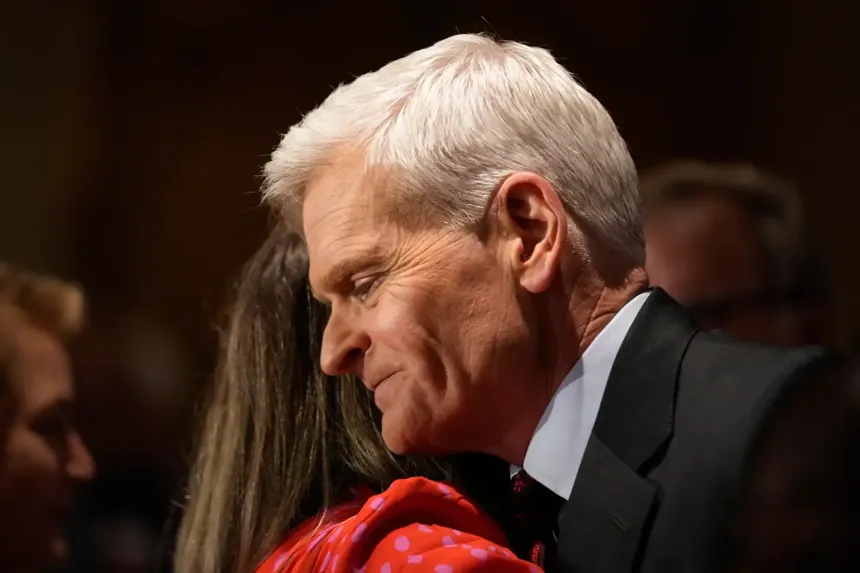
Republican Senator Bill Cassidy’s defeat in Louisiana’s Senate primary has become the latest sign of former President Donald Trump’s enduring dominance over the Republican Party, despite Cassidy’s years-long effort to rebuild ties after voting to convict Trump during his 2021 impeachment trial.
Cassidy failed to advance to a runoff in Saturday’s Republican primary, finishing behind Trump-backed Representative Julia Letlow and conservative challenger John Fleming. Political analysts described the result as a major victory for Trump’s campaign to marginalize Republicans viewed as disloyal within the party.
The Louisiana senator had spent years attempting to reconcile with Trump and his supporters after becoming one of seven Republican senators who voted to convict the former president over the January 6 Capitol attack. Despite backing several Trump-aligned initiatives during Trump’s second term, Cassidy remained a target of criticism among Republican voters.

Trump Loyalty Remains Central Republican Test
Cassidy’s defeat highlights how loyalty to Trump continues to shape Republican primary politics nationwide.
During the campaign, Cassidy emphasized his support for much of Trump’s agenda, including backing controversial cabinet nominees and conservative policy priorities. However, many Republican voters in Louisiana said the impeachment vote remained politically unforgivable.
Trump celebrated Cassidy’s loss on social media shortly after the results became clear, calling the senator disloyal and declaring his political career finished. Representative Julia Letlow, who secured Trump’s endorsement, openly credited the former president’s support for helping propel her campaign into the runoff election scheduled for June 27.
Senator Lindsey Graham of South Carolina, once a Trump critic before becoming one of his strongest allies, said Republicans who attempt to politically undermine Trump are likely to fail inside today’s GOP. Analysts noted that Graham’s comments reflected a broader shift in Republican politics, where ideological alignment increasingly revolves around personal loyalty to Trump.
Republican Moderates Continue to Disappear
Cassidy’s loss adds to a growing list of Republican lawmakers who faced political setbacks after opposing Trump following the 2020 election and Capitol riot.
■ Related News




Several Republican senators who voted to convict Trump in the impeachment trial — including Mitt Romney, Ben Sasse, Pat Toomey and Richard Burr — later chose not to seek reelection. Others, such as former Representative Liz Cheney, were defeated in Republican primaries after criticizing Trump publicly.
Political observers said Cassidy’s defeat demonstrates that Trump’s influence remains powerful even as he serves his constitutionally final term in office. Despite ongoing concerns over inflation, economic dissatisfaction and foreign policy tensions, Republican leaders have largely remained aligned with Trump’s agenda.
The Louisiana race was also shaped by changes to the state’s election system. Louisiana recently replaced its longstanding open “jungle primary” structure with a partisan primary system, a shift critics argued benefited more ideologically loyal candidates and weakened moderates like Cassidy who previously relied on broader crossover support.
Broader Implications for US Politics
The outcome is expected to reinforce Trump’s position ahead of the 2026 midterm elections as he continues to reshape the Republican Party around his political movement.
Analysts said Cassidy’s defeat may discourage other Republican lawmakers from openly challenging Trump or distancing themselves from his policies, particularly in conservative states where primary voters strongly support the former president. The result may also intensify debates about the shrinking space for moderate conservatives within the party.
Letlow and Fleming will now compete in a runoff that is expected to determine Louisiana’s next senator in the heavily Republican state.