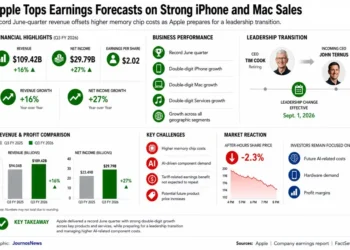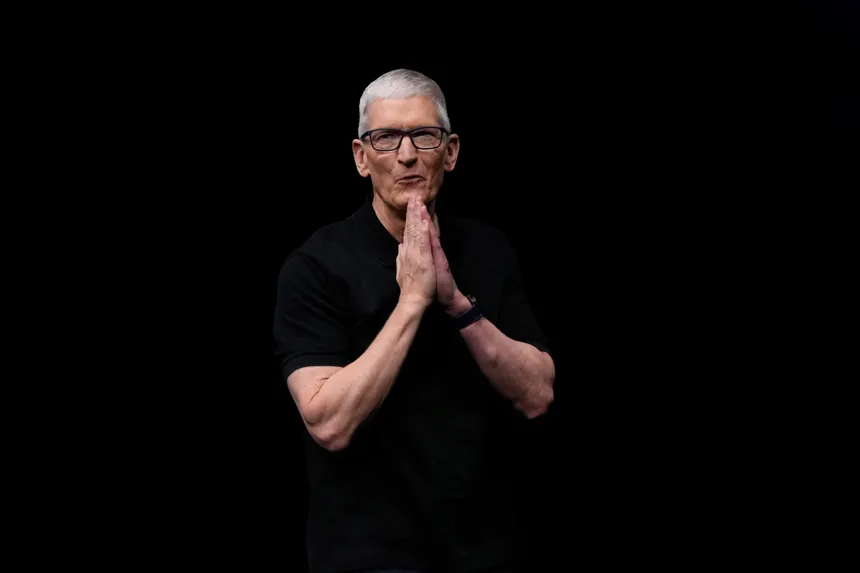
Apple Inc. is preparing for a significant leadership transition, with Chief Executive Officer Tim Cook expected to step down and transfer leadership to the company’s senior hardware executive. The move marks one of the most consequential corporate shifts at the Apple Inc. since Cook assumed the role in 2011, with implications for product strategy, innovation direction, and investor outlook.
According to reporting by Associated Press, Cook plans to hand over the CEO position to John Ternus, who currently leads Apple’s hardware engineering division. The transition, while not immediate, signals a deliberate succession strategy at a company with a market capitalization exceeding $2 trillion.
Leadership Transition and Strategic Continuity
Cook, who succeeded Steve Jobs following his death, has overseen Apple’s expansion into services, wearables, and recurring revenue streams. Under his leadership, annual revenue grew from approximately $108 billion in 2011 to more than $380 billion in recent fiscal years, according to company filings.

The appointment of Ternus suggests Apple may place increased emphasis on hardware-led innovation. As head of hardware engineering, Ternus has played a central role in flagship products, including iPhone development cycles and the company’s transition to in-house silicon chips.
Analysts cited by financial media including Bloomberg and Reuters indicate that leadership continuity is likely to remain a priority, with Apple historically favoring internal succession to preserve strategic alignment.
Market Implications and Investor Focus
The planned transition is expected to be closely monitored by investors, particularly given Apple’s position as one of the world’s most widely held stocks. Market participants typically assess leadership changes at large-cap technology firms for potential impacts on capital allocation, product pipelines, and long-term growth assumptions.
While no immediate financial guidance changes have been announced, industry analysts note that leadership transitions at companies of Apple’s scale often coincide with recalibration of strategic priorities. Data compiled by major financial outlets suggest that executive succession can influence valuation multiples, particularly in innovation-driven sectors.
Apple’s services segment—which includes subscriptions, cloud offerings, and digital payments—has become an increasingly important contributor to revenue diversification. Whether the incoming leadership maintains this balance or shifts toward hardware-led growth will be a key area of focus.



Succession Planning and Corporate Governance
Corporate governance experts point out that Apple’s structured succession planning reflects broader trends among large multinational corporations. According to reporting from Financial Times, internal leadership pipelines are often favored to minimize disruption and maintain institutional knowledge.
Cook is expected to remain involved in the company during the transition period, although the exact timeline and post-CEO role have not been fully detailed. Apple has not publicly disclosed a definitive date for the leadership change.
The transition also comes at a time when global technology firms are navigating regulatory scrutiny, supply chain shifts, and evolving consumer demand patterns. Leadership stability is often viewed as a key factor in managing these external pressures.
Strategic Outlook
The elevation of a hardware-focused executive to CEO could signal renewed emphasis on Apple’s core product ecosystem. At the same time, maintaining growth in high-margin services remains critical to sustaining overall financial performance.
Industry observers suggest the transition may represent a blend of continuity and recalibration rather than a fundamental shift in corporate direction. As Apple moves forward, investors and analysts will assess how leadership changes translate into measurable financial outcomes.