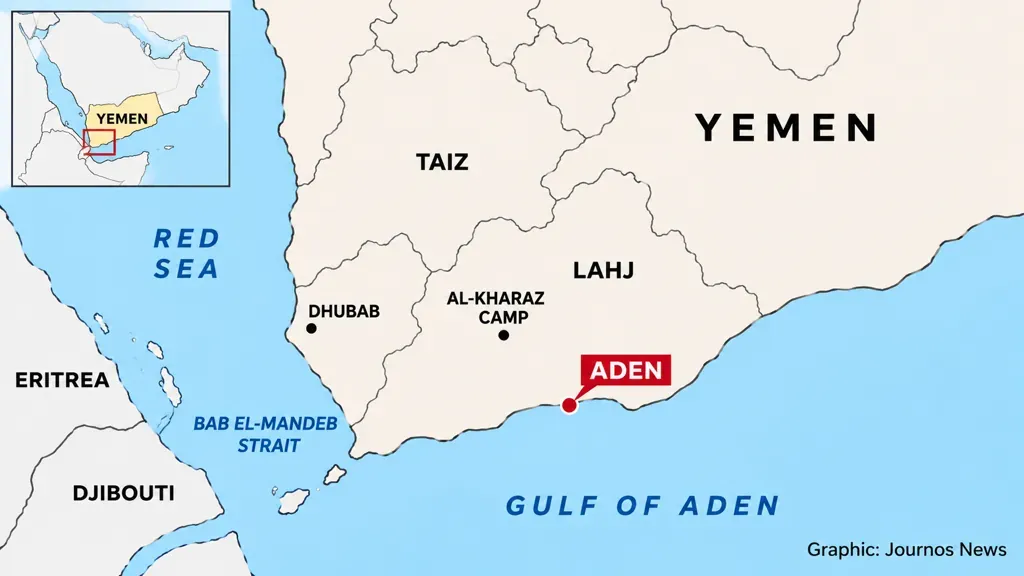
ADEN, Yemen — Houthi forces have advanced to within approximately 60 kilometers of Aden, the temporary seat of Yemen’s internationally recognized government, prompting government-aligned troops to establish a fortified defensive line around the southern port city.
Colonel Majed Abdullah Al-Nuzaily, spokesperson for Yemen’s armed forces, confirmed the distance during a virtual briefing on November 24. He said the situation was serious but rejected suggestions that the city was on the verge of falling. Government forces were positioned north and west of Aden, with reinforcements, checkpoints, trenches and earth barriers intended to prevent a further advance.
Al-Nuzaily said the government remained in Aden and would stay there. He acknowledged military setbacks but maintained that the forces defending the city were prepared to meet the threat.

Withdrawal from Bab el-Mandeb positions
The Houthi advance followed the withdrawal of government-aligned forces from positions near the Bab el-Mandeb Strait on November 15.
The Southern Armed Forces announced that they were repositioning troops from the Dhubab Airport and Bab al-Mandab areas in western Taiz governorate, citing developments on the front lines and the need to reinforce security around Aden and neighboring provinces.
The withdrawal ended a six-week counteroffensive intended to recover territory seized by the Houthis along Yemen’s western coast. Houthi forces subsequently consolidated control over areas vacated by government troops and advanced through parts of Lahj governorate.
Military and government sources placed Houthi fighters at Al-Kharaz camp in the Al-Madariba area, approximately 60 kilometers from Aden. Their positions threaten routes connecting the southern city with other government-held areas and could create additional pressure on the forces defending it.
Al-Nuzaily defended the redeployment, saying government troops could eventually return to positions along the strategic maritime corridor. He also acknowledged that the Houthis had reinforced their presence along the coast and could open additional fronts toward Aden, Marib or Shabwah.
■ Related News




Government warns of further fronts
The military spokesperson said government forces had achieved progress in Marib, including breaking through defensive positions that he said the Houthis had maintained for 12 years.
However, he acknowledged operational shortcomings and said there were indications that government communications had been compromised. He did not provide further details about the suspected breach.
The government has also called for international support to strengthen its coastal security capabilities. Foreign Ministry official Marwan al-Noman urged the United States and other Western countries to assist the Yemeni coast guard in intercepting weapons smuggling and provide training for forces fighting the Houthis.
The Houthis control Sanaa and large parts of northern Yemen. Their latest advances have increased pressure on the internationally recognized government and its Saudi-backed forces, while fighting has spread across several fronts.
Displacement deepens humanitarian pressure
The renewed fighting has forced hundreds of thousands of people from their homes, adding to Yemen’s prolonged humanitarian crisis.
The International Organization for Migration’s Displacement Tracking Matrix recorded approximately 354,335 displaced people in Yemen between June 7 and November 16, 2026. The agency said most were being hosted in Taiz and Lahj governorates, with many families moving repeatedly and seeking shelter in already overstretched displacement sites and host communities.
The concentration of displaced people in areas surrounding Aden adds pressure to communities already affected by insecurity and limited access to essential services.
The fighting also carries implications for maritime security. The Bab el-Mandeb Strait connects the Red Sea with the Gulf of Aden and is a major route for international commercial shipping. Further territorial gains by the Houthis along the western coast could complicate efforts to secure the waterway and protect nearby shipping routes. The United Nations has previously warned that military escalation around the strait threatens navigation and humanitarian access.
For now, the government says its defensive positions will prevent Aden from falling. The reported distance of approximately 60 kilometers, however, underscores how close the Houthi advance has brought the front line to the country’s interim political center.
Source: International Organization for Migration — Displacement Tracking Matrix, “Escalation in the Middle East and Beyond — Mobility Report (03 to 16 November 2026).” Records approximately 354,335 displaced people in Yemen between June 7 and November 16, with displacement concentrated in Taiz and Lahj. Read the IOM report. United Nations Department of Political and Peacebuilding Affairs — Assistant Secretary-General Khaled Khiari’s remarks to the Security Council on developments in Yemen (September 15, 2026). Documents the earlier escalation around Bab el-Mandeb, displacement and the UN’s concerns about maritime navigation and civilian protection. Read the UN statement.