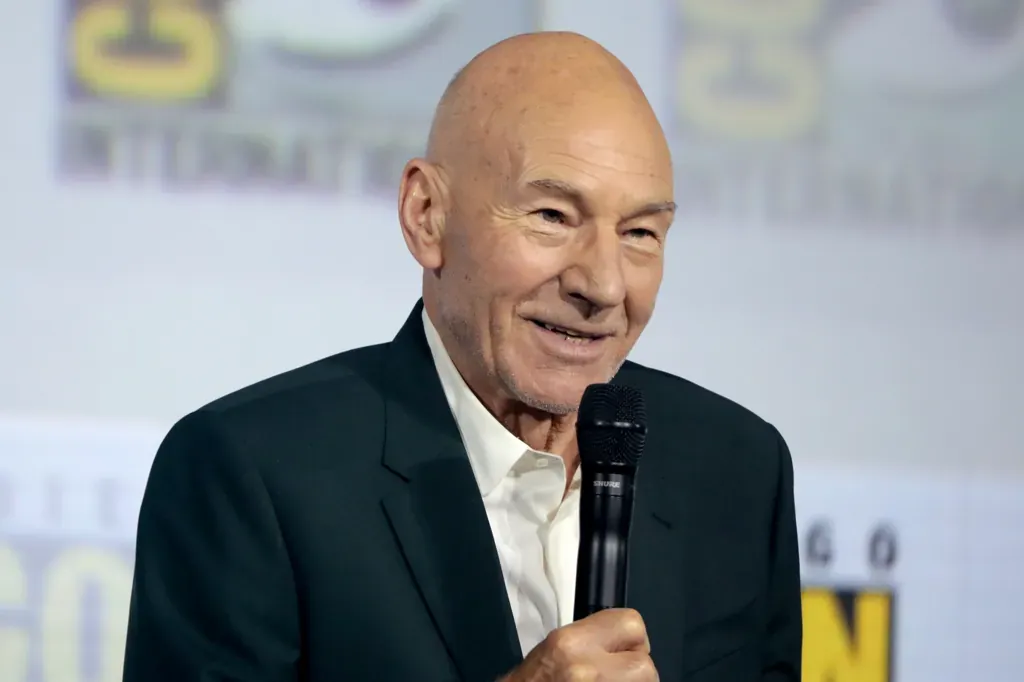
LOS ANGELES, United States – Sir Patrick Stewart, the British actor whose distinguished career ranged from Shakespearean theatre to two of Hollywood’s biggest franchises, has died at 86. His family announced his death on October 29 through his official social media accounts. He died at home in Los Angeles on October 28, with his wife, Sunny Ozell, by his side.
Family spokesperson Kelly Bush Novak said Stewart died after what she described as a “brief and poignant journey” with Alzheimer’s disease and Lewy body dementia. The family did not disclose when he received either diagnosis.
Stewart became internationally known as Captain Jean-Luc Picard in Star Trek: The Next Generation and Professor Charles Xavier in the X-Men films. Yet those roles represented only part of a career built over more than six decades.

Before Hollywood fame, he spent years performing Shakespeare with the Royal Shakespeare Company. He later earned major theatre awards, a Grammy and a knighthood for his contribution to drama.
His work also extended beyond acting. Stewart spoke publicly about domestic violence in his childhood and supported organizations helping survivors of abuse, refugees and military veterans.
From Working-Class Yorkshire to the Stage
Stewart was born on July 13, 1940, in Mirfield, West Yorkshire, England. His mother, Gladys, worked in the textile industry, while his father, Alfred, served in the British Army before taking civilian jobs.
He grew up in a working-class household with his two older brothers. In his memoir, Making It So, Stewart described a childhood shaped by financial hardship and violence at home.
He later spoke openly about witnessing his father physically abuse his mother. For many years, he kept those experiences private. As an adult, he chose to discuss them publicly, including their impact on his family.
■ Related News



His interest in acting began at school. An English teacher introduced him to Shakespeare when he was about 12, helping to shape his interest in theatre.
Stewart left school as a teenager and pursued professional training. He attended the Bristol Old Vic Theatre School after receiving a scholarship. He then worked in repertory theatre before joining the Royal Shakespeare Company in 1966.
In a later interview, Stewart described joining the company as the fulfilment of an ambition he had pursued for years. At that point, his main goal was to build a career on stage, not to become a Hollywood actor.
A Long Career With the Royal Shakespeare Company
Stewart joined the Royal Shakespeare Company in 1966 and became an associate artist two years later. He spent much of the following years performing classical theatre and developing his reputation as a Shakespearean actor.
His roles included King John, Oberon in A Midsummer Night’s Dream, Shylock in The Merchant of Venice and Titus Andronicus. He also played Prospero in The Tempest and Claudius in Hamlet.
His work with the company continued across different periods of his career. He returned to several productions and remained closely connected to British theatre even after his screen work took him to the United States.
Stewart also performed with the National Theatre and appeared in major British and American stage productions.
One of his most acclaimed Shakespearean performances came in Macbeth. His portrayal of the Scottish king earned major theatre recognition in 2007 and 2008.
In 2008, he appeared on Broadway in Macbeth, receiving a Tony Award nomination for Best Actor in a Play. He later shared the stage with Ian McKellen in Samuel Beckett’s Waiting for Godot, which reached Broadway in 2013.
These stage performances showed the range of his work beyond the science-fiction and superhero characters that later made him famous to wider audiences.
Three Olivier Awards and a Grammy
Stewart received three Laurence Olivier Awards during his career.
His first came in 1979 for his performance in Antony and Cleopatra. He received another in 1994 for his one-man performance of A Christmas Carol. In 2009, he won Best Performance in a Supporting Role for playing Claudius and the Ghost in the Royal Shakespeare Company production of Hamlet.
He also received a Grammy Award in 1996 for Best Spoken Word Album for Children. The award recognized his narration of Sergei Prokofiev’s Peter and the Wolf.
The recording demonstrated another side of his talent: a voice that could carry a story through rhythm, character and clear expression.
Stewart also received several major nominations for his television work, including Emmy recognition for productions such as Moby Dick and Hamlet.
In 2010, Queen Elizabeth II knighted him for services to drama. The honour recognized his contribution to British theatre and acting.
Captain Jean-Luc Picard Made Him an International Star
Stewart’s international breakthrough came in 1987, when he took the role of Captain Jean-Luc Picard in Star Trek: The Next Generation.
The series introduced a new crew aboard the USS Enterprise-D. Stewart played its captain for seven seasons, from 1987 to 1994.
Picard differed from the image of a traditional action hero. He often relied on diplomacy, reason and careful judgment. His character faced political disputes, ethical questions and threats to the Federation while trying to avoid unnecessary conflict.
Stewart brought a strong theatrical presence to the role. His measured delivery and commanding voice helped establish Picard as one of the franchise’s defining characters.
He continued playing the captain in four films: Star Trek Generations in 1994, Star Trek: First Contact in 1996, Star Trek: Insurrection in 1998 and Star Trek: Nemesis in 2002.
More than 15 years after the final film, Stewart returned to the character. Star Trek: Picard followed the retired admiral through a new chapter of his life. The series ran for three seasons, ending in 2023.
The return gave Stewart another opportunity to explore a character he had played for decades. It also brought back several members of the original Next Generation cast for its final season.
Professor Charles Xavier Expanded His Film Career
In 2000, Stewart began another major screen role as Professor Charles Xavier in X-Men.
Xavier leads a school for young mutants and works to build peaceful relations between mutants and humans. His belief in cooperation often puts him in conflict with Magneto, who takes a more militant approach to protecting mutantkind.
Stewart played Xavier as a thoughtful and determined leader. The character’s physical disability, intellectual strength and commitment to peaceful coexistence became central parts of his interpretation.
He returned in X2 in 2003 and X-Men: The Last Stand in 2006. He also appeared in later films, including X-Men Origins: Wolverine, The Wolverine, X-Men: Days of Future Past and Logan.
In 2022, he appeared as a version of Xavier in Doctor Strange in the Multiverse of Madness. The appearance connected his character to a wider Marvel screen universe.
Stewart also filmed an appearance in Avengers: Doomsday. Marvel identified the film as his final on-screen performance as Xavier. The film was scheduled for release in December 2026, after his death.
The role gave Stewart a second major franchise identity. While Picard represented leadership through diplomacy, Xavier embodied the struggle to protect a vulnerable community and maintain peaceful relations with a hostile world.
A Career Beyond Science Fiction and Superhero Films
Stewart’s work extended across film, television, animation and theatre.
His film credits included Dune, Excalibur, L.A. Story and Robin Hood: Men in Tights. He also appeared in television productions such as I, Claudius, Tinker Tailor Soldier Spy and Moby Dick.
His voice work included narration and animated productions. He became a familiar voice as Avery Bullock in the television comedy American Dad!.
Stewart also performed in one-man stage productions, including his interpretation of Charles Dickens’s A Christmas Carol. These performances reflected his interest in storytelling and the spoken word.
His career moved between classical drama and popular entertainment without abandoning either. He remained active in theatre even as his screen roles reached audiences around the world.
Speaking Publicly About Domestic Violence
Stewart’s childhood experiences later became an important part of his public advocacy.
He described witnessing repeated violence against his mother and explained how the family lived with the fear and silence surrounding abuse.
He became an ambassador for Refuge, a British charity supporting women and children affected by domestic violence. The organization has highlighted his willingness to use his public profile to challenge silence around abuse.
Stewart also supported Combat Stress, a charity that helps former members of the British Armed Forces with mental health conditions. His support reflected his public discussions about his father’s wartime experiences and their effects on family life.
He worked with the International Rescue Committee, which supports refugees and people displaced by conflict and disaster. He also supported the United Nations Association in the United Kingdom.
These activities gave his public life a wider purpose beyond entertainment. He used his own experiences to draw attention to people facing abuse, displacement and the long-term effects of trauma.
A Lasting Place in Theatre and Popular Culture
Stewart’s career connected two areas of performance that do not always share the same audiences.
In theatre, he built his reputation through Shakespeare and other demanding stage roles. In film and television, he became known to millions through Star Trek and X-Men.
His work as Picard helped shape a generation of science-fiction television. His portrayal of Xavier also helped establish the character as a central figure in the modern superhero film era.
Yet his influence cannot be measured only through the success of those franchises. His theatre awards, spoken-word recording and decades of stage work show the breadth of his contribution to acting.
His colleagues also remembered him as a generous performer and a respected presence on set. Tributes from the entertainment industry followed the family announcement, including statements from people who worked with him in Star Trek and X-Men.
For audiences, Stewart leaves behind two characters who became cultural landmarks. For theatre, he leaves a record of performances that began long before either franchise existed.
Sir Patrick Stewart’s career moved from a small town in Yorkshire to some of the world’s most recognized stages and screens. He remained an actor shaped by Shakespeare, committed to his craft and willing to speak about difficult experiences beyond the spotlight.
Reporting Credit: Based on the family announcement released through Patrick Stewart’s official social media accounts on October 29, 2026, and confirmation attributed to spokesperson Kelly Bush Novak; Stewart’s memoir, Making It So; Royal Shakespeare Company production records; UK government honours records; official Grammy and Olivier Awards records; StarTrek.com and Marvel Studios franchise records; and Refuge’s published information about Stewart’s advocacy. His death is reported as occurring at his Los Angeles home on October 28, 2026. Medical details are attributed to the family statement.