RIYADH, Saudi Arabia – Saudi Arabia’s Saudi-led Coalition to Support Legitimacy in Yemen said on October 15 that it had intercepted and destroyed a cruise missile over the Medina region, but the announcement reproduced by Yemen’s state news agency did not identify who launched it. The missile’s origin remains unverified in the evidence reviewed for this report.
The announcement was attributed to coalition spokesperson Maj. Gen. Turki al-Maliki and published through the Saudi Press Agency (SPA), according to the Yemen News Agency, known as SABA. The reproduced statement described an interception in the airspace over Medina but provided no supporting technical evidence, information about the intended target or details of any casualties or damage.
The distinction matters because a coalition announcement establishes what the military authority reported, not independently that every aspect of the reported event has been verified.

Conflicting accounts of responsibility
Saudi Gazette published a different account on October 15, saying the coalition had intercepted a Houthi cruise missile and that al-Maliki confirmed it had been launched by the Houthi movement. The accessible SABA reproduction of the SPA announcement does not contain that attribution.
The discrepancy could reflect a separate statement, an additional update or an attribution that cannot be substantiated from the reproduced announcement. The evidence reviewed does not establish which explanation applies. No separate coalition statement explicitly identifying the Houthis as the launcher was located in this review.
Anadolu Agency’s report also said the coalition announcement did not identify the launcher or the missile’s intended target. The Associated Press likewise described the statement as not assigning blame. Those accounts are consistent with the text reproduced by SABA, but the outlets’ agreement does not independently verify the interception itself.
Houthis deny carrying out an attack
Houthi military spokesperson Yahya Saree denied that Yemeni forces had conducted an operation targeting Saudi territory on October 15. A contemporaneous report published by Dawn, citing Agence France-Presse, quoted Saree as describing Saudi claims of an attack on Medina as false.
The denial is a competing claim, not independent proof that no missile was intercepted. The original social-media post was not independently accessed for this report, and the available evidence does not establish whether the Houthi statement specifically addressed the reported cruise missile beyond its broader denial of operations against Saudi territory that day.


The coalition’s reported interception and the Houthi denial therefore remain competing accounts. Neither, on its own, settles the missile’s origin.
What the available evidence establishes
The documentary record reviewed establishes that SABA published an account of an SPA announcement attributing the interception claim to al-Maliki. It also establishes that Saudi Gazette published a more specific attribution to the Houthis, while contemporaneous reporting documented a Houthi denial.
The review did not establish the interception through independently authenticated imagery, recovered missile debris, forensic analysis or other independent technical evidence. Nor did it establish the missile’s launch point, intended target, flight path or the circumstances of its destruction.
The available material also does not independently confirm whether the incident caused casualties, property damage or disruption. The absence of such information in the reviewed announcement should not be interpreted as proof that no consequences occurred.
Regional escalation is separate from missile attribution
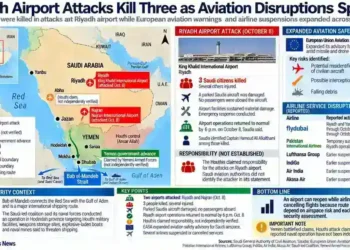
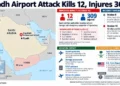
The incident was reported amid a broader escalation involving Saudi Arabia and the Houthis. A statement issued by the United Nations Security Council on October 15 condemned what it described as escalating Houthi attacks against Saudi Arabia, including strikes on Riyadh’s airport. That statement provides context for the deteriorating security situation, but it does not independently identify the launcher of the missile reported over Medina.
The distinction is important: evidence of other attacks, even when responsibility for those incidents is established, does not establish responsibility for this particular missile.
Saudi-Houthi conflict remains relevant background for understanding the security environment, but the immediate reporting question is narrower: whether the coalition can substantiate its reported interception and clarify the missile’s origin.
Key questions remain unanswered
The available record does not resolve whether the coalition issued a separate statement naming the Houthis, whether Saudi Gazette relied on additional information, or whether its attribution exceeded the wording of the announcement available for review.
The coalition’s spokesperson’s office has not been contacted as part of this research, and no response from the coalition or a Houthi representative was obtained. The absence of a response must not be treated as confirmation of either account.
Further reporting should seek the original coalition statement, any subsequent clarification, the original Houthi denial and any independently verifiable evidence concerning the incident. Until that evidence is available, responsibility for the reported Medina missile remains unestablished.
The defensible conclusion is limited but consequential: the coalition announced an interception, the Houthis denied conducting an operation against Saudi territory that day, and the accessible evidence reviewed here does not independently determine who launched the missile.
Reporting Credit: Saudi Press Agency announcement as reproduced by Yemen News Agency (SABA); Houthi military spokesperson Yahya Saree’s denial as quoted in Dawn’s report citing Agence France-Presse. The original Houthi post and a separate coalition attribution statement were not independently accessed.