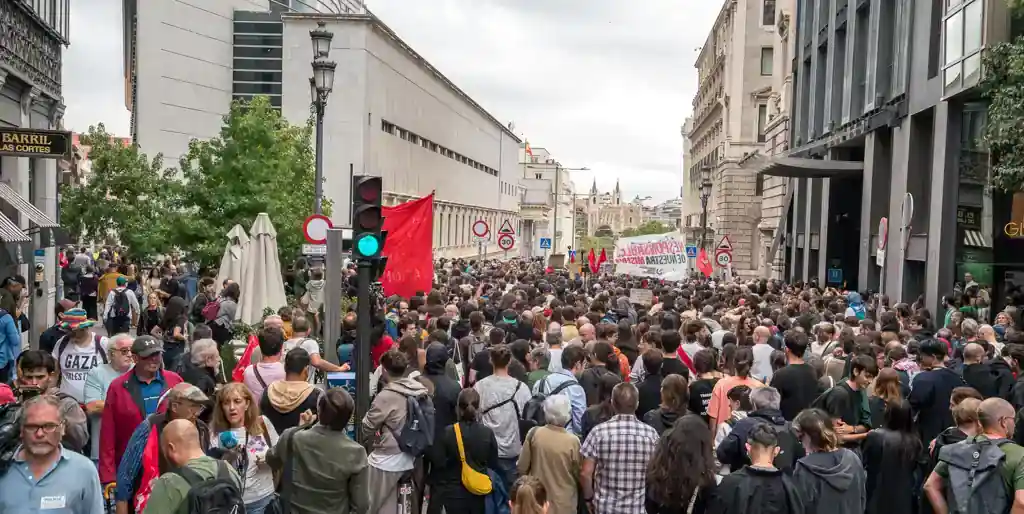
MADRID, Spain – Tens of thousands of people marched across Spain on Oct. 3 demanding action on housing, one day after Parliament rejected two government housing decrees amid growing anger over rents, evictions and the shortage of affordable homes.
The demonstrations followed weeks of mobilization that intensified after the eviction of 87-year-old María del Carmen “Maricarmen” Abascal, who had lived in her Madrid apartment for about 70 years.
In Madrid, the regional government delegation estimated that about 70,000 people took part in four columns that converged at Cibeles. The Madrid Tenants’ Union gave a substantially higher estimate of 500,000. The government figure is used here as the independently reported official estimate.

Demonstrations were also held in more than 50 locations around Spain, according to organizers and media reports. The Madrid march was largely peaceful, although separate clashes and police actions were reported later in the capital and in Valencia.
The protests have developed into a broader campaign over housing affordability rather than a movement centered solely on Maricarmen’s case.
Parliament rejects emergency housing measures
Spain’s Congress rejected two government housing decrees on Oct. 2.
One measure, Royal Decree-Law 26/2026, included provisions aimed at protecting vulnerable tenants from eviction when they lacked an alternative home, strengthening tenant protections and increasing the supply of affordable housing.
The second, Royal Decree-Law 27/2026, concerned the stability of residential rental contracts. It included changes to rules governing rental-contract extensions and was intended to reinforce housing-tenancy stability.
■ Related News




Both measures were subsequently repealed by Congress.
The official state gazette records that Congress repealed Decree-Law 26/2026 on Oct. 2. A separate resolution records the repeal of Decree-Law 27/2026 on the same day.
The vote came after the government had presented the measures as an emergency response to housing pressures.
The first decree was rejected by 178 votes to 172, according to the parliamentary record reported by Spain’s national news agency. The second was also rejected.
The measures had faced opposition from several parties, including the People’s Party, Vox and Junts. Their objections and policy positions differ, and the parliamentary defeat should not be reduced to a simple left-right dispute.
How Maricarmen became a national symbol
Maricarmen’s eviction on Sept. 23 transformed an individual tenancy dispute into a national symbol for housing campaigners.
A court-ordered eviction was carried out at her Madrid apartment after a long-running dispute over a protected rental agreement dating back decades. Police removed activists who had gathered to prevent the eviction, and Maricarmen was taken to hospital afterward.
The legal history is important.
The eviction should not be described as illegal. Courts authorized the eviction after ruling that the protected tenancy had ended, and the Supreme Court upheld the property owner’s position, according to the documented legal history of the case.
The dispute nevertheless became politically significant because of Maricarmen’s age, the length of time she had lived in the property and the broader affordability pressures facing tenants.
A path back home
The immediate circumstances have also changed since the eviction.
Maricarmen’s representatives and the property company reached an agreement mediated by Madrid’s municipal government that provides for a new rental contract allowing her to return to the apartment where she lived for about seven decades.
According to Madrid municipal authorities, the proposed contract would last eight years, with the rent capped at 30% of her net income. The arrangement is being made under Spain’s rental law and through the city’s municipal rental-intermediation service.
Maricarmen remained in hospital as of Oct. 1 and was not yet in a position to leave, according to Madrid officials.
The new arrangement does not reverse the earlier court ruling or restore the former protected tenancy. It represents a separate agreement for a new rental relationship.
That distinction has become important as the protests have expanded beyond her individual case.
From one eviction to a national housing movement
Tenant organizations have used Maricarmen’s case to illustrate what they describe as the growing gap between housing costs and household incomes.
The Madrid Tenants’ Union organized Saturday’s demonstrations under a call for a “general strike” over housing and said further mobilization would follow. Its attendance estimate was much higher than the government’s 70,000 figure, illustrating the continuing dispute over the size of the movement itself.
The demonstrations are not limited to opposition to evictions. Protesters have also demanded lower rents, more affordable housing and broader government action to address housing costs.
The rejected government decrees had attempted to address several of those issues, including rental stability, protections for vulnerable tenants and measures affecting the housing market. Their defeat means the measures no longer remain in force.
Protests remain mostly separate from incidents of violence
The national demonstrations should not be characterized as a single violent movement.
The Madrid march reported by the government delegation passed without incident during the main daytime demonstration. Later, however, police arrested three members of a far-right group in Madrid, while police used rubber bullets during clashes reported that evening. Violence was also reported in Valencia.
Those incidents occurred alongside predominantly peaceful demonstrations and should therefore be reported separately rather than used to characterize all housing protesters.
The wider housing dispute
Spain’s housing debate extends well beyond Maricarmen’s eviction.
The government has sought measures affecting rental contracts, tenant protections, vulnerable households and the supply of affordable housing. Parliament’s rejection of the two emergency decrees has now left those specific measures without effect.
For housing organizations, the parliamentary defeat has become another reason to continue mobilizing.
For the government, the rejection represents a setback in its attempt to respond to a politically sensitive affordability problem.
But Maricarmen’s case remains distinct from the broader policy debate. Her eviction was carried out under a court order, while the subsequent agreement offers her a new route back into the same home.
The protests now reflect a wider question facing Spain: how to protect tenants and expand affordable housing while balancing the interests of property owners, landlords and the wider housing market.
Reporting Credit: Spanish Congress of Deputies; Official State Gazette (BOE); Madrid Government Delegation; Madrid City Council; Spanish judicial records and court reporting concerning Maricarmen Abascal’s tenancy dispute; Madrid Tenants’ Union; and Spanish government housing authorities.