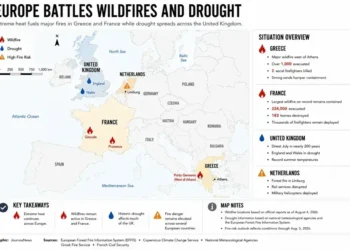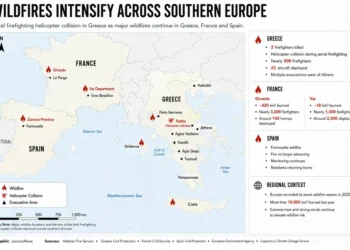
ATHENS, Greece – Hundreds of firefighters battled major wildfires across Portugal, Greece and Spain on Sunday as emergency crews worked to contain fast-moving blazes fueled by dry conditions, with European partners deploying reinforcements to Portugal and Greek authorities warning residents about dangerous levels of toxic smoke.
The fires have stretched emergency resources across southern Europe during the peak of the summer wildfire season, underscoring the region’s continued vulnerability to increasingly severe fire conditions.
Portugal receives European firefighting support
Portugal’s largest wildfire continued burning in the central Vouzela area, where more than 1,200 firefighters, nearly 400 emergency vehicles and 15 aircraft were deployed to combat flames that have burned since Thursday.

According to Portugal’s Civil Protection authority, the fire had scorched approximately 12,000 hectares (30,000 acres) by Sunday, based on mapping data from the European Union’s Copernicus satellite monitoring program.
The EU Civil Protection and Humanitarian Aid department said Spain dispatched 120 firefighters and 45 vehicles to Portugal on Friday, while Italy and Spain also sent three firefighting aircraft to reinforce Portuguese emergency crews.
By Sunday afternoon, Portuguese media reported that the wildfire had eased somewhat, with officials indicating there were no longer major active fire fronts, although firefighters continued working to extinguish remaining hot spots.
Greek authorities warn of toxic smoke
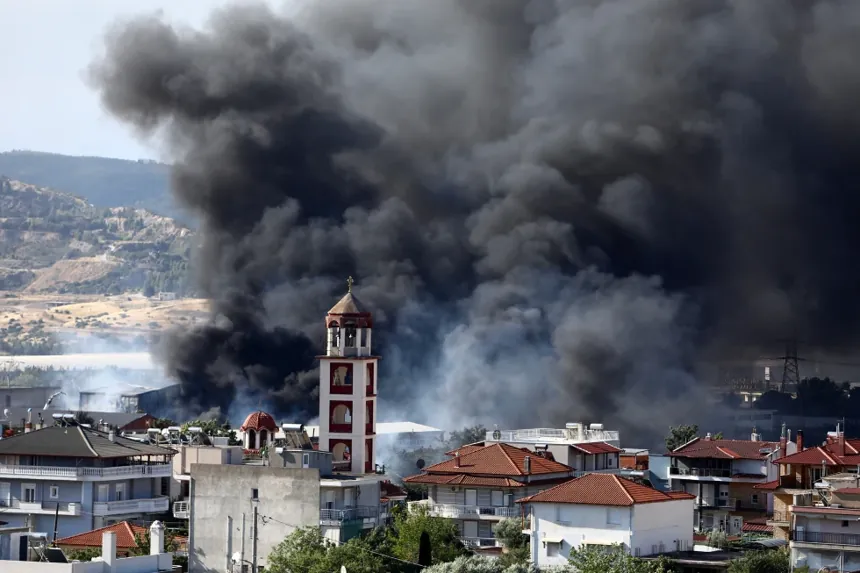
In northern Greece, authorities urged residents in parts of Thessaloniki, the country’s second-largest city, to remain indoors and keep windows and doors closed after a wildfire engulfed a recycling plant, producing hazardous smoke.
The blaze erupted Saturday evening near the suburb of Oraiokastro, prompting evacuation alerts for three nearby communities as well as a care facility housing 157 people with disabilities.
■ Related News

Strong winds complicated firefighting efforts overnight, with approximately 160 firefighters working until water-dropping aircraft were able to resume operations after sunrise.
Oraiokastro Mayor Pandelis Tsakiris told Greece’s state broadcaster ERT that several homes and businesses sustained damage, although authorities were continuing to assess the full extent of the destruction.
The Greek Fire Department said a 76-year-old man was arrested on suspicion of negligently starting the fire after sparks from his vehicle allegedly ignited roadside vegetation. He was scheduled to appear before a prosecutor on Sunday.
The incident occurred only days after another wildfire in the same region claimed the lives of a 12-year-old boy and his father.
Athens wildfire triggers large emergency response
Elsewhere in Greece, firefighters mounted a major response after another wildfire broke out Sunday west of Athens in the Mandra area.
The Fire Department deployed 210 firefighters, supported by volunteer crews, specialized response teams and 29 aircraft, including helicopters and water-dropping planes, to battle flames spreading through pine forest.
Authorities sought to contain the wildfire before nightfall, when aerial firefighting operations must be suspended.
Spain continues battle against Girona blaze
In northeastern Spain, firefighters continued efforts to contain a wildfire that has burned since Friday in the Girona region.
According to the EFE news agency, the blaze has destroyed nearly 2,200 hectares (5,400 acres). Eduard Martinez, head of operations for the Catalan Fire Service, said the fire had created a perimeter of approximately 40 kilometers (25 miles) and warned that crews might not succeed in bringing it under control on Sunday.
Negligence remains leading cause of Greek wildfires
Greek fire department spokesperson Brig. Ioannis Artopoios said approximately 85% of wildfires in Greece result from negligence, including sparks generated by agricultural equipment, discarded cigarette butts and outdoor barbecues.
Speaking on ERT television, Artopoios said many of the country’s wildfires could be prevented through greater public caution.
Greece regularly experiences destructive wildfires during its hot, dry summers. In 2018, a catastrophic wildfire east of Athens killed more than 100 people, while the largest wildfire ever recorded within the European Union burned through a protected nature reserve in northeastern Greece in 2023.
To strengthen wildfire detection and response, Greece has increasingly invested in new technology. Authorities are integrating four satellites launched into low-Earth orbit in May to improve wildfire monitoring across the country.
Although Greece has largely avoided the extreme heatwaves that affected much of western Europe this summer, firefighters have still responded to dozens of wildfires across the mainland and several islands.
Primary Category: World News
Subcategory: Europe
Article Topics: Wildfires | Portugal | Greece | Spain | Civil Protection | Climate | Emergency Response | European Union
This report is based on reporting by The Associated Press.