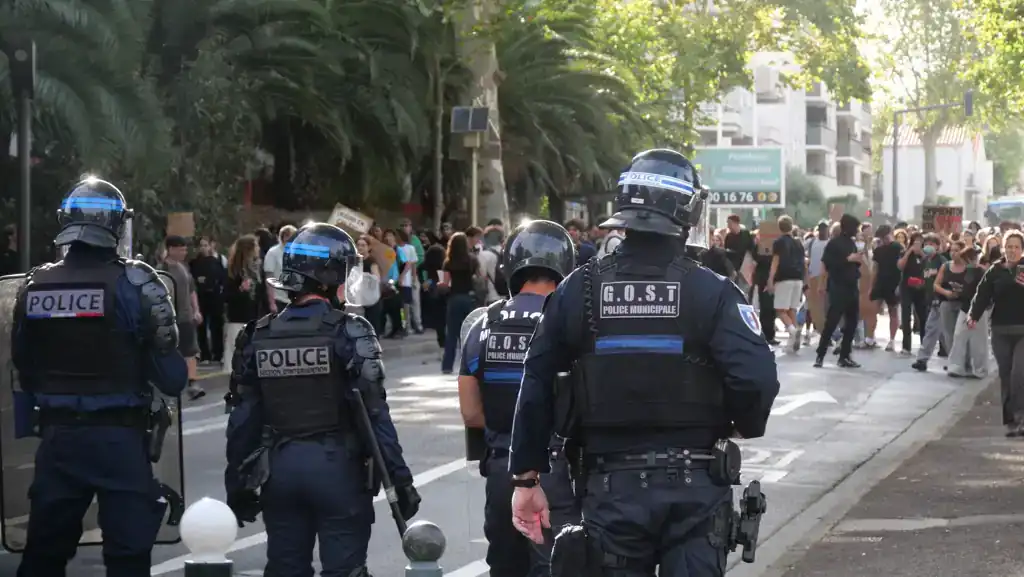
PARIS, France – Student protests that began over conditions in French schools have spread nationwide, with demonstrations increasingly accompanied by blockades, fires, clashes with police and large numbers of arrests.
The movement began around Sept. 21 in the Paris region and initially focused on complaints about teacher shortages, overcrowded classrooms, deteriorating school facilities and other education problems. It has since expanded to hundreds of schools across France and begun involving university students as well.
The scale of the disruption changed significantly during the week. France’s Education Ministry reported that more than 1,020 high schools were affected by protests or strikes on Thursday, including 222 blockades. On Friday, the ministry reported that 735 schools had been affected, a decline from the previous day but still representing a substantial nationwide disruption.

The figures refer to schools affected in some way by the movement and do not mean that all of those schools were completely blockaded.
Protests expand beyond the Paris region
The first demonstrations emerged in the Paris-area school system before spreading to other parts of France.
Students have raised complaints about unfilled teaching positions, overcrowded classrooms, school buildings and classrooms in poor condition, long school days and pressure surrounding the country’s university-admissions system, Parcoursup.
The movement has also expanded beyond high schools. University students have begun participating, although the university component remains smaller than the high-school mobilization. Some teachers’ and student organizations have called for further action next week.
What began as demonstrations around specific education grievances has therefore developed into a broader national protest movement.
■ Related News




The expansion has not meant that every demonstration has been violent. Many of the underlying demands remain focused on education conditions, while the most serious confrontations have occurred at particular demonstrations and school blockades.
Clashes and arrests increase
The Interior Ministry reported 1,747 arrests on Friday in connection with the mobilization, compared with 1,954 on Thursday, according to Interior Minister Laurent Nuñez. The ministry said the cumulative number of arrests since Monday had exceeded 5,000.
On Thursday alone, authorities reported 305 police officers, gendarmes and firefighters injured. The government also reported hundreds of arrests that day as confrontations spread.
Friday brought further reports of fires, projectiles thrown at police and clashes in several cities. Police used tear gas in some confrontations.
The violence has included incidents involving people other than police. French authorities and local officials have reported attacks or injuries involving teachers, school personnel and other members of the public. Those incidents are separate from the education grievances driving the wider movement.
Government response hardens
The French government has shifted from treating the demonstrations primarily as an education protest toward a stronger public-order response as violence increased.
Prime Minister Sébastien Lecornu and Interior Minister Laurent Nuñez described the situation on Thursday as having moved into what the government called “urban violence.” The Interior Ministry subsequently increased the deployment of police units around affected schools and demonstrations.
The government has nevertheless continued to acknowledge students’ right to peaceful protest while insisting that violence, attacks and blockades preventing access to schools cannot continue.
Education Minister Édouard Geffray met with representatives of high-school students and parents on Friday. Student representatives subsequently said they had not received concrete measures addressing their demands and called for further mobilization the following week.
The government has also pointed to additional education spending in its proposed 2027 budget. The Education Ministry’s official site lists the 2027 school budget as a current government priority, while reporting on the protests has put the proposed education allocation at €65.5 billion.
The existence of additional proposed spending does not by itself resolve the students’ complaints about staffing, classroom conditions or how resources are distributed.
Dispute over political involvement
The protests have acquired a political dimension as the government and opposition figures disagree over the role of political organizations in the movement.
Government officials have accused La France Insoumise, the left-wing political party, and groups described by officials as far-left or radical, of contributing to the escalation of the protests. Education Minister Édouard Geffray said the movement had initially reflected legitimate student concerns but was subsequently being influenced by political groups.
La France Insoumise and its supporters have rejected the government’s characterization. Jean-Luc Mélenchon has supported the students’ demands and criticized the police response.
These competing claims do not establish that political organizations caused the protests or that the broader student movement is controlled by them.
The movement began before the latest escalation and has involved student organizations, teachers, parents and other participants with different positions and demands.
Concerns over police conduct
The escalation has also generated disputes over police tactics.
French authorities have defended the use of police to prevent violence, protect schools and respond to attacks. At the same time, reports have emerged of young protesters being injured during confrontations with police, prompting questions about the use of force in demonstrations involving large numbers of minors.
Individual allegations of excessive force should be distinguished from confirmed findings. Where specific injuries are being investigated by police oversight or judicial authorities, those investigations should be reported separately from broader claims about police conduct.
The government has emphasized the need to protect public order, while student groups and some political figures have criticized the scale and methods of the police response.
Education grievances remain at the center
Despite the growing violence surrounding some demonstrations, the original education complaints remain central to the movement.
Students have cited staff shortages, overcrowding, school infrastructure problems, long school days and concerns about access to higher education through Parcoursup. The protests are occurring against wider concerns about educational performance and inequality in France.
The government’s proposed education spending is intended to address some of those pressures, but student organizations have said that additional funding has not yet translated into the concrete improvements they are seeking.
The Friday discussions between government officials and student representatives did not produce an announced settlement, and further demonstrations are planned.
Protests enter a politically sensitive period
The unrest is unfolding months before France’s next presidential election, adding political significance to the demonstrations without making the protests themselves an election campaign.
Political figures from different parts of the French political spectrum have taken opposing positions on the student movement, the government’s response and the use of police powers.
That political debate is separate from the immediate question facing French authorities: how to respond to a protest movement involving large numbers of students while distinguishing peaceful demonstrations from incidents involving violence and property damage.
For now, the movement remains active. The number of affected schools fell from more than 1,020 on Thursday to 735 on Friday, but the Interior Ministry still reported 1,747 arrests on Friday and student representatives called for further mobilization next week.
The developments leave France facing two connected but distinct issues: longstanding complaints about education conditions and a rapidly escalating public-order crisis surrounding parts of the protest movement.
Reporting Credit: French Ministry of Education; French Ministry of the Interior; French government and Prime Minister’s Office; regional education authorities; student organizations; teachers’ and parents’ organizations; relevant French judicial and police oversight authorities where applicable.