KYIV, Ukraine – Russian drone strikes disrupted three major bridges across the Dnipro River in Kyiv on Friday, forcing the full closure of one crossing and restricting traffic on two others as commuters faced severe congestion across the capital.
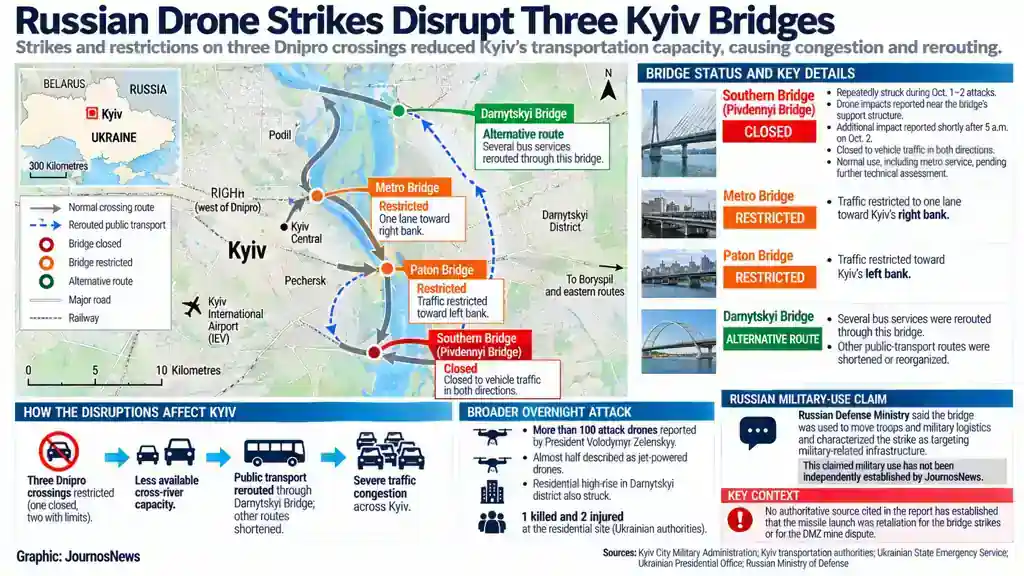
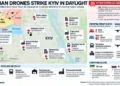
The Southern Bridge was closed in both directions after repeated strikes, while the Metro Bridge was restricted toward Kyiv’s right bank and the Paton Bridge was restricted toward the left bank, according to Kyiv city authorities. Public transport routes were redirected to other crossings.
The disruption affected one of the city’s main transportation links between its eastern and western banks and produced extensive traffic delays during the morning commute.

Southern Bridge repeatedly struck
The Southern Bridge, also known as Pivdennyi Bridge, was hit repeatedly during Russian drone attacks on Oct. 1 and into the early hours of Oct. 2.
Kyiv Mayor Vitali Klitschko said drones struck near the bridge’s support structure on Oct. 1. The bridge was temporarily closed while specialists examined its condition. Later attacks struck the crossing again, including an impact reported shortly after 5 a.m. on Oct. 2.
Kyiv authorities subsequently kept the Southern Bridge completely closed to vehicle traffic. The city said it was awaiting expert assessments before deciding when normal use of the bridge, including metro service, could resume.
The city had briefly restored some ground transportation over the bridge on Oct. 1 after an initial inspection found no critical structural damage. Further strikes led to new restrictions.
The sequence means the bridge’s operational status changed repeatedly within a short period as attacks continued and engineers assessed the structure.



Two other crossings restricted
The Paton and Metro bridges were not reported as completely closed to all traffic in the same way as the Southern Bridge.
Kyiv’s official transportation update said traffic on the Metro Bridge was restricted to one lane toward the right bank. On the Paton Bridge, traffic toward the left bank was restricted.
The restrictions forced authorities to reroute several bus services through the Darnytskyi Bridge. Other public transportation routes were shortened or reorganized.
The resulting disruption extended beyond the damaged crossing itself because traffic was redirected onto fewer available routes.
Kyiv authorities said the city was working with military and other agencies to develop alternative transportation arrangements while assessing the bridges and associated security risks.
Traffic disruption spreads across the capital
The bridge restrictions caused significant congestion on roads approaching the Dnipro crossings.
Residents reported journeys taking substantially longer as commuters attempted to move between Kyiv’s left and right banks. Some people resorted to walking after vehicles and buses became caught in the traffic.
Kyiv’s bridges are particularly important because the Dnipro divides the capital geographically, requiring major road and public-transport routes to cross the river.
The immediate consequence of the strikes was therefore not simply damage to one bridge. Restrictions at three crossings simultaneously reduced the available capacity for movement between the two sides of the city.
Residential building hit during wider attack
The bridge strikes were part of a broader Russian overnight drone attack on Ukraine.
President Volodymyr Zelenskyy said Russia launched more than 100 attack drones overnight, with almost half described as jet-powered drones. He said several drones struck the Southern Bridge and that a residential high-rise in Kyiv was hit during the attack.
Kyiv authorities reported a strike on the upper floors of a residential building in the Darnytskyi district. A fire broke out at the site, and emergency services responded. Later reports from Ukrainian authorities said one person was killed and two were injured.
The residential-building casualties are reported separately from the bridge damage. There is no evidence in the official Kyiv information reviewed that people were killed or injured directly on the bridges.
Russia says bridge had military use
Russia has presented the bridge strikes as attacks on infrastructure it says was being used for military purposes.
The Russian Defense Ministry said its forces struck a road-and-rail bridge over the Dnipro in Kyiv and characterized it as being used to move troops and military logistics. Russian authorities have similarly described other Ukrainian infrastructure struck during the campaign as connected to military activity.
That characterization is a Russian government claim and has not been independently established by JournosNews.
Ukraine, meanwhile, has described the attacks as part of Russia’s continuing aerial campaign against the country’s infrastructure. Zelenskyy said Russian drones struck the Southern Bridge repeatedly during the overnight attack.
The documented effect in Kyiv is clear: damage and repeated closures or restrictions disrupted civilian transportation across the Dnipro.
The available evidence does not establish that Russia’s purpose was specifically to paralyze civilian traffic or cause commuting disruption. Those effects followed from the damage and security restrictions imposed after the strikes.
A broader escalation in aerial attacks
The bridge strikes came amid an increasingly intensive exchange of long-range drone attacks between Russia and Ukraine.
Ukraine has continued using long-range drones against targets in Russia, including industrial and energy facilities, while Russia has maintained large-scale drone attacks against Ukrainian cities and infrastructure. Both sides describe their own attacks as directed at military or strategically relevant targets and reject accusations that they deliberately target civilians.
For Kyiv, however, the immediate consequences are being felt through the city’s transportation network.
The Southern Bridge remains fully closed while authorities await further technical assessments. The Metro and Paton bridges have continued to operate with restrictions, while public transport has been rerouted to other crossings.
The operational situation remains subject to change as engineers assess the affected infrastructure and city authorities adjust traffic arrangements.
The attacks therefore represent a significant disruption to Kyiv’s urban transportation system, while the precise military purpose behind the bridge strikes remains a matter of competing claims rather than an independently established conclusion.
Reporting Credit: Kyiv City Military Administration; Kyiv Mayor Vitali Klitschko; Kyiv city transportation authorities; Ukrainian State Emergency Service; Ukrainian Presidential Office; Russian Ministry of Defense.