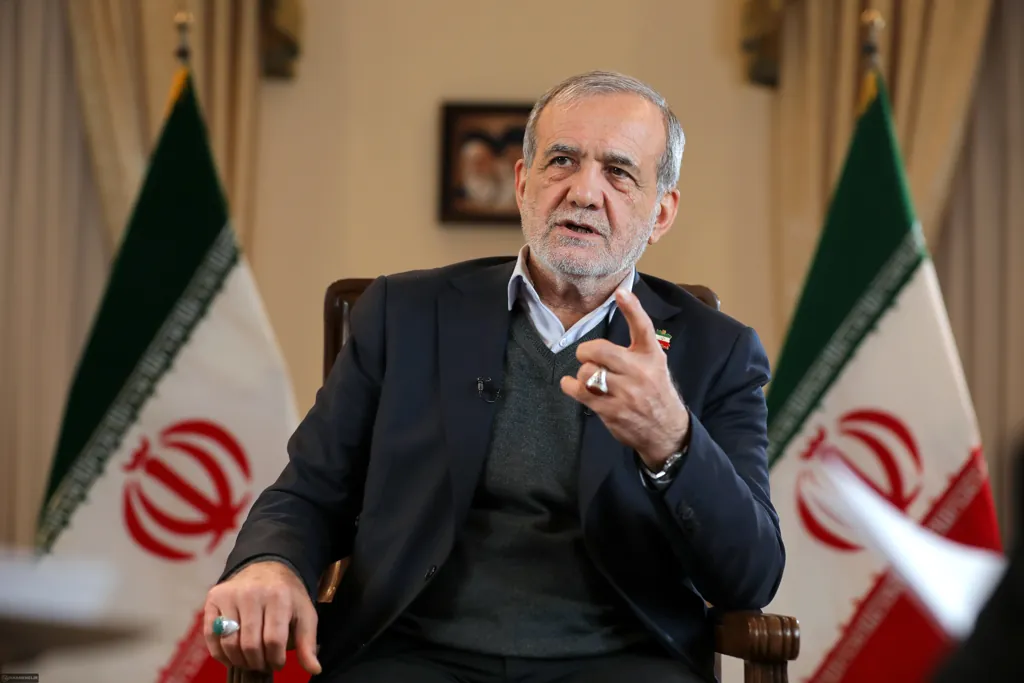
NEW YORK CITY, United States – Iranian President Masoud Pezeshkian told the United Nations on Wednesday that Iran would not surrender in its war with the United States, directly answering President Donald Trump’s threat the previous day while saying Tehran remains prepared for diplomacy.
Pezeshkian’s address to the 81st UN General Assembly combined two messages that are central to Iran’s current position: Tehran will continue defending itself against what it describes as foreign aggression, but it remains willing to negotiate if talks are not conducted under military threats or coercion.
“We will never bow our head or bend at the knee,” Pezeshkian said, before telling Trump and others seeking to pressure Iran that Tehran was ready for “dialogue and diplomacy and negotiations” without accepting what he called the language of force.

The speech came one day after Trump used the same UN platform to say he faced a choice between reaching a deal with Iran and “annihilating” the Islamic Republic if an agreement was not reached.
Pezeshkian answers Trump’s threat
Trump’s speech on Tuesday framed Iran as a central issue in his foreign-policy argument at the General Assembly.
He said Washington had prevented Iran from obtaining a nuclear weapon and warned that the United States could destroy the Islamic Republic if negotiations failed. Trump also said he believed a deal could eventually be reached.
Pezeshkian responded without accepting that premise.
He rejected the characterization of Iran as a terrorist state and accused the United States and Israel of attacking his country. He said pressure and sanctions would strengthen Iranian resistance rather than force Tehran to surrender.
The Iranian president also displayed photographs of people he said had been killed during the conflict, including children from a school in Minab.
Those claims about the strike, its victims and responsibility remain matters requiring separate verification and attribution. Pezeshkian presented them as evidence of what Iran considers foreign aggression.
Iran says diplomacy remains possible
Despite the confrontational tone of the address, Pezeshkian did not close the door on negotiations.
His statement that Iran was ready for dialogue and diplomacy was one of the most consequential parts of the speech because it came after several months of military confrontation and amid renewed U.S.-Iran contacts in New York.
Iranian Foreign Ministry spokesman Esmaeil Baqaei said afterward that messages had been exchanged with U.S. officials through Qatari mediators. He said Tehran had reiterated conditions including an end to the war and the U.S. naval blockade and the release of frozen Iranian assets.
The contacts followed a meeting involving U.S. special envoy Steve Witkoff and Iranian Foreign Minister Abbas Araghchi on the sidelines of the UN gathering.
Trump described the meeting as productive, while U.S. Secretary of State Marco Rubio later cautioned against treating it as a major breakthrough. Iranian officials likewise characterized the exchange as part of continuing contacts rather than a new diplomatic agreement.
No agreement ending the conflict was announced.
The U.S. delegation walks out
The diplomatic divide was visible inside the General Assembly chamber.
The U.S. delegation left at the beginning of Pezeshkian’s speech. Reuters reported that the U.S. mission to the United Nations did not immediately respond to a request for comment.
Israeli seats were also empty during the address, according to contemporaneous reporting.
The walkout underscored the sharp disagreement between Washington and Tehran even as officials on both sides continued exchanging messages through intermediaries.
The sequence also illustrated the difference between diplomatic contact and diplomatic progress. The two sides were communicating, but their public positions remained far apart.
Hormuz remains central to the dispute
Pezeshkian devoted part of his address to the Strait of Hormuz, the strategic waterway through which a substantial share of global energy shipments passed before the war.
He rejected the idea that countries could benefit from the waterway while, in Iran’s view, using it as part of military pressure against Tehran. He said the continued presence of hostile naval forces and expansion of the war would not produce peace.
The issue has consequences well beyond Iran and the United States.
The Strait of Hormuz has become one of the principal pressure points in the conflict, with disruptions to shipping contributing to higher global energy prices and forcing oil producers, importers and governments to adjust to reduced flows.
For Washington, keeping pressure on Iran’s military and economic capacity remains part of its stated strategy.
For Tehran, control over access to the waterway has become intertwined with its broader demand that military pressure against Iran end.
Nuclear issue remains unresolved
Pezeshkian also defended Iran’s right to peaceful nuclear technology while reiterating that Tehran does not seek nuclear weapons.
He argued that Iran should not be subjected to restrictions on peaceful nuclear activity while Israel, which is not a party to the Nuclear Non-Proliferation Treaty, maintains an undeclared nuclear arsenal according to widely held international assessments.
The argument reflects Tehran’s longstanding position, but it does not resolve the central disagreement with Washington over Iran’s nuclear capabilities and the international safeguards governing them.
Trump has made preventing Iran from obtaining a nuclear weapon a central justification for U.S. policy toward Tehran.
The two governments therefore remain divided not only over the war but also over the terms under which a diplomatic settlement involving Iran’s nuclear program could be reached.
Defiance and diplomacy coexist
Pezeshkian’s speech did not amount to an Iranian rejection of negotiations.
Nor did his statement that Iran was willing to negotiate establish that a settlement was close.
Instead, the address set out conditions under which Tehran says diplomacy could proceed while making clear that Iran does not accept surrender as the outcome of negotiations.
That distinction is important as Washington and Tehran continue indirect contacts.
The United States has demanded major changes in Iran’s nuclear program and its regional activities. Iran has insisted that military pressure must end and that it retain rights to peaceful nuclear technology. Both sides have continued to use sharply different descriptions of the conflict and its causes.
The public rhetoric therefore remains confrontational even as diplomatic channels remain open.
No breakthrough announced
Pezeshkian’s appearance at the UN produced no announced ceasefire, peace agreement or new negotiating framework.
What it did provide was a clearer public statement of Tehran’s position after Trump’s address.
Iran will not accept surrender, according to Pezeshkian, but it is prepared to continue diplomacy if negotiations are conducted without what Tehran considers coercive military pressure.
That leaves the next stage dependent on whether the private exchanges in New York can address the issues that have kept the two governments apart.
For now, the contrast between the two leaders’ speeches is stark.
Trump presented Iran with a choice between a deal and further destruction.
Pezeshkian answered that Iran would continue resisting military pressure while saying the country remains willing to negotiate.
The two positions leave diplomacy possible, but they do not yet amount to an agreement on how the war should end.
Reporting Credit: United Nations General Assembly — official record and proceedings of the 81st General Debate; Office of the President of Iran — President Masoud Pezeshkian’s statements and position; Iranian Ministry of Foreign Affairs — statements concerning U.S.-Iran communications and negotiating conditions; White House — President Donald Trump’s September 22 UN address and statements concerning Iran; U.S. Mission to the United Nations — U.S. position at the General Assembly.