


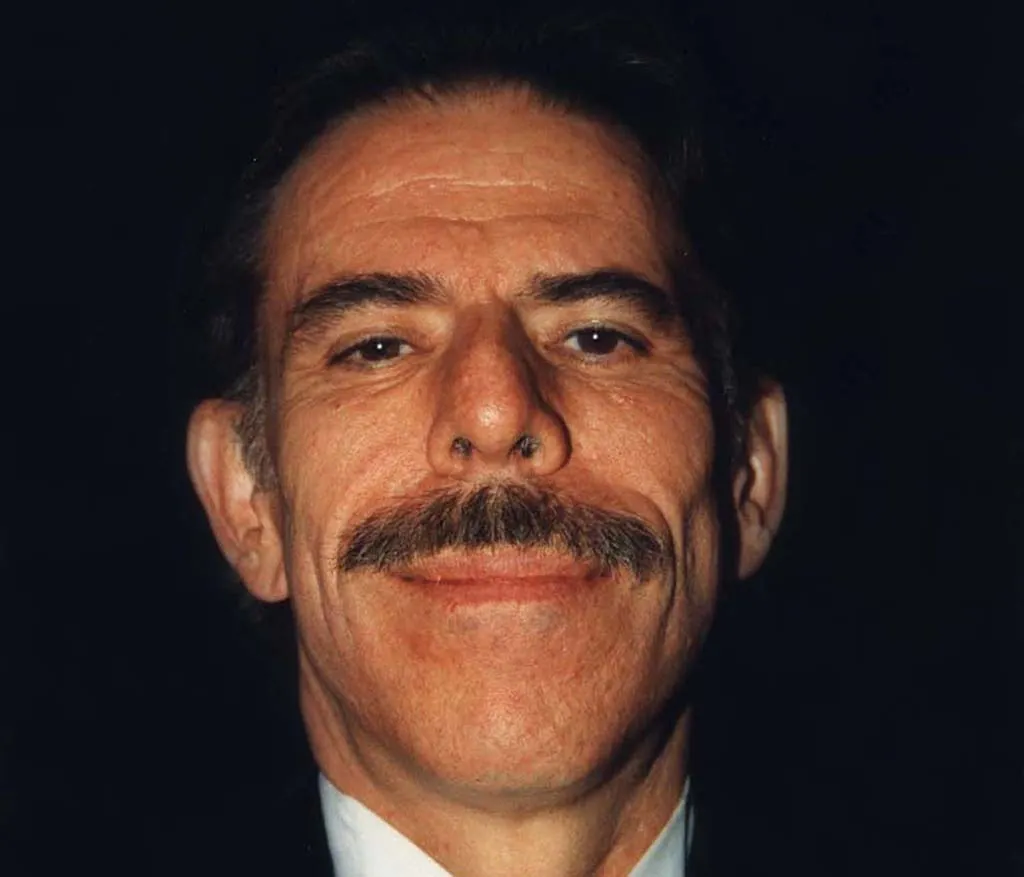
NEW YORK, United States – Peter Max, the German-born American artist whose saturated colors, cosmic imagery and psychedelic designs became closely associated with the visual culture of the 1960s, has died at 88.
Max died Monday, his son Adam Max said in a statement released Wednesday. No cause of death was given in the announcement.
His work became one of the most recognizable visual signatures of the flower-power era. Posters filled with stars, planets, flowers, rainbow colors and stylized human figures appeared on college dormitory walls and across a rapidly expanding commercial culture. His designs also moved well beyond posters, appearing on household products, clothing, publications, transportation and major public events.

Max’s influence was not limited to the counterculture imagery with which he became identified. He later served as an official artist for events including the Olympics, Super Bowl, Indianapolis 500, World Cup and World Series. His designs were also used on a Boeing 777 and a Norwegian Cruise Line ship, while his portrait subjects included American presidents and contemporary entertainers.
From Berlin to New York
Born Peter Max Finkelstein in Berlin in 1937, Max was raised in a Jewish family that fled Nazi Germany when he was a baby. The family spent years in Shanghai and later lived in Israel and Paris before arriving in New York when Max was 16.
His early artistic training was considerably more traditional than the work that would later make him famous. He studied realism at the Art Students League of New York and continued his education at the School of Visual Arts. His fascination with astronomy and the visual influences he encountered during his travels eventually became important elements of his artistic vocabulary.
In the early 1960s, Max established a graphic design studio in Manhattan. His work soon attracted advertising agencies, publishers and corporate clients, giving him a route into mass culture before his psychedelic imagery fully emerged.
The face of the psychedelic era
Max’s breakthrough came in the second half of the 1960s, when his art increasingly combined intense color, celestial imagery and simplified human forms.
His 1967 “Be In” poster became associated with the counterculture movement in New York, while his appearances on television helped turn the artist himself into a recognizable cultural figure. His work appeared on The Tonight Show set and later on The Ed Sullivan Show, where he demonstrated his drawing technique.
By the end of the decade, Max’s imagery had become commercially ubiquitous. His work appeared on products ranging from clocks and bedspreads to clothing and stationery. He was featured on the cover of Life magazine in 1969, at the height of his public profile.
The commercial success was enormous, but Max eventually became uncomfortable with the distance between his business empire and his painting.
In the early 1970s, he withdrew from much of the commercial operation and returned his attention to painting. His later work moved toward more expressionistic techniques, while continuing to draw on the cosmic and colorful imagery that had defined his earlier career.
From popular culture to public art
Max continued working across popular culture and public life for decades.
Among his best-known later projects was his series of Statue of Liberty paintings. In 1981, he painted large versions of the statue at the White House after being invited by first lady Nancy Reagan. The U.S. Department of State’s Art in Embassies program identifies Max’s Statue of Liberty works among the artist’s public contributions.
His work was also exhibited by museums. The Museum of Modern Art in New York lists seven works by Max in its collection, including pieces from the 1960s such as Psychedelic Cloud, Untitled (Bob Dylan) and 1 2 3 Infinity.
His relationship with the fine-art establishment was more complicated. Critics sometimes questioned the artistic value of his commercial success and the enormous volume of products carrying his imagery. Yet the persistence of his work in museums, exhibitions and popular culture reflected a different kind of influence: Max had helped make graphic art part of the everyday visual environment of an entire generation.
A complicated legacy
Max’s career also included controversies away from the canvas. He pleaded guilty to tax fraud in 1997 after authorities accused him of concealing more than $1 million in income. He paid back taxes and a fine and completed community service teaching art in Harlem schools.
His family life also became the subject of a public legal dispute in the 2010s, involving allegations concerning his finances and personal relationships. Those disputes unfolded as Max’s health declined.
One persistent misconception concerns the Beatles’ 1968 animated film Yellow Submarine. Max is sometimes credited with creating its distinctive visual style, but the film’s art direction is officially associated with Heinz Edelmann. Max’s involvement was described by his longtime gallery as early consulting work.
An enduring visual language
Max’s importance to American popular culture ultimately rested on the unusual reach of his imagery.
His art could exist simultaneously in galleries, on posters, in advertising, on consumer products and at major public events. That accessibility helped make his stars, rainbows, planets and vividly colored figures familiar to people who might never have entered a contemporary art museum.
The Peter Max Studio biography describes the artist’s work as a meeting point between his lifelong interests in art and astronomy, while the U.S. Department of State has described his paintings and graphics as capturing the spirit of the 1960s.
Max leaves behind a body of work that remains immediately recognizable decades after the era that made him famous. His children, Adam Max and Libra Astro, survive him.
Reporting Credit: Adam Max — confirmation of Peter Max’s death and family statement; Museum of Modern Art — collection records for Peter Max’s works; U.S. Department of State, Art in Embassies — biographical and public-art records; Peter Max Studio — artist biography and career chronology.

