Last updated: September 3, 2026 | 04:00 UTC
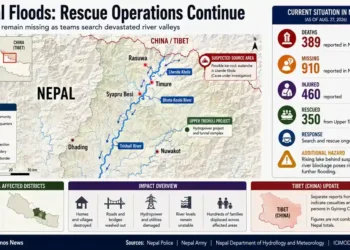
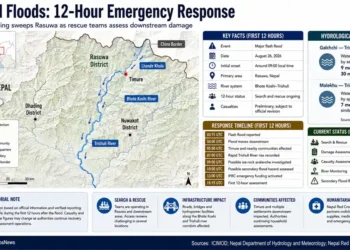
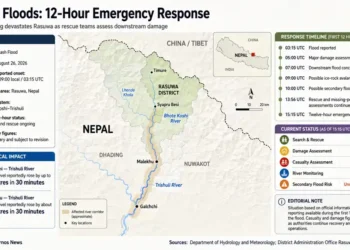
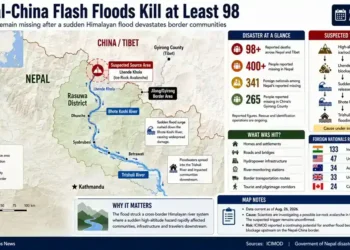
Nepal remains in a large-scale search, rescue, recovery and relief operation after flash floods struck the Bhote Koshi river corridor on August 26.
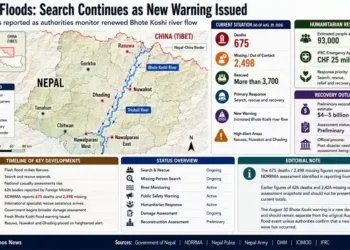
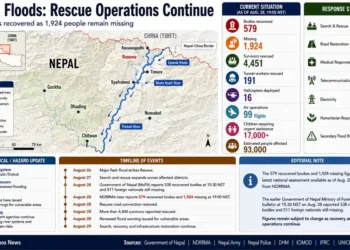
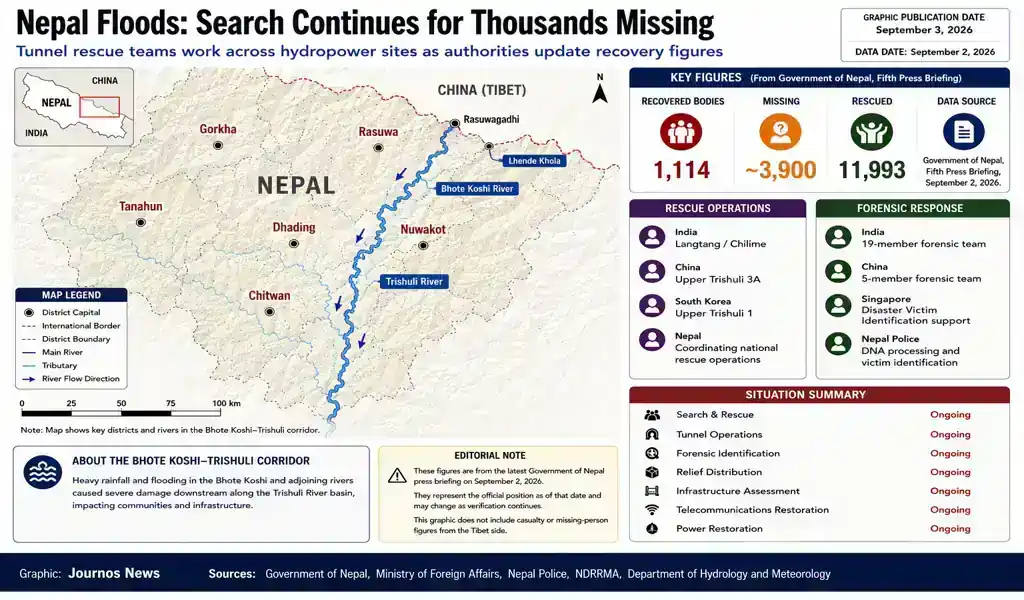
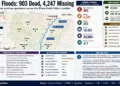
The Government of Nepal said in its latest daily briefing on September 2 that authorities had recovered 1,114 bodies, while about 3,900 people remained missing and 11,993 people had been rescued. The government said the figures were still being updated as teams continued search and verification operations.

The response is now heavily focused on hydropower tunnels in Rasuwa and Nuwakot. Nepal has deployed specialized teams from India, China and South Korea alongside Nepali rescue personnel.
Major Developments We’re Following
- Nepal’s latest government briefing reports 1,114 bodies recovered, about 3,900 people missing and 11,993 rescued.
- Tunnel-rescue teams from India, China and South Korea are working with Nepali rescue teams at several hydropower sites.
- Chinese rescuers have opened parts of the tunnel at Upper Trishuli 3A, while Indian teams continue work at Langtang and Chilime.
- South Korean teams are working with Nepali personnel at Upper Trishuli 1.
- Nepal’s government says forensic teams from India, China and South Korea, together with a Disaster Victim Identification team from Singapore, are assisting with DNA and identification work.
- Rescue and recovery operations continue while authorities assess damage to roads, bridges, homes, hydropower facilities and other infrastructure.
- Nepal continues restoring damaged telecommunications, electricity and road connections in affected areas.
What We Know
- Event: Bhote Koshi–Trishuli flash floods
- Date of disaster: August 26, 2026
- Main affected areas: Rasuwa, Nuwakot, Dhading, Gorkha, Chitwan and other downstream areas
- Latest government recovered-body figure: 1,114
- Latest government missing figure: About 3,900
- Latest government rescue figure: 11,993
- Search and rescue: Ongoing
- Hydropower tunnel rescue: Ongoing
- Forensic identification: Ongoing
- Infrastructure assessment: Ongoing
- International technical assistance: Active
The Government of Nepal said the figures remain subject to change as search teams verify information and recover additional remains.
What We Don’t Know
- The final national death toll has not yet been established.
- Authorities have not completed the reconciliation of missing-person records.
- The exact number of people still inside hydropower tunnels remains uncertain.
- The full scale of infrastructure damage has not yet been established.
- The final economic cost of the disaster remains unknown.
- Authorities have not completed a comprehensive national loss-and-damage assessment.
Public Safety Information
Nepal’s official Rasuwa Flood Rescue Portal continues to provide emergency information and government rescue updates.
The portal lists 1234 for rescue, 100 for police, 102 for ambulance and 1155 for NDRRMA.
The Department of Hydrology and Meteorology continues operating its flood forecasting and early-warning services. Its official system provides river monitoring, rainfall monitoring and weather warnings.
Residents should follow current instructions from Nepal’s government, local authorities and emergency agencies rather than relying on unverified social-media reports.
Live Updates
September 2, 14:00 UTC — Nepal Government Reports 1,114 Bodies Recovered
Nepal’s Ministry of Foreign Affairs reported 1,114 recovered bodies, around 3,900 people still missing and 11,993 people rescued in its fifth daily briefing on the Bhote Koshi floods.
The ministry said the figures continued to change as search and verification operations progressed.
September 2, 14:15 UTC — Government Urges Reliance on Verified Figures
Nepal’s government again urged media organizations and the public to rely on official information.
The Ministry of Foreign Affairs said authorities were continuing to verify casualty, missing-person and rescue figures through government agencies, particularly NDRRMA, Nepal Police and the Nepal Tourism Board.
September 2, 14:30 UTC — Tunnel Rescue Operations Continue at Three Major Sites
The government said specialized tunnel teams from India, China and South Korea were working alongside Nepali rescue teams.
Indian teams were operating at Langtang and Chilime. Chinese rescuers were working at Upper Trishuli 3A, while South Korean personnel were supporting operations at Upper Trishuli 1.
September 2, 15:00 UTC — Chinese Team Opens Part of Upper Trishuli 3A Tunnel
Nepal’s Foreign Ministry said the Chinese tunnel-rescue team had opened parts of the Upper Trishuli 3A tunnel.
However, mud and large rocks remained inside the tunnels, slowing progress and preventing teams from reaching all areas.
September 2, 15:30 UTC — Indian Teams Continue Work at Langtang and Chilime
Indian tunnel-rescue personnel continued working with Nepali rescuers at Langtang and Chilime.
The government said teams had made progress toward opening the tunnels but still faced substantial quantities of mud and boulders inside the structures.
September 2, 16:00 UTC — South Korean Team Supports Upper Trishuli 1 Search
South Korean rescue personnel continued working with Nepali teams at Upper Trishuli 1.
Nepal’s Foreign Ministry said additional Korean support and logistics were expected to strengthen the operation.
September 2, 16:30 UTC — Forensic Teams Expand Identification Work
Nepal continued expanding forensic operations to identify recovered bodies and help families locate missing relatives.
The government said a 19-member Indian forensic team was working with Nepal Police. A five-member Chinese forensic team had also joined the operation, while Singapore was sending a Disaster Victim Identification team.
September 2, 17:00 UTC — DNA Analysis Continues
Forensic teams continued processing DNA samples from recovered remains.
Nepal’s government said additional equipment and personnel were being mobilized to speed up DNA testing and victim identification.
September 2, 17:30 UTC — Temporary Burial Used After Forensic Procedures
Nepal’s government said authorities had begun temporary burial of some recovered remains after completing necessary forensic procedures.
Officials said the process would allow authorities to preserve identification information and potentially return remains to families after DNA matching.
September 2, 18:00 UTC — Government Says Damage Assessment Is Expanding
Nepal said authorities now had greater access to some affected areas and were gaining a clearer picture of damage to homes, roads, bridges and hydropower facilities.
However, the government said preliminary assessments remained incomplete and that a broader assessment would follow.
September 2, 18:30 UTC — Relief Supplies Continue Moving Into Affected Areas
The government said relief materials were continuing to reach affected communities.
Additional supplies and assistance from international partners were also expected as authorities continued assessing local requirements.
September 2, 19:00 UTC — Nepal Continues International Coordination
Nepal continued coordinating with neighboring countries and international partners for specialized equipment and technical assistance.
The government said requested equipment included LiDAR systems, temporary bridges, DNA testing equipment, drones, human-remains storage equipment and heavy transport equipment.
September 2, 19:30 UTC — Government Reports Progress in Border Repatriation
Nepal’s government said China had helped facilitate the return of Nepali and foreign nationals from Tibet through alternative border points.
Authorities said about 2,500 people who had been traveling to or from Mount Kailash had already returned through Hilsa and Tatopani.
September 2, 20:00 UTC — About 1,500 Nepalis Remain in Kerung
Nepal’s Foreign Ministry said approximately 1,500 Nepali nationals were in Kerung and that officials were coordinating with Chinese authorities to facilitate returns for those who wanted to leave.
The government also said it was working to reroute Nepali trucks and containers stranded in the area.
September 2, 20:30 UTC — Government Says Search Remains the Priority
Nepal’s government said its main priorities remain locating missing people, rescuing survivors and providing support to affected communities.
Officials said the search operation would continue with Nepali security forces and specialized international teams.
September 2, 21:00 UTC — Rescue Efforts Focus on Possible Survivors in Tunnels
Reuters reported that rescue teams were concentrating on about 90 people in two hydropower tunnels where authorities believed survival remained possible.
The report said rescue teams were working through difficult underground conditions while continuing efforts to reach workers who may have access to air, food or water.
September 2, 21:30 UTC — Nepal Continues Restoring Critical Services
Nepal continued work to restore telecommunications, electricity and road connections damaged by the floods.
Prime Minister Balendra Shah said the government was working to reconnect affected communities and restore essential infrastructure while rescue operations continued.
September 2, 22:00 UTC — Rescue Operations Continue Despite Difficult Access
Search teams continued working in areas where mud, debris and damaged infrastructure restricted access.
Authorities have emphasized that conditions inside hydropower tunnels remain difficult and that rescue teams must clear blocked sections before reaching deeper areas.
September 2, 23:00 UTC — Final Casualty Figures Remain Unsettled
Nepal’s latest official briefing continues to list 1,114 recovered bodies and approximately 3,900 missing people.
Other reports have published different figures based on later or separate operational counts. JournosNews will retain the latest government figure as the primary national reference until Nepal’s authorities issue a reconciled update.
September 3, 00:00 UTC — Search Enters Another Overnight Phase
Rescue and recovery teams continued operations overnight as authorities worked to reach inaccessible areas and hydropower facilities.
The government has not announced a new national casualty reconciliation since its September 2 afternoon briefing.
September 3, 01:00 UTC — Tunnel Rescue Remains Central to Response
Hydropower tunnel searches remained one of the most technically difficult parts of Nepal’s disaster response.
Teams from Nepal, India, China and South Korea continued working at separate sites, while authorities coordinated equipment and logistical support.
September 3, 02:00 UTC — Identification Work Continues
Forensic teams continued processing DNA information from recovered remains.
Nepal’s government has asked families of missing people to provide DNA information through Nepal Police or the appropriate authorities to assist formal identification.
September 3, 03:00 UTC — Government Continues Monitoring River Conditions
Nepal’s Department of Hydrology and Meteorology continues operating its flood forecasting and early-warning systems.
The agency provides live river monitoring and rainfall information as authorities continue managing the aftermath of the disaster.
September 3, 04:00 UTC — Current Situation
Nepal remains in an active search, recovery and relief operation.
The latest official government briefing reports 1,114 bodies recovered, around 3,900 people missing and 11,993 rescued. Tunnel-rescue teams from India, China and South Korea continue working with Nepali teams, while forensic specialists support DNA identification.
The government has not yet released a newer reconciled national casualty figure. JournosNews will therefore retain the September 2 government figures as the principal verified national snapshot rather than substitute a larger figure from secondary reporting.
Emergency Response
Nepal Army, Nepal Police and Armed Police Force personnel continue search, rescue, evacuation and relief operations.
The Government of Nepal says specialized international teams are supporting specific technical tasks, including tunnel rescue and forensic identification.
International Assistance
India, China and South Korea have supplied specialized rescue expertise and equipment.
Nepal has also coordinated with Singapore and other international partners on forensic identification, drones, LiDAR, temporary bridges and other equipment.
Infrastructure Recovery
The government continues assessing damage to roads, bridges, homes and hydropower facilities.
Restoration of telecommunications, electricity and road links is also underway in affected areas.
Weather and Flood Monitoring
The Department of Hydrology and Meteorology continues operating Nepal’s flood forecasting and early-warning services.
Its official systems provide river-level, rainfall and weather information. JournosNews will report new flood warnings only when the relevant government agency issues them.
What Changed During This 12-Hour Window
Latest official recovered-body figure: 1,114
Latest official missing-person figure: About 3,900
Latest official rescued figure: 11,993
Tunnel rescue: Active at Langtang, Chilime, Upper Trishuli 3A and Upper Trishuli 1
Forensic response: Expanded with teams from India, China, South Korea and Singapore
Infrastructure: Assessment and restoration ongoing
Relief: Continuing
River and weather monitoring: Active
Sources / References
Primary sources: Government of Nepal; Ministry of Foreign Affairs of Nepal; Department of Hydrology and Meteorology; Rasuwa Flood Rescue Portal; Nepal Police; National Disaster Risk Reduction and Management Authority. Supporting reporting: Reuters and other professional news organizations used only where they provide additional verified information not contained in available primary-source updates.