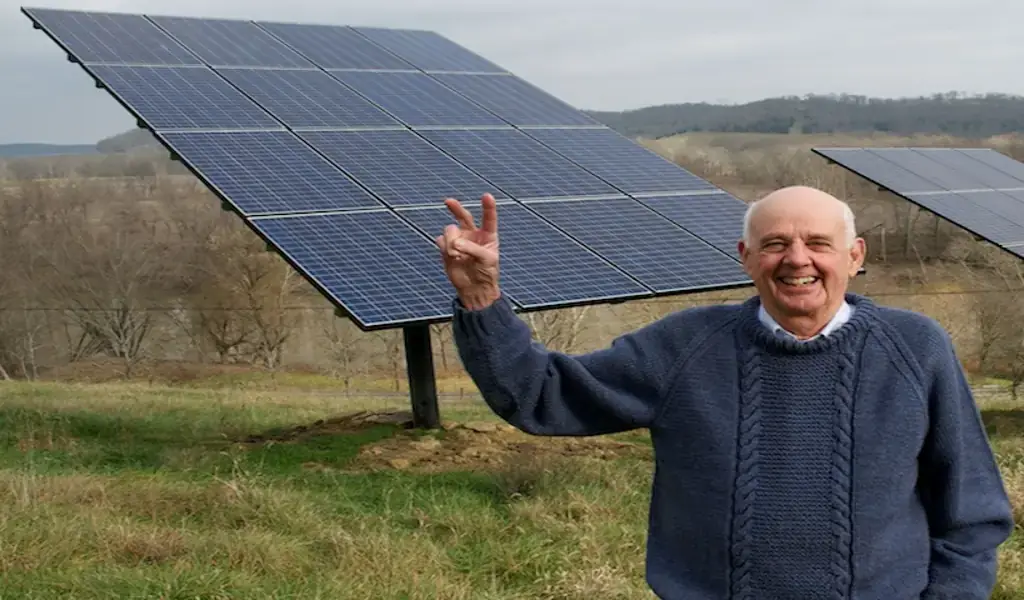
PORT ROYAL, Kentucky – Wendell Berry, the Kentucky-born poet, novelist, essayist and farmer whose writing championed rural communities, environmental stewardship and a simpler way of life, has died at 92. His daughter, Mary Berry, confirmed that he died Monday, August 31, at his home in Port Royal, Kentucky.
Berry became one of America’s most influential literary voices on agriculture, land and community while remaining deeply connected to the Kentucky landscape that shaped his work. He published more than 40 books, including fiction, poetry and essays, and received major national honors during a career spanning more than six decades.
A writer who returned home
Berry was born in Henry County, Kentucky, in 1934 and grew up around his family’s farming tradition. He studied English at the University of Kentucky before receiving a Wallace Stegner Fellowship at Stanford University in 1958.

He later lived in New York and taught at several universities, but eventually returned to Kentucky and settled in Port Royal, where he farmed and wrote for much of the rest of his life.
His decision to remain closely connected to the land was central to his philosophy.
Berry believed that communities could not be understood separately from the farms, forests, rivers and local economies that sustained them. His writing repeatedly challenged the idea that economic growth and technological progress should come at the expense of those relationships.
The Unsettling of America became a landmark
Berry’s 1977 book “The Unsettling of America: Culture and Agriculture” established him as a major critic of industrial agriculture.
He argued that the consolidation and mechanization of farming were damaging not only soil and ecosystems but also the knowledge, relationships and communities built around agriculture.
■ Related News




His broader argument was that food production should remain connected to people, place and responsibility rather than being treated solely as an industrial business.
The book became an important influence on later discussions about sustainable agriculture, local food systems and environmental conservation.
His fiction brought rural Kentucky to life
Berry’s literary work extended beyond essays about agriculture.
His novels and short stories created the fictional community of Port William, drawing heavily on the rural Kentucky world he knew.
Among his best-known works are “Nathan Coulter,” “A Place on Earth,” “Jayber Crow” and “Hannah Coulter.” His poetry collections included “A Timbered Choir: The Sabbath Poems 1979-1997.”
Through those works, Berry explored family, work, marriage, aging, death, faith and the changing relationship between people and the land.
His writing often resisted the speed and abstraction of modern life, instead emphasizing the value of knowing one’s neighbors and remaining accountable to a particular place.
He lived according to his principles
Berry did not simply write about a simpler life.
For decades, he and his wife, Tanya, operated a farm in Henry County. They deliberately avoided many modern technologies and lived without computers, television and telephones.
Berry also became an outspoken opponent of mountaintop-removal coal mining, protesting the environmental consequences of the practice in Kentucky and elsewhere. In 2011, he participated in a sit-in at the Kentucky governor’s office over strip mining.
His environmental activism was closely connected to his literary work: he viewed care for the land as both an ecological and moral responsibility.
A national literary figure
Although Berry remained rooted in rural Kentucky, his influence reached far beyond the state.
His ideas influenced writers, environmentalists, farmers and advocates of local food systems. Author Michael Pollan and chef and food activist Alice Waters were among those who publicly acknowledged his influence.
Berry received the National Humanities Medal from President Barack Obama in 2010 and was a member of the American Academy of Arts and Letters.
He also received the National Book Critics Circle’s lifetime achievement award in 2016, along with numerous other literary and cultural honors.
His views were sometimes controversial
Berry’s criticism of modern society extended into politics, religion, technology and American history.
Some of his positions generated controversy, including his views on historical memory and his opposition to removing a controversial mural at the University of Kentucky.
He also opposed the death penalty and protested U.S. military actions and environmental policies.
Those positions sometimes placed him at odds with institutions and political movements, but his writing remained focused on what he saw as the moral consequences of how people treated one another and the natural world.
A legacy rooted in place
Berry’s significance came partly from the consistency between his writing and his life.
He spent decades arguing that people should pay attention to where they live, how their food is produced, how communities function and what happens when economic systems separate people from the land that sustains them.
He remained in Kentucky while becoming a nationally recognized literary figure.
That connection to place became one of the defining characteristics of his career.
His death leaves behind a body of work that continues to influence debates over agriculture, conservation, rural communities and the meaning of a sustainable life.
What Happens Next
Berry is survived by his wife, Tanya, his children Mary Berry and Pryor “Den” Berry, grandchildren and great-grandchildren.
Details of funeral and memorial arrangements were not immediately available in the sources reviewed for this report.
Key Facts
- Name: Wendell Berry
- Born: 1934
- Died: August 31, 2026
- Age: 92
- Home: Port Royal, Kentucky
- Profession: Author, poet, novelist, essayist and farmer
- Major work: The Unsettling of America
- Books: More than 40
- National Humanities Medal: 2010
- National Book Critics Circle lifetime achievement award: 2016
- Known for: Agrarianism, environmentalism, rural communities and criticism of industrial agriculture
- Status: DIED — OBITUARY
Reporting Credit: Family of Wendell Berry — confirmation of death; National Endowment for the Humanities — National Humanities Medal; University of Kentucky — academic history and biographical information; The Berry Center — Berry’s legacy, writings and agricultural advocacy.