Last updated: September 1, 2026 | 13:14 UTC
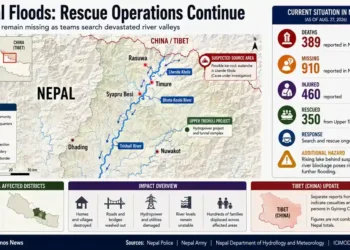
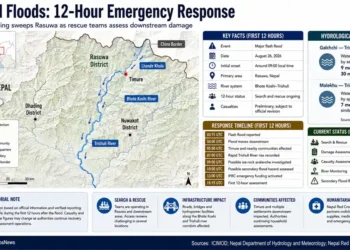
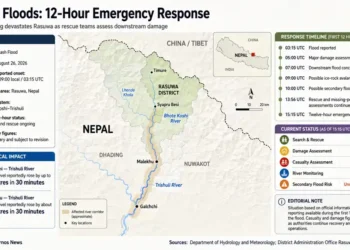
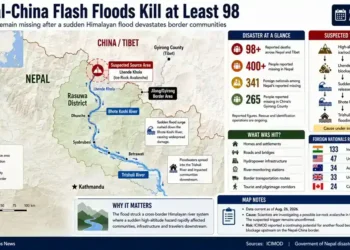
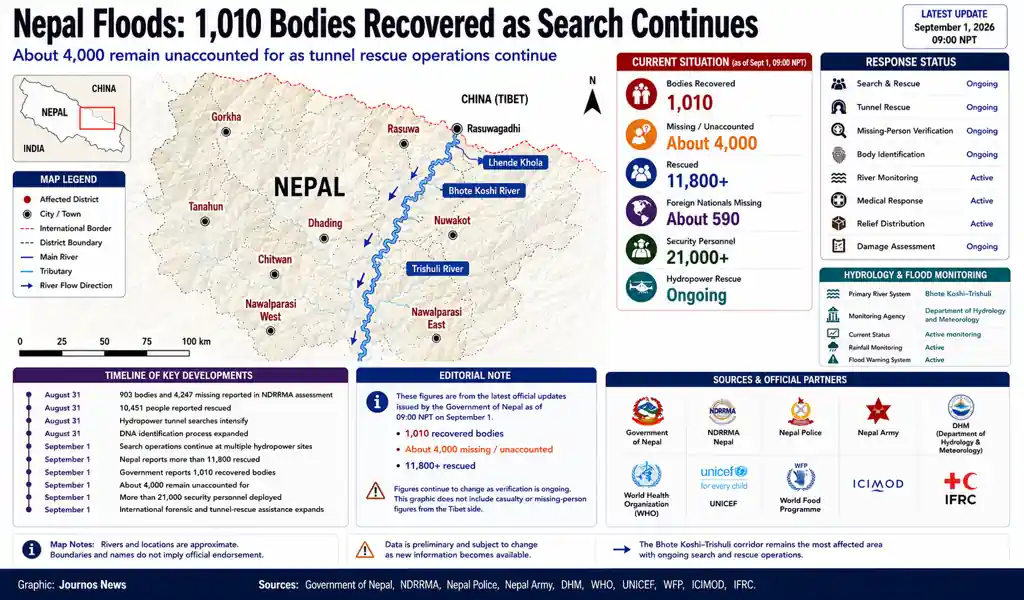
Nepal remains in an active search, rescue, recovery and relief operation on the seventh day after the August 26 Bhote Koshi flash flood devastated communities and infrastructure across Rasuwa and downstream districts.
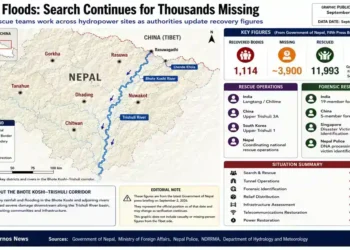
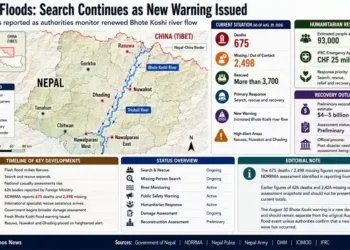
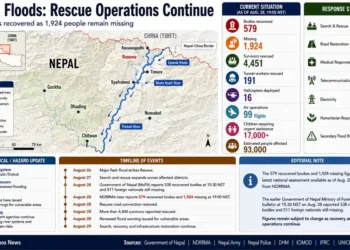
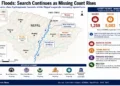
The latest Government of Nepal briefing reported 1,010 recovered bodies, about 4,000 people still unaccounted for and more than 11,800 people rescued. The government said the figures remain subject to further search and verification.

More than 21,000 security personnel are currently involved in search, rescue, evacuation and relief operations. Specialist tunnel-rescue teams from India, China and South Korea are working with Nepali authorities at affected hydropower projects.
Major Developments We’re Following
- Nepal’s Ministry of Foreign Affairs says 1,010 bodies have been recovered.
- About 4,000 people remain unaccounted for, according to the latest government briefing.
- More than 11,800 people have been rescued, including about 324 foreign nationals.
- Approximately 590 foreign nationals from 39 countries remain missing.
- More than 21,000 Nepal Army, Nepal Police and Armed Police Force personnel are deployed across affected areas.
- Specialist tunnel-rescue teams from India, China and South Korea are assisting operations at hydropower sites.
- Nepal’s police have begun a DNA-based identification process requiring first-degree relatives of missing people to provide samples.
- Nepal’s hydrological authorities continue monitoring rivers and warning conditions as the monsoon remains active.
What We Know
- Disaster: Bhote Koshi flash flood and associated debris flows
- Initial event: August 26, 2026
- Primary affected area: Rasuwa
- Main river systems: Bhote Koshi and Trishuli
- Bodies recovered: 1,010
- Missing / unaccounted: About 4,000
- Rescued: More than 11,800
- Foreign nationals missing: About 590 from 39 countries
- Security personnel deployed: More than 21,000
- Hydropower rescue: Ongoing
- Body identification: Ongoing
- River monitoring: Active
- Relief operations: Ongoing
- Affected districts: Rasuwa, Nuwakot, Dhading, Gorkha, Tanahun, Nawalparasi East, Nawalparasi West and Chitwan, among others.
What We Don’t Know
- The final death toll remains unknown.
- The exact number of missing people remains unresolved.
- Some people listed as missing may later be located.
- The number of people still inside or near damaged hydropower facilities has not been established.
- The full extent of damage to homes, roads, bridges and hydropower infrastructure remains under assessment.
- The final economic cost of the disaster has not yet been determined.
- The precise scientific sequence that triggered the flood remains under assessment.
Public Safety Information
Nepal’s Department of Hydrology and Meteorology continues operating its river-monitoring and warning systems. Its September 1 monitoring platform shows active hydrological information and warning services.
The department reports a current 24-hour maximum rainfall of 98.8 millimetres at Dandaswara and continues monitoring river levels across the country.
The Government of Nepal has repeatedly advised residents and response personnel to rely on official warnings and verified information as river and weather conditions change.
JournosNews should reproduce specific evacuation or emergency instructions only when issued by the relevant Nepalese authority.
■ Related News
Live Updates
August 31, 13:30 UTC — Government Expands International Rescue Coordination
Nepal continued coordinating specialized international assistance for search, rescue and relief operations.
The Government of Nepal said it particularly required technical assistance involving tunnel rescue, forensic identification, DNA testing, LiDAR, high-capacity drones, temporary bridges and equipment for preserving recovered remains.
August 31, 14:30 UTC — Search Focuses on Hydropower Projects
Search teams continued concentrating on hydropower facilities in Rasuwa and Nuwakot, where hundreds of workers remained unaccounted for.
NDRRMA had previously listed 933 people associated with hydropower projects as missing, although subsequent verification has changed the number as authorities reconcile attendance and rescue records.
August 31, 15:30 UTC — Tunnel Rescue Operations Continue
Nepali and international teams continued clearing mud, water and debris from hydropower tunnels.
At Upper Trishuli-3A, rescuers were working through a heavily obstructed tunnel system. At Chilime and Langtang Khola, teams were also attempting to reach areas where workers remained unaccounted for.
August 31, 16:30 UTC — Nepal Army Reports 279 Hydropower Workers Rescued
The Nepal Army reported that 279 people had been rescued from hydropower projects affected by the flood.
The largest group was rescued from Upper Trishuli-I, while other rescues were conducted at Mailung Khola, Rasuwagadhi, Upper Trishuli-III B, Trishuli, Devighat and other facilities.
August 31, 17:30 UTC — Three More Bodies Recovered From Hydropower Tunnels
Rescue teams recovered three bodies from two hydropower tunnels during ongoing operations.
The discovery came as specialist teams continued working through mud-filled tunnel systems where access remains severely restricted.
August 31, 18:30 UTC — 903 Bodies and 4,247 Missing in Latest NDRRMA Assessment
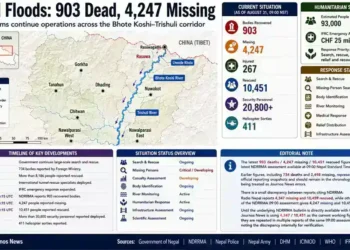
NDRRMA’s August 31 assessment reported 903 recovered bodies, 4,247 people missing and 10,451 people rescued.
The assessment also reported 411 rescue and relief flights and more than 20,800 security personnel deployed.
These figures were later superseded by the September 1 government briefing, which reported 1,010 recovered bodies and about 4,000 still unaccounted for. The change should be treated as an updated official assessment, not a JournosNews correction.
August 31, 19:30 UTC — DNA Identification Process Expanded
The Government of Nepal published guidance asking families of missing people to provide fresh blood samples from a first-degree relative to assist DNA identification.
The Nepal Police said the samples will be compared with DNA profiles obtained from recovered bodies or human remains.
August 31, 20:30 UTC — Communications Restoration Continues
Nepal continued restoring communications infrastructure damaged by the flood.
Government reporting said Nepal Telecom had restored all 110 damaged towers, while 75 of Ncell’s 78 damaged towers had returned to operation.
August 31, 21:30 UTC — Relief Materials Continue Moving Into Affected Areas
Government agencies continued transporting food and relief supplies into Rasuwa, Nuwakot and other affected areas.
NDRRMA reported that relief shipments were being moved by road and helicopter as damaged infrastructure continued to complicate access.
September 1, 00:30 UTC — Search Operations Continue Overnight
Search teams continued working at hydropower facilities and downstream locations as authorities sought to locate missing people and recover additional remains.
The Nepal Army continued working with specialist teams from India, China and South Korea at selected tunnel sites.
September 1, 02:00 UTC — Temporary Access Routes Support Rescue Operations
Nepalese authorities and international partners continued work to restore transportation links and reach isolated areas.
Reuters reported that temporary bridges and heavy equipment were being used to reopen routes and support rescue and relief operations.
September 1, 03:30 UTC — Hydropower Tunnel Searches Continue
Rescue teams entered multiple tunnels to search for workers still unaccounted for.
At Chilime, Langtang and Upper Trishuli-I, teams advanced into tunnel systems but had not yet completed the searches.
September 1, 04:30 UTC — International Rescue Assistance Expands
South Korea announced that it would send a 44-member emergency relief team to Nepal following a formal request from the Nepalese government.
The team includes personnel from South Korea’s Foreign Ministry and fire agency and is expected to support search-and-rescue operations in Rasuwa.
September 1, 05:30 UTC — More Than 1,000 Bodies Recovered
The Government of Nepal’s latest Foreign Ministry briefing reported that 1,010 bodies had been recovered.
The ministry said about 4,000 people remained unaccounted for and emphasized that casualty and missing-person figures were still being updated as search and verification continued.
September 1, 06:00 UTC — More Than 11,800 People Rescued
The latest government briefing reported that more than 11,800 people had been rescued, including approximately 324 foreign nationals.
The government said the rescue operation remained active across the affected areas.
September 1, 06:30 UTC — About 590 Foreign Nationals Remain Missing
Nepal’s Foreign Ministry reported that approximately 590 foreign nationals from 39 countries remained missing.
The ministry’s Emergency Control Room continues coordinating with diplomatic missions, families and Nepalese authorities to verify information and assist with identification and repatriation.
September 1, 07:00 UTC — More Than 21,000 Security Personnel Deployed
The Government of Nepal said a unified force of more than 21,000 Nepal Army, Nepal Police and Armed Police Force personnel is engaged in search, rescue, evacuation and relief operations.
The deployment covers affected communities, hydropower facilities and other areas requiring emergency assistance.
September 1, 07:30 UTC — Specialist Tunnel Teams Continue Work
The Foreign Ministry said 24 Indian specialists in two teams and nine Chinese specialists were deployed at affected hydropower sites, with a South Korean team also present.
Indian teams are working with the Nepal Army at Chilime and Langtang, while a Chinese team is coordinating with Nepali forces at Upper Trishuli-3A.
September 1, 08:00 UTC — Forensic Assistance Expanded
An 18-member Indian forensic team specializing in DNA analysis has been working with Nepalese authorities since August 29.
The Foreign Ministry said a four-person Chinese forensic team was expected to arrive on September 1 and that Nepal was also coordinating with Singapore over a Disaster Victim Identification team.
September 1, 08:30 UTC — Government Requests Specialized Equipment
Nepal has requested specialized equipment including LiDAR systems, temporary bridges, freezers, DNA-testing kits, load carriers, human-remains bags, high-capacity drones and genetic sequencing equipment.
The requests reflect the shift from immediate rescue toward increasingly complex recovery, identification and access operations.
September 1, 09:00 UTC — Damage Assessment Continues
The Government of Nepal said authorities were assessing damage to homes, roads, bridges, hydropower facilities and other critical infrastructure.
A broader Post-Disaster Needs Assessment is expected to provide a clearer picture of overall damage, losses and long-term recovery requirements.
September 1, 10:00 UTC — Hydrological Monitoring Remains Active
The Department of Hydrology and Meteorology continues monitoring rainfall and river conditions across Nepal.
Its September 1 system shows active warning and hydrological-monitoring services, with a reported 24-hour maximum rainfall of 98.8 millimetres at Dandaswara.
September 1, 11:00 UTC — Nepal Police Continues Body Management
Nepal Police continued documenting recovered remains and coordinating identification.
Police have also published information on unidentified people and requested DNA samples from families of missing persons to support formal identification.
September 1, 12:00 UTC — Relief Operations Continue
Food, medical supplies and other relief materials continued moving into affected communities.
The Government of Nepal said assistance from international partners was being coordinated according to specific requirements identified on the ground rather than through a general request for unrestricted assistance.
September 1, 13:14 UTC — Current Situation
Nepal remains in an active search, recovery and relief phase on the seventh day after the Bhote Koshi flood.
The latest Government of Nepal briefing reports 1,010 recovered bodies, about 4,000 people still unaccounted for and more than 11,800 rescued. More than 21,000 security personnel remain deployed, while specialist teams continue searching hydropower tunnels and forensic teams work to identify recovered remains.
Emergency Response
The Government of Nepal continues to lead the national response, with the Nepal Army, Nepal Police, Armed Police Force, local governments, medical teams and humanitarian organizations operating across affected areas.
The government is coordinating specialized international assistance from India, China, South Korea and other partners for tunnel rescue, forensic identification, emergency equipment and relief logistics.
The Ministry of Foreign Affairs’ Emergency Control Room continues assisting with foreign-national cases, while diplomatic missions are helping verify information and coordinate with families.
Humanitarian Response
UNICEF says 17,000 children require urgent humanitarian assistance following the flooding. Roads and bridges have been destroyed, while water, health and telecommunications infrastructure has been damaged.
The WFP and other humanitarian organizations continue supporting food, logistics and emergency relief operations. A dedicated humanitarian response is also being coordinated through the United Nations and Nepalese authorities.
Infrastructure and Recovery
The government says damage assessments are underway for houses, roads, bridges, hydropower facilities and other critical infrastructure.
A full Post-Disaster Needs Assessment has not yet been completed, so any current reconstruction-cost estimate should be treated as preliminary rather than a final figure.
Scientific Assessment
The precise chain of events that caused the August 26 flood remains under scientific assessment.
Earlier scientific and humanitarian assessments identified a sudden surge entering the Bhote Koshi from the Tibet side and investigated high-altitude ice-rock processes. JournosNews should continue describing the exact trigger as under investigation unless a competent scientific authority establishes a final cause.
What Changed During This 24-Hour Window
Recovered bodies:
903 → 1,010
Missing / unaccounted:
4,247 → about 4,000
Rescued:
10,451 → more than 11,800
Security personnel:
20,899 → more than 21,000
Foreign nationals missing:
Approximately 590 from 39 countries
These changes represent evolving official assessments and verification. They should not be described as JournosNews corrections.
Reporting Credit: Government of Nepal — National Disaster Risk Reduction and Management Authority and Ministry of Foreign Affairs; Nepal Army, Nepal Police and Armed Police Force — search, rescue and recovery operations; Department of Hydrology and Meteorology — rainfall, river monitoring and warnings; WHO, UNICEF, WFP, ICIMOD and IFRC — humanitarian and scientific assessments.