Last updated: August 30, 2026 | 02:46 UTC
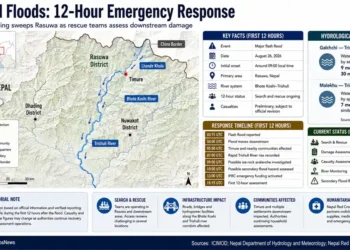
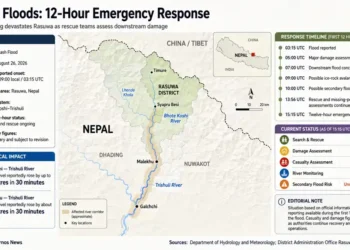
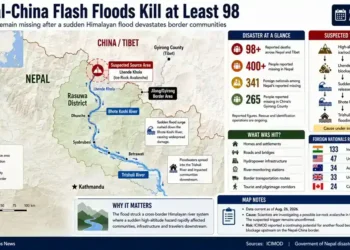
Nepal is continuing a large-scale search, rescue and recovery operation four days after a catastrophic flash flood swept through the Bhote Koshi and Trishuli river systems.
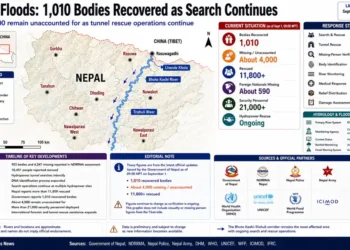
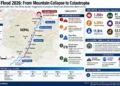
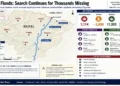
The latest NDRRMA assessment reported 675 deaths and 2,498 people missing or out of contact. More than 3,700 people have been rescued, while authorities continue searching river corridors, settlements and hydropower facilities.

A new public-safety warning was issued on August 30 after local authorities reported an increase in the sound and flow of the Bhote Koshi River. NDRRMA placed Rasuwa, Nuwakot and Dhading on heightened alert and asked people near the river to exercise caution.
Major Developments We’re Following
- NDRRMA’s latest assessment reports 675 deaths and 2,498 people missing or out of contact in Nepal.
- More than 3,700 people have been rescued from affected areas, according to the latest national reporting.
- Nepal issued a fresh warning for the Bhote Koshi River after reports of increased water flow, with Rasuwa, Nuwakot and Dhading placed on heightened alert.
- The Government of Nepal says search, rescue, relief and recovery remain its national priority, with 626 bodies already recovered by the Foreign Ministry’s 2 p.m. briefing on August 29; later NDRRMA figures subsequently increased the toll to 675.
- The government is preparing a broader post-disaster assessment while immediate rescue and relief operations continue. Preliminary reconstruction estimates are in the $4 billion–$5 billion range, but officials stress that this is not a final damage estimate.
- Humanitarian agencies continue supporting affected communities. IFRC has launched a CHF 25 million Emergency Appeal, following its initial emergency funding for the Nepal Red Cross response.
What We Know
- Event: Major flash flood and associated debris flow
- Initial event: August 26, 2026
- Primary affected area: Rasuwa, Nepal
- Main river system: Bhote Koshi–Trishuli
- Latest reported deaths: 675
- Latest reported missing/out of contact: 2,498
- Rescued: More than 3,700
- Current response: Search, rescue, recovery and relief operations
- Current hazard: Renewed concern over increased Bhote Koshi River flow
- High-alert districts: Rasuwa, Nuwakot and Dhading
- Affected infrastructure: Roads, bridges, hydropower facilities, telecommunications and other critical infrastructure
- Humanitarian impact: IFRC estimates around 93,000 people may have been affected.
What We Don’t Know
- The final death toll remains unknown.
- The final number of missing people remains unresolved.
- The full extent of damage in remote mountain areas has not been established.
- Some people listed as missing or out of contact may subsequently be located.
- The complete number of foreign nationals affected remains subject to reconciliation between Nepalese authorities and foreign governments.
- The precise cause and evolution of the renewed Bhote Koshi flow remain under assessment.
- The final reconstruction cost cannot yet be established.
Public Safety Information
NDRRMA issued a fresh warning on August 30 after the District Administration Office in Rasuwa reported hearing an increased flow of water in the Bhote Koshi River.
The authority asked people in areas around the river in Rasuwa, Nuwakot and Dhading to exercise caution and said further updates would follow as information becomes available. Emergency services and local administrative units in Nuwakot and Dhading were placed on standby.
Nepal’s Department of Hydrology and Meteorology currently has flood monitoring and warning systems operating and provides real-time river information and emergency flood information.
JournosNews should reproduce specific evacuation instructions only when issued by the relevant Nepalese authority.
Live Updates
August 29, 14:00 UTC — Government Maintains National Rescue Priority
Nepal’s Foreign Minister said the government’s immediate priority remained saving lives, locating missing people, rescuing survivors and providing urgent relief.
The government said all available resources were being mobilized for search, rescue, relief and recovery, including assistance for Nepali and foreign nationals affected by the disaster.
August 29, 15:00 UTC — 626 Bodies Recovered
The Ministry of Foreign Affairs reported that 626 bodies had been recovered as of its 2 p.m. briefing on August 29, while approximately 2,400 people remained unaccounted for.
The ministry stressed that search, rescue and recovery operations were continuing and that figures could change as authorities reached additional areas.
August 29, 16:00 UTC — Search Operations Continue Across Multiple Districts
Nepal Police and other security agencies continued searching river corridors and affected communities across Rasuwa, Nuwakot, Dhading, Gorkha, Tanahun, Nawalparasi and Chitwan.
Radio Nepal reported that rescue teams were prioritizing missing-person searches while documenting human and infrastructure losses.
August 29, 17:00 UTC — Hydropower Workers Remain a Major Missing-Person Group
An industry association reported that hundreds of people connected with hydropower projects in Rasuwa and Nuwakot remained out of contact.
The Independent Power Producers’ Association of Nepal reported 934 people associated with 11 hydropower projects as uncontactable, although this figure is an industry assessment and should not be added separately to NDRRMA’s national missing-person total.
August 29, 18:30 UTC — NDRRMA Reports 675 Deaths
The latest NDRRMA assessment raised the reported death toll in Nepal to 675.
Bodies had been recovered across multiple downstream districts, with Chitwan, Nawalparasi East and Nawalparasi West among the areas recording the highest numbers.
August 29, 18:30 UTC — 2,498 People Reported Missing or Out of Contact
The same latest NDRRMA assessment reported 2,498 people missing or out of contact.
This replaced earlier figures of 2,426 and 1,924 as the latest national assessment. JournosNews should preserve those earlier figures in the chronology rather than treat the changes as editorial corrections.
August 29, 19:00 UTC — More Than 3,700 People Rescued
More than 3,700 people had been rescued in Nepal as search-and-rescue operations continued into the fourth day.
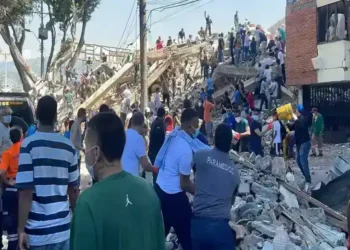
Helicopters remained important for reaching communities cut off by damaged roads and bridges, while ground teams continued searches in river valleys and damaged infrastructure.
August 29, 20:00 UTC — Specialist Tunnel Rescue Support Arrives
An Indian team of doctors and tunnel-rescue specialists arrived in Nepal to provide technical support for rescue operations involving hydropower facilities affected by the floods.
The specialist support comes as rescuers continue efforts to reach people who may remain trapped or unaccounted for inside damaged tunnels.
August 29, 21:00 UTC — Government Begins Longer-Term Damage Assessment
Nepal began preparing a post-disaster needs assessment while maintaining the immediate focus on rescue and relief.
Government officials estimated that reconstruction could eventually require $4 billion to $5 billion, but the figure remains preliminary and is not a final damage estimate.
August 29, 22:00 UTC — Unidentified Bodies Require Forensic Documentation
Prime Minister Balendra Shah said unidentified bodies would be managed only after DNA and other evidence had been preserved to assist future identification.
Bodies identified by relatives would instead be handed over to their families. The measure reflects the difficulty authorities face in identifying victims recovered from the flood zone.
August 29, 23:00 UTC — Humanitarian Response Expands
The IFRC launched a CHF 25 million Emergency Appeal to support the Nepal Red Cross Society’s response to the disaster.
The appeal follows an initial emergency release of nearly CHF 1 million and is intended to support communities affected by the destruction of homes, roads, bridges and other infrastructure.
August 30, 00:00 UTC — Flood Monitoring Remains Active
Nepal’s Department of Hydrology and Meteorology continued operating its flood-monitoring system.
The department’s public system provides river-level information and warning classifications, while its current website shows active warning and hydrological monitoring services.
August 30, 01:00 UTC — Fresh Bhote Koshi Warning Issued
NDRRMA issued a new public-safety warning after local authorities reported an increase in the sound and flow of the Bhote Koshi River.
The warning applies to areas along the river in Rasuwa, Nuwakot and Dhading. Authorities asked residents and relief teams to remain highly alert and monitor conditions closely.
August 30, 02:00 UTC — Emergency Services Placed on Standby
Emergency services and local administrative units in Nuwakot and Dhading were placed on standby following the new Bhote Koshi warning.
Authorities said additional information would be issued as it became available. No new flood wave or confirmed additional casualty figure had been independently established at the time of this update.
August 30, 02:46 UTC — Current Situation
Nepal remains in an active search, rescue and recovery phase.
The latest national assessment available reports 675 deaths and 2,498 people missing or out of contact, while a fresh warning over increased Bhote Koshi flow has added a new public-safety concern in Rasuwa, Nuwakot and Dhading.
JournosNews will continue to treat casualty figures as provisional until authorities finalize their assessments.
Emergency Response
The Government of Nepal remains responsible for the national search, rescue, relief and recovery operation.
Nepal Police, the Nepal Army, Armed Police Force, local authorities, health services and disaster-management agencies remain deployed. Specialist assistance from India and other international partners is being integrated into the response where requested.
The Government of Nepal has also established the Rasuwa Flood Rescue Portal for missing-person searches, help requests, emergency contacts and official rescue and relief information.
Humanitarian Response
IFRC estimates that approximately 93,000 people may have been affected and has launched a CHF 25 million Emergency Appeal to support the Nepal Red Cross response.
Humanitarian access remains difficult because bridges and roads were destroyed or severely damaged.
Infrastructure and Recovery
The government is preparing a post-disaster needs assessment covering infrastructure, housing and livelihoods.
Officials have warned that the eventual reconstruction requirement could reach $4 billion to $5 billion, but the estimate remains preliminary until the full loss and damage assessment is completed.
A current Kathmandu Post assessment also reports that the disaster has exposed shortages of specialized rescue equipment despite increased use of drones, GIS, satellite imagery and other technologies by government agencies.
Scientific Assessment
ICIMOD reported that the August 26 flood sent a powerful surge of water, sediment and boulders through the Bhote Koshi and Trishuli systems.
The organization investigated a possible ice-rock avalanche and other high-mountain processes as part of determining the event’s origin. The precise causal sequence should remain attributed to scientific assessments until authorities establish it conclusively.
Background
The August 26 flood struck the Bhote Koshi system in Rasuwa before moving downstream through the Trishuli river network.
The disaster severely damaged settlements, roads, bridges, hydropower facilities and other infrastructure across several districts. The continuing search has extended far downstream because bodies and debris were carried through the river system.
Sources / References
Government of Nepal: Government of Nepal; Ministry of Foreign Affairs; National Disaster Risk Reduction and Management Authority; Nepal Police; Nepal Army; Department of Hydrology and Meteorology; Office of the Prime Minister and Council of Ministers; Rasuwa Flood Rescue Portal.
Scientific and humanitarian institutions: ICIMOD | Nepal Red Cross Society | IFRC; United Nations agencies | WHO | UNICEF | Asian Development Bank.